


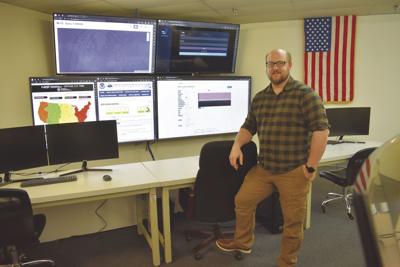
GILFORD — Three years ago, Jeromy Grimmett launched Rogue Space Systems as a company with a bold idea: to develop, launch and operate a fleet of small orbiting robots that could service the growing field of satellites circling the Earth.
Earlier this month, Grimmett and a significant chunk of his small, sprightly team were standing on the California coastline, about 4 miles north of the Vandenberg Air Force Base, and felt the concussion wave as a rocket blasted off into space. Aboard the rocket was a robot, named Barry-1, about the size of a small loaf of bread. That robot represented the fruits of three years of dogged toil — “literal blood, sweat and tears,” as Grimmett said — as it ascended.
“So the first thing you're doing is you're praying that the damn thing doesn't blow up on its way,” Grimmett recounted. “The second thing you're praying for is that it actually reaches orbit. The third thing you're worried about, is it actually getting dispensed and pushed off the second stage? And then the worst and the highest anxiety is if the damn thing turned on.”
The rocket didn’t explode. The robot — their first operational spacecraft — was dispensed into low-Earth orbit. And the mechanical switches on the exterior of the robot's casing were indeed flipped as it exited, starting a two-minute timer that then led to the unfurling of the robot’s photovoltaic panels, giving life to Barry-1.
The launch was Nov. 11, and Grimmett said the reality still hasn’t sunk in. The company he started in downtown Laconia three years ago, now headquartered in Gilford, has developed and launched an orbiting robot, which they are now tracking and operating.
Barry-1’s mission is to prove to the world that Rogue is capable of doing what it says it can do. Since its launch, Rogue’s team has been tracking and communicating with Barry-1, sending the robot signals and receiving data back, and testing out its various functions. Barry-1 is intended to orbit for two years, and once they’ve run through all of the robot’s native functions, they plan to offer the robot as a vehicle for other similarly minded companies to see how their software works in orbit.
But the most important part of the launch, Grimmett said, is the fact that it’s now a part of the company’s timeline.
“The big part of this, or the big milestone, is space heritage,” Grimmett said. “It's getting something on top of a rocket, putting something into space, having it actually work, and operating that spacecraft. ... Being able to prove that Rogue is capable of doing this is a massive achievement.”
He noted there are other companies with similar objectives that are “far better funded,” yet are still on the ground looking up. “We've been successful. So being able to do this at the pace that we have, under the budget restrictions, under the capital restrictions that we've been under, with the team that we have, which is unbelievably awesome, it's a huge statement.
“That's really what it's all about,” Grimmett said. “This is all about space heritage, getting some of our hardware up there.”
Rogue currently has a staff of about 30, according to Chris Banks, a U.S. Air Force veteran who transitioned to Rogue after his military service and has since become its program manager. With their first robot now in orbit, the company is looking at growth, he said.
“That is certainly the intent of a demonstration of our capability as a company,” Banks said. “We’re taking customers.”
It will yet be a couple of years before Rogue will be able to perform the services it intends to provide. Barry-1 was a huge step, and proved that Rogue can build a satellite and get it into space with working communications and sensory functions. The company's next spacecraft, which might be launched as early as 2026, would carry motor functions to allow it to maneuver in proximity to another satellite and perhaps perform some physical manipulation to that satellite, such as expanding a panel or scaffolding that didn’t properly deploy.
Rogue’s success has come after three years of sustained effort, navigating layers of financing, staffing, federal agencies and even weather. Yet this moment of success is not the time to relax, Banks said.
“It’s only the beginning, it really is,” Banks said. “It demonstrates how truly accessible space is, but equally so, it's still complex, like there’s a huge barrier to entry. But it’s not that far, and there’s an entire economy waiting, just waiting to happen.”


(0) comments
Welcome to the discussion.
Log In
Keep it Clean. Please avoid obscene, vulgar, lewd, racist or sexually-oriented language.
PLEASE TURN OFF YOUR CAPS LOCK.
Don't Threaten. Threats of harming another person will not be tolerated.
Be Truthful. Don't knowingly lie about anyone or anything.
Be Nice. No racism, sexism or any sort of -ism that is degrading to another person.
Be Proactive. Use the 'Report' link on each comment to let us know of abusive posts.
Share with Us. We'd love to hear eyewitness accounts, the history behind an article.