


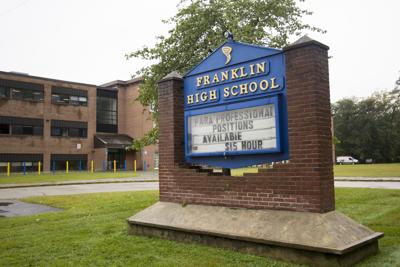
FRANKLIN — With a struggle to hire teaching staff this year, Franklin High School had to pivot to find ways to meet basic educational requirements for students. Through partnerships with other institutions in the area, school leaders believe they have made lemonade from lemons.
Parents were notified in August that, because of a teacher shortage, core courses in science, technology, engineering and math would not be offered by the high school this year — including math more advanced than geometry and science other than physical science. To ensure students have the options they need to meet graduation requirements, school administrators collaborated with Lakes Region Community College and Winnisquam Regional High School to arrange a catalog of ways students could meet curriculum requirements.
While still aiming to hire teachers and close the hiring gap, Principal David Levesque sees the adaptations as pragmatic and forward-thinking solutions to a nationwide problem that has shown no signs of abatement, as well as an opportunity for students to save money and time in college by starting early.
“When people heard about this, it came across as, ‘We are struggling and things aren't good and we're in dire straits,’ but that was never the intent,” Levesque said. “I think what we’re doing is very progressive in a way that is going to be the direction that more schools will be going to based on teacher needs and opportunities.
“I'm very optimistic. I know we'll have some growing pains but I feel that our students are going to get the best of both worlds.”
Though not impacting their core curriculum, Winnisquam joins Franklin and districts across the state in facing headwinds in hiring, Winnisquam Superintendent Shannon Bartlett told The Daily Sun.
"The lack of available educators has been incredible. Like, I've never seen anything like it before," Bartlett said. "So being able to have something like this with a school that's just a mile or two down the street is awesome, and I think it's just going to be a great way for us to help each other."
LRCC has had partnerships with local high schools for years, but usually as a jump-start option students can take in addition to regular courses offered at their high school, according to Carlene Rose, interim vice president of academic and student affairs. This is the first time students will be taking core high school curriculum through LRCC as a substitute for what would normally be offered at their local school.
“This really is a pilot with Franklin High School, in this particular case, of what we're specifically doing and the courses that we're helping to put together for them,” Rose said. “I do think that this is part of an evolution, and it's something that I think that could fill a need for many high schools.”
To get the core classes Franklin is unable to staff, students can dual-enroll in online courses with LRCC, meaning they will get both high school and transferable college credits, including for traditional high school courses such as algebra and precalculus, Rose said. In addition, LRCC professors will teach two college-level courses in machine tool math and blueprint reading at the high school, Levesque said. LRCC is also offering an introduction to college class to help prepare students for the transition to higher education.
There will be a dedicated staff member at Franklin High every day, available to support and guide students who struggle or stumble with their online courses, Levesque said.
In addition to courses through LRCC, Franklin High and neighboring Winnisquam Regional are reviving a “flip” program, where students from each school can take classes at the other as needed. Enrolling in the Virtual Learning Academy Charter School is also an option.
According to Levesque, more than 60 parents came to an informational meeting after the plan was shared, and each of the avenues offered to students had growing numbers of registrants going into the school year. As of the end of August, 10 students — nine at LRCC and one at New Hampshire Technical Institute — were registered for dual enrollment courses, four students had registered for classes at Winnisquam and more than 10 students had registered for each of the classes taught at Franklin by an LRCC professor. The number of students who had opted for VLACS courses was in “at least double digits.”
The costs to students and their families, Levesque said, will be “minimal at best.” VLACS is free to New Hampshire students, and the state covers the costs of up to two community college courses for high schoolers. In addition, LRCC offers financial aid and scholarships — the tuition for a dual enrollment course is $150. LRCC is also covering the cost of books and any access fees for Franklin students in its classes this year.
Levesque framed the menu of options and network of school partnerships pursued by Franklin this year as something that could become a model as small schools continue to struggle with teacher shortages.
Smaller districts like Franklin, Levesque continued, are affected most acutely by drops in staff: larger districts have more resources to patch staffing gaps by growing class sizes or moving teachers around. By the end of the summer, it became clear those would not be an option in Franklin.
“Teacher shortages ... although we hope it goes away, there’s a strong potential that it won't go away,” he said. “We’re looking at this as an opportunity to do things a little bit differently.”
Partnerships, Bartlett agreed, are an increasingly essential lifeline for districts with fewer resources. And though scheduling and logistics for students across different programs can be a challenge — Bartlett compared the process to solving a Rubik's Cube — but it's one she said is "absolutely worth it."
"If we're thinking like this and we're working together like this, I think it ultimately is going to create more opportunities for kids. That's the most important thing," she said.
That the state started setting aside funding to cover college courses for high schoolers, Rose said, demonstrates that the building blocks of this arrangement are not novel, even if the specifics with Franklin are new.
Despite this optimism, though, community colleges sharing the load of resource-pressed high schools is not a limitless frontier.
“We are eager to help our high school partners wherever we can, and we were in a great situation in this particular case where we could do that,” Rose said. But if this model is successful and if shortages accelerate, causing more districts to lean on LRCC in this way, “I think it would really have to be a case-by-case basis to make sure that we don't drain our own resources.”
In the short-term, though, Rose and Levesque emphasized that students in these programs get a leg up: earning college credit for courses taken now means they can shave time, and money, off their higher education.
“By joining with LRCC and Winnisquam, we are giving our kids more opportunity to be successful outside of the academic four walls,” Levesque said.
“High school is not the way it was 30 and 40 years ago.”


(0) comments
Welcome to the discussion.
Log In
Keep it Clean. Please avoid obscene, vulgar, lewd, racist or sexually-oriented language.
PLEASE TURN OFF YOUR CAPS LOCK.
Don't Threaten. Threats of harming another person will not be tolerated.
Be Truthful. Don't knowingly lie about anyone or anything.
Be Nice. No racism, sexism or any sort of -ism that is degrading to another person.
Be Proactive. Use the 'Report' link on each comment to let us know of abusive posts.
Share with Us. We'd love to hear eyewitness accounts, the history behind an article.