


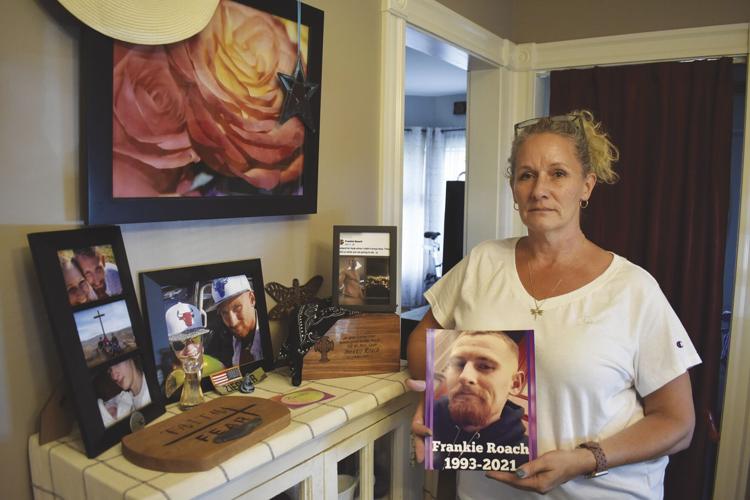

FRANKLIN — Bonnie Tisdale knows the look — the expression and the appearance of someone in the grips of addiction, someone whose illness has caused them to push away those who are trying to love and care for them.
“When you first start drinking, you have that choice. But at some point, if you have an addictive personality, that choice goes away,” Tisdale said. “So any time I see somebody that is high, or using, I don’t judge them. I actually care for them. I handed a kid my phone the other day and asked him to call his mother. I can’t get that call anymore.”
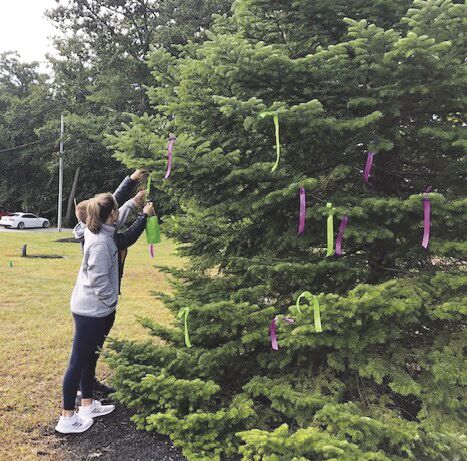
Tisdale, a Bristol resident, knows the deep and agonizing pain of losing a child to substance misuse. Her son, Frank Roach, who graduated from Newfound High School, died of an overdose Sept. 13, 2021, just a few weeks shy of his 28th birthday. She is now turning her personal tragedy into a message of hope and recovery for others, leading "Team Frankie’s Angels" at the annual Bridge to Recovery Walk hosted by Concord Hospital-Franklin.
“I’m a very vocal person,” Tisdale said, explaining that one way she addresses her grief is by telling Roach’s story. She hopes another parent won’t have to endure what she’s going through.
“I’ve always been looking for a platform, I guess, to help get the message out about recovery,” Tisdale said. Her son was, like his mother, an athletic person. He was also a headstrong teenager who clashed with her when he entered high school, and she didn’t approve of the older students he was starting to hang around.
She doesn’t know if that conflict pushed her son to make life-changing choices — it’s impossible to say why he started using drugs — but she suspects he started experimenting with drugs as a young teenager.
Some parents claim ignorance of a child’s behaviors, at least before the problem becomes apparent. But it was a series of events all too familiar to Tisdale, who has been in recovery herself for 30 years.
That meant she could see, with painful clarity, what her son was going through. It also meant she understood there was a limit to how much she could do to stop it.
“I always told him, 'I can’t help you until you’re helping yourself,'” she said.
Still, she did what she could, dropping him off at the Manchester Fire Department when they were running the “Safe Station” program there, talking to him in stark terms about the risks he was taking with his own life, and connecting him with recovery services whenever he seemed willing — each time hoping it would stick.
“Frankie went in and out several times. I did myself, it was several times before I decided that I was tired of chasing booze,” Tisdale said. “For me, it took for me to be really sick and tired of chasing, and giving up that chase and realizing that I really needed help.”
She counts herself lucky that her illness was with alcohol. Her son went from alcohol, to prescription drug misuse, to opioids and meth.
Frankie tried — several times. She knows because since his death she has read his journals. He was in 12-step programs, and was serious about following the steps. The relapses would come weeks or months into his sobriety.
That’s what happened in 2021. Tisdale said her son was doing well — they even competed in a Spartan race in Loudon together — and had plans to go to Texas later that year to do another. He died before that race arrived. Tisdale still went, and used it as a fundraiser for a nearby sober facility.
While attention has been focused on infectious disease lately, substance misuse continues to threaten the lives of New Hampshire residents. According to the Centers for Disease Control and Prevention, overdose deaths statewide are likely to exceed both homicides and deaths due to COVID-19.
But for those whose lives are affected by substance misuse, there is hope. One reason is the Recovery Clinic, with locations at Concord Hospital-Franklin and a medical park in Gilford. The clinic was started when the facilities were organized as LRGHealthcare, and have continued since Concord Hospital absorbed the hospitals into their network.
Concord Hospital-Franklin will host the annual Bridge to Recovery Walk on Sunday, Sept. 24. The 2-mile walk will take place on the hospital campus, beginning at 9 a.m. Walkers will be treated to a pancake breakfast prepared by Boomer’s Barbecue, a business owned by Dr. Paul Racicot, who oversaw the Recovery Clinic’s founding.
“Substance-use issues in our community continue to be a significant concern, and the Recovery Clinic and The Doorway are committed to continuing to serve as many people as possible,” said Corey Gately, director of substance use services. The Recovery Clinic, which utilizes medication-assisted treatment strategies, has frequently had between 650 and 700 patients at one time, said Gately, adding that demand has increased over the past couple of years.
The Doorway program offers assistance with accessing every level of substance-use disorder treatment, through nine trusted community hospitals, including Concord Hospital locations.
Entering recovery by reaching out for help can be a difficult moment for someone in need of the services, though. Often that choice is complicated by many previous ones, through the course of the addiction, which have left the individual in a vulnerable situation.
That’s why the Bridge to Recovery Walk was founded in 2017. The event raises money to support recovery programs by addressing short-term material needs of patients who are ready to take back their lives from substance-use disorder or other mental health challenges, but have hurdles standing in their way. Revenue from the walk is used to provide a bridge over those roadblocks, sometimes in the form of gas cards, co-pays, or basic hygiene supplies.
“Proceeds support the recovery clinics in both Gilford and Franklin,” said Heidi Smith, philanthropy officer for Concord Hospital Trust, who said the money is used for “immediate needs of patients while they wait for resources to be in place.”
The message Tisdale wants to deliver during the walk is: “There’s no such thing as just one more.” That’s just one of the lies addiction tells to lure its victims back into its grips. Roach had been clean for months before he gave in to that lie.
“If I can help just one person, then I’ve done my job,” she said.
Tisdale said she doesn’t want her son to be defined by substance misuse, and she wants those in active use to know that they don’t have to think of themselves in that way, either.
Rather than thinking of Roach as someone who overdosed, she prefers to think of him as someone who cared for others, despite his own personal struggles.
“He had a friend that he had been kind of close with, using, a young girl,” Tisdale said. “Frankie was trying to help her. I hadn’t really seen her, and she was at his service. I hadn’t seen her in two years, she was clean, she was healthy, she said everything that Frankie did, up until his death [to help her], and she has been clean since ... It’s those little pieces of hope.”
Visit concordhospital.org/classes-events for more information.
•••
The Sunshine Effect is a new series in The Laconia Daily Sun highlighting the people and organizations working to improve our communities through volunteering and fundraising. We believe that telling their stories will encourage others to support their work, and launch new charitable efforts of their own. Have a suggestion for someone making a difference we should feature? Share it with us at laconiadailysun.com/sunshineeffecttip.


(0) comments
Welcome to the discussion.
Log In
Keep it Clean. Please avoid obscene, vulgar, lewd, racist or sexually-oriented language.
PLEASE TURN OFF YOUR CAPS LOCK.
Don't Threaten. Threats of harming another person will not be tolerated.
Be Truthful. Don't knowingly lie about anyone or anything.
Be Nice. No racism, sexism or any sort of -ism that is degrading to another person.
Be Proactive. Use the 'Report' link on each comment to let us know of abusive posts.
Share with Us. We'd love to hear eyewitness accounts, the history behind an article.