


LACONIA — Lynn Powers said her military service was sparked by sibling rivalry. Soon, though, her career in the Army became about herself, a person she said had completely changed by the time she ended her active duty.
Powers, who was known as Lynn Daigle at the time, said she signed up for the Army while a senior at Laconia High School, Class of 2003. She was trying to figure out what she was going to do after high school, she said, and decided she wanted to go to UNH. That seemed like a financial stretch, but one the Army could help her achieve.
“I wanted to join the Army because I thought it was a cool thing to do, kind of bad-ass,” Powers said. Her older brother had a friend who had enlisted with the Air Force, and when she told her sibling that she liked that idea, “He said, ‘You would never be able to do something like that.’ I was like, ‘I’ll prove you wrong.’”
Powers’ parents were in her corner from the beginning, she said. “They were all about it. My brother ended up being a big cheerleader for me. I enlisted when I was in high school, I went to basic training immediately after graduating.” She joined ROTC, which allowed her to study sociology and justice at UNH.
“It was a win-win all around. It was a good experience, I enjoyed that experience,” she said. After graduation, Powers joined the 368th Engineering Battalion, based in Londondery, as a 2nd lieutenant, commissioned as a medical services officer.
Powers spent most of her career as a reserves officer. She made the rank of captain but, after a few years, found herself in something of a crisis. She had been living in the Midwest, where she said she “put myself in a rough situation.” She found herself broke, without a house or a car, and decided to move home with her parents to regroup. That’s when her father, who had encouraged her to join the Army in the first place, suggested that she take her career further.
“My dad said, ‘I heard about this cultural support team,’” she said. Powers said she, as a female, had always been noticeably in the minority during her service, and the cultural support team was an opportunity to leverage that difference into an asset.
In Afghanistan, where the Army was attempting to remove the Taliban’s influence over villagers, the ability of American soldiers to interact and communicate with local residents was limited by local culture, which prohibited Afghani women from speaking with male soldiers.
Powers, who considers herself to have good interpersonal skills, figured she might be the kind of soldier the Army needed for the job. And she needed the challenge.
“I needed to do something for me,” she explained. “I was worried about trying to make other people happy, I wasn’t focused on myself, I wasn’t confident in myself.”
And then there was an uneasiness with her career, which had been spent stateside while others were fighting abroad: “How can I be an Army captain without being deployed?”
Powers filled out an application and sent it in. But that was only the beginning of the process. The female soldiers who made it through the process were eventually assigned to either Special Forces or Rangers, elite units that lived in villages, outside of the protection of fortified bases, and anyone tagging along had to be able to carry her share of the mission.
Powers joined about 50 other women at Fort Bragg in North Carolina, home of the Army’s Special Forces, where they faced their first test. They were drilled, deprived of sleep, drained to the point of mental and physical exhaustion. Those who didn’t wash out advanced to the next level, two months of physical and mental training.
“It was very physically demanding. Every day you’d get up and do runs, crossfit-style training, you’d work out twice each day,” she said. In between the workouts, their time was filled with classwork. They learned the basics of the Pashtu language, the norms of Afghani culture, how to interact with the people who live there, as well as the history of Afghanistan, weapons training, and what to expect about their living conditions when they got there. That is, if they made the next cut.
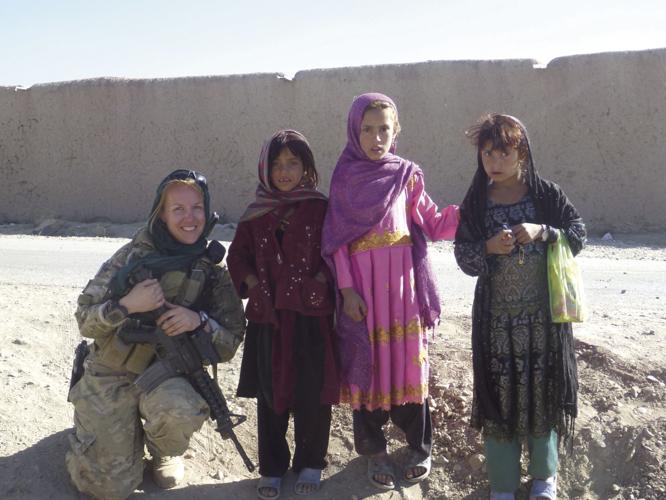
“Ultimately, we knew we would not be on a base. We knew we would be out beyond the wire,” she said. Some of the program’s graduates, those who were more suited to direct enemy engagement, were assigned to accompany Ranger units. Those such as Powers, who had stronger interpersonal skills, joined Special Forces soldiers whose mission was to influence the civilian population against the Taliban. As she put it, it was a “hearts and minds” mission.
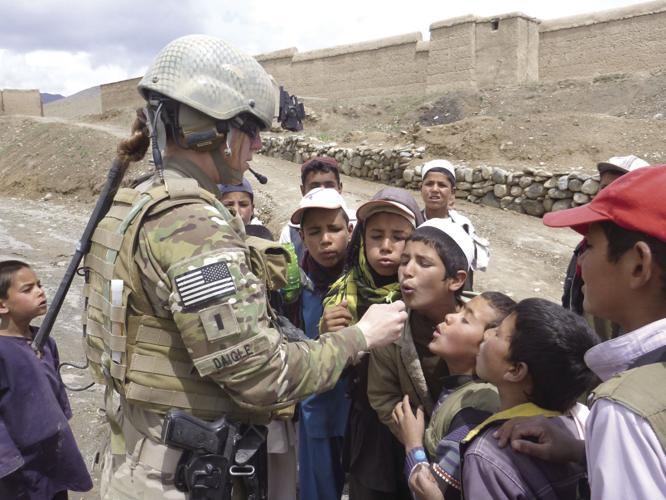
Powers served in the Wardak Province’s Tangi Valley, and later in the Paktika province. They lived in the villages, trying to convince the Afghani people that the Americans were a force for good.
“A lot of what we were doing over there was to see what the villages needed in order to be a stable village,” Powers said. If the village was dependent on the Taliban in order to provide drinking water, for example, the Special Forces would work with non-governmental organizations to eliminate that need.
“We did a lot of well drilling. We would work with NGOs and identify places that needed wells. That would create jobs for the Afghani men, it would also bring some economic stability to the village,” she said.
Powers was paired with another member of the cultural support team, Meredith Mathis, a Washington woman. It was Mathis who came up with the idea for one of Powers’ proudest accomplishments of her service. Women were forbidden to go to school under Taliban rule, so Mathis and Powers worked with an NGO to get as many small radios as they could, then gave them out to households in their village. Then, with help from an interpreter, they put on educational programs.
“I have every hope that it’s still continuing today. We would bring radios to all these households, we had a little radio station, we would give them radios and a learning book, we would do a lesson two times a week over the radio. That was something we did to interact with the population and earn some trust, while bringing some value to them. It was one of our bigger successes over there,” she said.
Powers found the Afghani people to be warm and inviting, even to groups of Americans who showed up at their homes.
“I knock on your door, I have 14 very strong men with very powerful weapons surrounding me, and they say, come on in,” she said. “I will say, for the most part, the people over there were incredibly kind. I had some really incredible experiences there with the Afghani people and how positively respected we were. They would give you the last of their bread – they loved having guests,” she said.
Villagers invited Powers and her fellow soldiers to join them in a wedding, and to celebrate Eid, the holiday that marks the end of Ramadan: “We did henna (tattoos) on our hands, we made a special dinner, we slaughtered a goat then cooked the meat and made this special dinner. Then we did dancing all night. It was a special thing to be part of.”
Powers was in Afghanistan for about a year, and not every memory from her time there is friendly. She said she saw a “significant amount of combat,” including one incident when her convoy hit an improvised explosive device. Although she and Mathis were there to communicate with female members of the village, there were no idle hands when their unit was under attack.
This was during the same period when the role of women in combat was being debated back home, and Powers feels that she and Mathis helped prove to their fellow soldiers that there was a role for women on the front lines.
Even so, she ran into officers in Afghanistan who couldn’t see the evidence when it was right in front of them: “We were sent back to a (forward operating base) to refit, we met an infantry colonel there. I was talking with him, he was talking about women in combat and he didn’t think they could hack it, and I was like, I’m doing it right now. We have women all over the country right now carrying 60-pound rucksacks and weapons; they’re doing it right now,” she recalled.
That served as a lesson for her. “It doesn’t matter if you’re actually...doing it, people are still going to doubt you.”
It also taught her to take her direction from within, and ignore the limits that others try to place on her: “Have confidence in yourself, believe in yourself, don’t listen to anyone else. If there’s something you want to do, just do it. You can do it if you put your mind to it. You’re better than you think you are, and you’re definitely better than other people think you are. Challenge yourself to do a little bit more than what you think you can.. You have to believe you’re better than other people think you are, and handle yourself that way.”
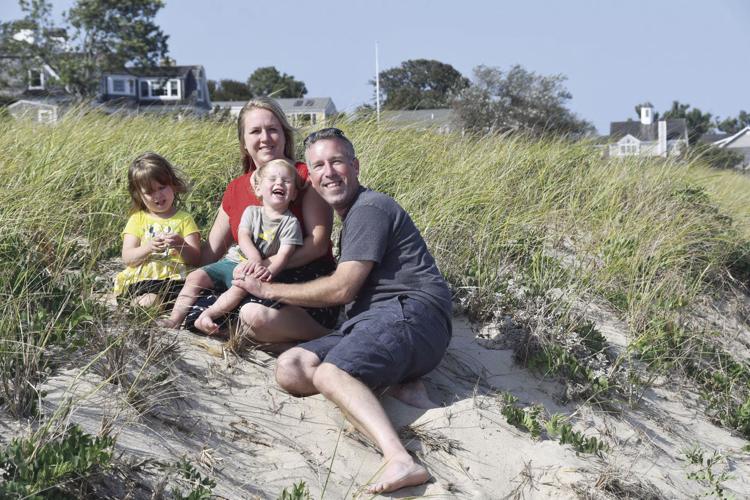
After her deployment ended, Powers, who was given a Bronze Star for her service, decided to retire from the Army. Nothing could top her experience in Afghanistan, she figured, and she wanted to settle down, get married – her husband, Pat, is also a veteran – and raise a family. She’s got two young kids, they live in the southern New Hampshire town of Brookline, and Powers has launched into a new career, selling real estate. She’s also a volunteer with CASA, an organization that advocates for children who have experienced abuse or neglect.
Her life today is a world away from when she served in Afghanistan, but she said she’s the woman she is now because of that experience.
“It was life-changing,” she said. “There’s Lynn before my deployment, and Lynn after my deployment; they’re two different people.”


(0) comments
Welcome to the discussion.
Log In
Keep it Clean. Please avoid obscene, vulgar, lewd, racist or sexually-oriented language.
PLEASE TURN OFF YOUR CAPS LOCK.
Don't Threaten. Threats of harming another person will not be tolerated.
Be Truthful. Don't knowingly lie about anyone or anything.
Be Nice. No racism, sexism or any sort of -ism that is degrading to another person.
Be Proactive. Use the 'Report' link on each comment to let us know of abusive posts.
Share with Us. We'd love to hear eyewitness accounts, the history behind an article.