


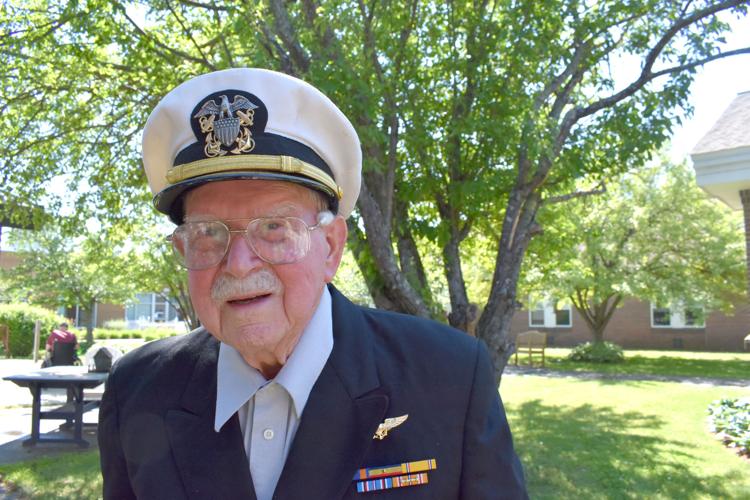
TILTON — Walter Pierce retired to Gilford, but he was born in Rhode Island on July 3, 1919, and grew up in Massachusetts. When he was in his early 20s, he was visiting Hampton Beach with his parents, when he heard Winston Churchill say something that moved him to enlist.
“‘It isn’t whether you get involved or not, but when,’” Pierce remembered. I said, well, if I’m going to get in, I want to be able to do something that I’m capable of doing.”
Pierce was still a student at Fitchburg State Teacher’s College, and though World War II was already raging in Europe, the United States was watching on the sidelines. Convinced that it was only a matter of time until his country would join the fight, Pierce decided to enter on his own terms.
“The day I graduated from college, I called up the Boston Naval District and asked them to enter me into a naval flying position,” Pierce said in an interview at the New Hampshire Veterans Home, a few days prior to his 100th birthday.
Pierce got what he wanted, and several months after enlisting, was training in Pensacola, Florida, to fly bombers. He was off-duty watching a movie one day, he recalled, when the manager of the theater interrupted. “All Naval personnel report immediately to your base.” It was Dec. 7, 1941, the day that Pearl Harbor was the target of a surprise and devastating attack.
Even today, 78 years later, the memory is an emotional one for Pierce.
“I was shook,” said the man who served as Commodore of the Winter Harbor Yacht Club in Gilford in 1962. “I said, Pearl Harbor has got to be defended. We had military there, we had the whole Navy there, just about. The good ship Arizona was sunk, right where she was docked… Hell of a way to die.”
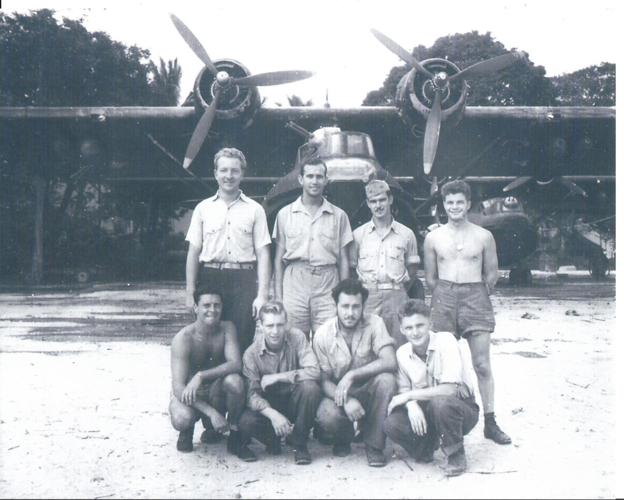
Pierce was not yet eight years old when Charles Lindbergh flew from New York to Paris. “That made a big impression on me, from then on, I wanted to fly.” Prior to the war, Pierce trained on the B-24, a four-engined, heavy bomber. But when pressed into action, Pierce was assigned to a different craft: the Consolidated PBY Catalina.
“The PBY was a sea plane with two engines, but it was a bomber, one 5,000-pound bomb and one 1,000-pound bomb,” he said. “It was a good little airplane. I loved it.”
Pierce was deployed to the Pacific, where he and his crew would join nighttime bombing raids.
“We’d take off every night at 5:30, fly all night looking for Jap ships, come back and land at 8:30 in the morning, using radar for eyes,” he said. But, for pilots of the PBYs, which could land on the ocean surface, the job was two-fold. “Every (flight) was a bombing mission, but it turned out to be something else.”
If one of their wingmates was shot down, it would be Pierce’s duty to try to find the aviator, bobbing on the surface of the Pacific, at night. It wasn’t easy to spot them, but he knew that if they didn’t find him, he wouldn’t be coming home. He declined to say how many people he rescued, answering only that it was part of his duty.
“Any time there was a bombing mission, we’d know there would be somebody wanting to be rescued,” he said. “We had a mission to find somebody and bring them back.”
The PBY was a good plane to fly, he said, stable in the air and with a long range. Landing on the ocean? “That’s a different story,” Pierce said. Especially in high seas, it could be a dicey proposition. But one that couldn’t be avoided if there was a rescue to be made. He said he would fly into the wind, as slowly as he could without losing control, set the plane down gently and hope for the best. “I’ve landed in a 15-foot sea. It’s a wonder we didn’t break something up, but we stayed together.”
Pierce served the country for the duration of the war. However, he took issue with the way the Emperor of Japan was forced to surrender. He said he found the use of atomic weapons to be objectionable.
“I didn’t believe in it,” he said. “It was mass slaughter. They aren’t the people carrying the war; they’re the home people for the people carrying the war.”
Pierce stayed on with the Navy after peace was declared. He helped fly military aircraft back from forward-deployed positions, until, on one flight, his vision went funny and he had to let his co-pilot take control. “All of the instruments looked like they popped out of their position on the instrument panel. I turned myself in after that.”
The Navy tried to put him in charge of an attack squadron, but Pierce didn’t feel qualified, so he resigned. He was discharged in 1945 at the rank of lieutenant commander.
Pierce returned to Massachusetts and settled into civilian life. He was already married – he and Phyllis had begun dating while they were both students at Fitchburg State, and wed before he shipped out to war. The Pierces settled in Leominster, where Phyllis was a first-grade teacher. Walter took a job at a steel plant.
“I didn’t want to go in the office, I wanted to go into the plant and find out how the parts are made,” he said. Pierce soon was noticed – he had an eye for how things could be done better – and the company sent him to train as an engineer. He retired as a plant manager.
He and Phyllis had two daughters. Diane Murphy, one of them, said he was “very supportive” as a father, however, he kept one rule for them: “He always told us, whatever we did, to do our best at what we were doing.”
Murphy became district manager for a telephone company. Her sister, Cathy, became director for the Red Cross in Leominster. In addition to his daughters, Pierce has five grandchildren and three great-grandchildren.
He and Phyllis were always active in their home community of Leominster, Murphy said. He was also an avid woodworker and wood carver. Now a resident of the Veterans Home, he continues to paint and sketch, and listen to music and sing. In his younger days, he loved to sail in New Hampshire.
“From the time I was eight, we spent every summer on Winnipesaukee, and he loved Winter Harbor Yacht Club,” Murphy said. She said she’s proud of her father. “He’s my hero.”
Reflecting on an image of himself some 70 years ago, Pierce said he isn’t that much different from the man in the photograph. “I’m basically the same guy. All that behind me, it’s just part of my background now.”


(0) comments
Welcome to the discussion.
Log In
Keep it Clean. Please avoid obscene, vulgar, lewd, racist or sexually-oriented language.
PLEASE TURN OFF YOUR CAPS LOCK.
Don't Threaten. Threats of harming another person will not be tolerated.
Be Truthful. Don't knowingly lie about anyone or anything.
Be Nice. No racism, sexism or any sort of -ism that is degrading to another person.
Be Proactive. Use the 'Report' link on each comment to let us know of abusive posts.
Share with Us. We'd love to hear eyewitness accounts, the history behind an article.