


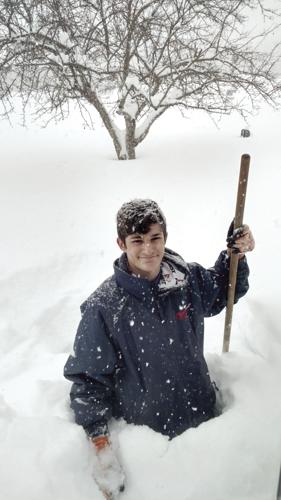
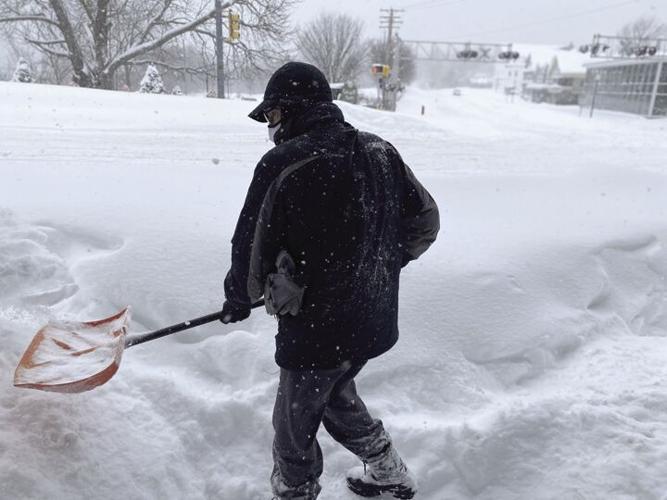
LACONIA — A historic storm dumped up to 3 feet of snow at some locations in the Lakes Region on Thursday, sending vehicles skidding off the road in near whiteout conditions.
Police Chief Matt Canfield said officers were incredibly busy responding to vehicles stuck in the roadway, blocking traffic or disabled on the side. There were dozens of calls.
“It’s been nuts, nonstop,” he said.
People got into trouble when they tried to travel and found conditions worse than expected.
“The visibility was very limited, sometimes zero visibility,” Canfield said. “And there was a significant number of people out for a snowstorm of this magnitude.
“A very blustery wind was blowing snow, and it was coming down fast.”
In some cases, cars were stopped on the road and other vehicles ran into them.
There were no significant injury accidents, but there was concern for people who got out of their vehicles and were exposed to the elements and vulnerable to being hit by a passing car.
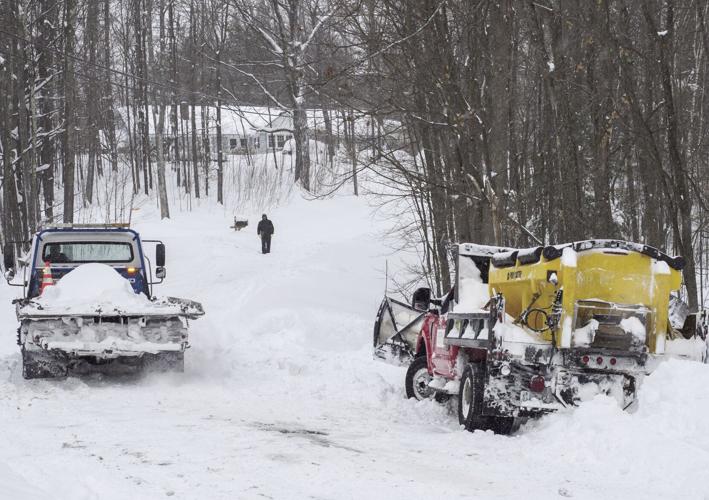
Conditions were so bad that a tow truck got stuck on Eastman Shore Road.
Forecasters knew a Nor’easter was coming but snowfall amounts exceeded expectations, said Andy Pohl, a meteorologist with the National Weather Service in Gray, Maine.
Pohl said the snowfall rivaled that of some of the most intense storms ever to hit the region, but forecasters had not yet compiled the climatological data to determine when the area last got this much snowfall in a 24-hour period.
“We knew there was going to be a band of snow, but the models are not great at forecasting intensity,” he said.
Accumulations were double the predicted amount in some places.
In Sanbornton, snow was falling at a rate of 6 inches per hour during the height of the storm.
At 3:02 p.m. as snowfall eased, the National Weather Service put out a public information statement with snow accumulations recorded by the public or weather spotters.
A reading of 39 inches was recorded in Meredith at 1:47 p.m. and 37 inches was reported in New Hampton at 12:11 p.m. More than 3 feet of snow fell at the airport in Gilford.
Fire Chief Kirk Beattie measured a snow depth of 31 inches at the downtown fire station around noon, with the snow continuing to fall.
He said there were no medical calls related to the storm, but there were some other calls and the snow was so deep in places that a firefighter in a pickup truck with a plow had to be used to clear a path for ambulances.
“It’s been a long time since we’ve had a storm like this,” Beattie said. “Fortunately, it’s primarily a light snow and that’s helped with us not having to have lines down and power outages.”
He estimated it will take firefighters three days to dig out all of the city’s fire hydrants.
Runways were closed at Laconia Airport, where Dave Emerson, of Emerson Aviation, estimated a snow depth of 38 to 44 inches.
He got to the airport at 5:30 a.m. and began driving a loader with a plow, pushing snow into 6-foot drifts that had to be cleared before he could take another pass at the runway. Heavy-duty snow blowers were also used in the process.
“All our runway lights are 36 inches off the ground and just about all of them are buried,” Emerson said.
“I was born and raised here, will be 59 next month, and this is the biggest snow I can remember,” he said.
Knowing the storm was coming, Laconia Public Works Director Wes Anderson slept the night on a cot in his office rather than try to drive in from his home on Eastman Shore Road.
The city fielded its full complement of a dozen plow trucks.
“Right now we’re focusing on keeping the main roads open and the collectors, Union, Court, Elm, Highland, Lynnewood, Holman,” he said. “A normal snow route takes us four hours to do. With the snow falling at a rate of 3 or 4 inches per hour, by the time we come back, the snow is 10 or 12 inches deep. There is no way to keep up with it.”
Plow trucks were also used to clear paths for emergency vehicles.
“We’ve been working with police and fire,” Anderson said. “If they need to get someplace. We’ll get them there.”
Gov. Chris Sununu said 700 pieces of state and local machinery worked to clear snow.
“The drifts are high,” he said. “For loved ones and neighbors, maybe check in on them.”
The Public Works Department notified residents that the storm delayed Thursday’s Laconia trash pickup until Friday, and Friday’s trash will be picked up Saturday.
“Laconia Public Works asks all residents and businesses on Thursday’s route who left their trash cans out on the curbside during the storm to dig them out of the snow banks so that the collection crew can empty them.”
As a major coastal storm with north to northeast winds, this was called a Nor’easter. It was caused by a low pressure system that developed over the ocean off Cape Cod.


(0) comments
Welcome to the discussion.
Log In
Keep it Clean. Please avoid obscene, vulgar, lewd, racist or sexually-oriented language.
PLEASE TURN OFF YOUR CAPS LOCK.
Don't Threaten. Threats of harming another person will not be tolerated.
Be Truthful. Don't knowingly lie about anyone or anything.
Be Nice. No racism, sexism or any sort of -ism that is degrading to another person.
Be Proactive. Use the 'Report' link on each comment to let us know of abusive posts.
Share with Us. We'd love to hear eyewitness accounts, the history behind an article.