


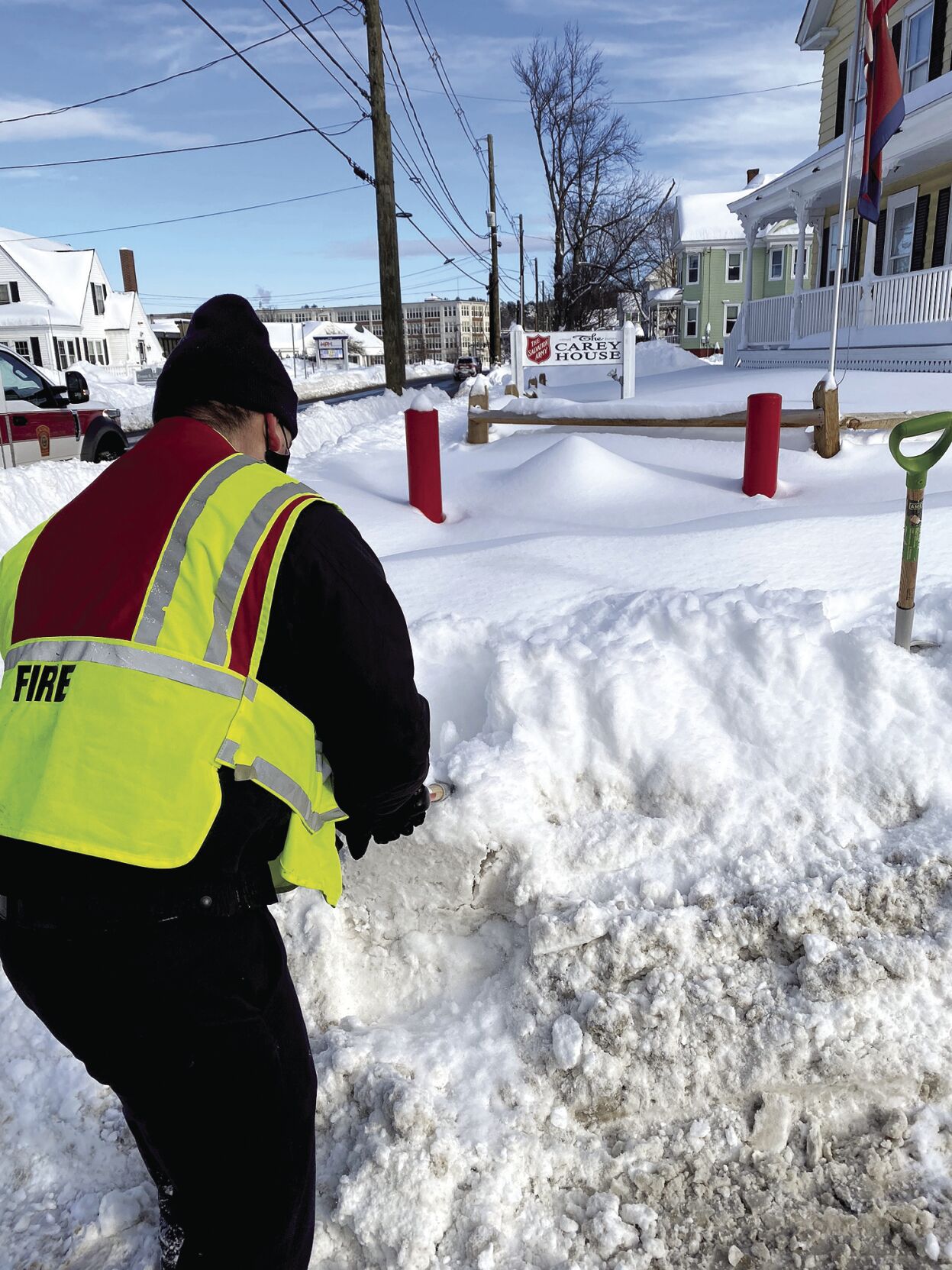
LACONIA — Firefighters are asking for the public’s help in digging out nearby fire hydrants after more than 3 feet of snow fell Thursday in the city.
Hydrants across the city are now blocked by snow banks that are 4 feet tall or more, Firefighter Justin Griffin, president of Laconia Professional Firefighters Local 1153, said Friday.
Given the depth of the snow, Griffin estimated that it could take firefighters three or four days to dig out all the hydrants across the city. That poses an added risk should there be a building fire, he said.
“If the firefighters have to dig out a hydrant in order to connect fire hoses they’re losing valuable time,” Griffin said. “Every second counts in getting water on the fire.”
There are about 600 hydrants in the city, according to Fire Chief Kirk Beattie. Firefighters are responsible for keeping most of them clear of snow during the winter. But Griffin said in light of Thursday’s epic storm anyone willing to dig out a hydrant in their neighborhood could be doing them a big favor.
Hydrants in larger residential communities like South Down and Briarcrest are kept clear by contractors who do snow removal in those areas, Griffin explained.
Griffin said should clear a 3-foot path around a hydrant which provide enough room for hoses to be attached to the connection point without kinking.
Griffin also said that because of the extraordinary snow depths homeowners should check to make sure that any vents from household appliances, such as furnaces, pellet stoves, or gas dryers, should be checked to make sure they are clear of snow. Failure to do so would result in a buildup of carbon monoxide inside a building which can lead to sickness and even death.
If the snow is blocking parts of windows, the snow should be knocked down so that someone could escape out the window in the event of an emergency, he said.


(0) comments
Welcome to the discussion.
Log In
Keep it Clean. Please avoid obscene, vulgar, lewd, racist or sexually-oriented language.
PLEASE TURN OFF YOUR CAPS LOCK.
Don't Threaten. Threats of harming another person will not be tolerated.
Be Truthful. Don't knowingly lie about anyone or anything.
Be Nice. No racism, sexism or any sort of -ism that is degrading to another person.
Be Proactive. Use the 'Report' link on each comment to let us know of abusive posts.
Share with Us. We'd love to hear eyewitness accounts, the history behind an article.