







MOULTONBOROUGH — Road salt isn’t going anywhere, but the approach to clearing roads in winter may be changing.
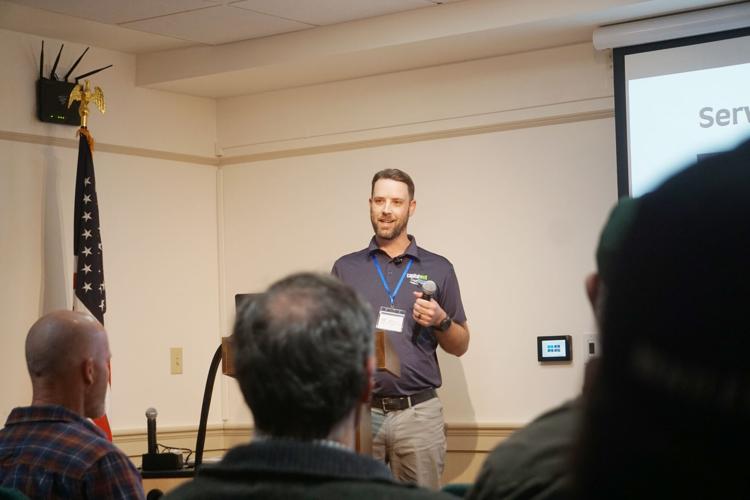
The Lake Winnipesaukee Alliance and the Moultonborough Conservation Commission brought together experts on road salt use through the winter from both the public and private sectors Thursday evening, for a presentation on the topic. Perhaps most importantly, numerous contractors attended the event at the Moultonborough Public Library.
Eric Siy, executive director of LWA, started his role in September. He described the presenters as “the A team.”
“It’s going to take a lake, it’s going to take a village to address this issue,” Siy said.
“We are using too much salt on our roads,” Siy said. “Salt is incredibly destructive, I don’t think I need to tell any of you that, in terms of what it does to vehicles, infrastructure, etc. But what it does to water, what it’s doing to the lake, what it does to drinking water — you’re going to hear about that, as well. And what it does to our personal health — if we know nothing else, we know too much salt in your diet is a bad thing.”
Siy told the crowd of about 50 that in the Lake Winnipesaukee watershed, there’s been a three-fold increase in the level of chlorides in the lake since 1975.
“We are far from a tipping point, so on one hand that should make us feel good, but it shouldn’t make us complacent. At some point, if we continue this trend — and it’s accelerating, it’s getting worse — we will hit that tipping point, and we will forever change this resource,” Siy said.
Unlike acid rain, Siy said, salt use isn’t necessarily something that can effectively be addressed with new federal or state regulations. Rather, cooperation is needed. Siy remembered working with another presenter, Phill Sexton of WIT Advisors, to reduce road salt use at Lake George in upstate New York over a 10-year period.
“We reduced road salt there with Phill’s leadership by 50% and more in the basin, and the results are definitive. We’re already seeing results in the water that flows into the lake, and the lake proper, as well,” Siy said. “The bottom line is this can be done. We’re not landing anybody on Mars, we’re simply using salt smarter.”
Ted Diers, New Hampshire Department of Environmental Services Water Division assistant director, told the crowd New Hampshire was the first state to use road salt as a deicer on a regular basis in its highway department in 1938.
“We know that salt use statewide has more than doubled in the last 40 years, and we also know that it’s effecting our water bodies,” Diers said.
The state has water quality standards for chlorides. Chlorides are included on the list for chemicals detrimental to the environment.
“I call that our table of methyl-ethyl death, that is all of the things that are horrible — there’s PCBs on there — and chlorides show up on that list, next to chlordane,” Diers said. “We treat this as a toxin, because it is toxic to fish.”
The number of contaminated wells has also increased over the last 30 years. Proximity of a well to a driveway, road or parking lot is correlated with increased contamination of chlorides, Diers said.
These are also expensive problems to fix. In Merrimack Village District, Diers said, they lost a major production well because of chlorides. The cost to replace a well providing over a million gallons is about $2 million.
“This is not a big community, this is a small community that lost a major production well,” Diers said. “That’s astounding.”
The expansion of Interstate 93 in the early 2000s included park-and-ride lots and bigger on and off ramps, which required more salting and plowing, and changed drainage.
“One of the problems with changing that drainage is that instead of that salt-laden water slowly sinking into the ground and getting into the lake, now it’s got a straight shot,” he said. “Pretty much goes directly into Canobie Lake and Cobbetts Pond.”
It takes upward of a decade or more for salt water to work its way through ground water and eventually make it into surface waters. More than 50% of salt is coming from parking lots in the private sector, as opposed to highways, which contributed around 10%, Diers said. That was the impetus behind creating the Green SnowPro training program, offered by the state to contractors and local communities.
“The chloride levels you see today in our lakes are a decade-old reflection on the land use in those places a lot of times,” he said. “It took us a long time to get us into this mess, it’s going to take us a long time to get out.”
Dan Harris of RealGreen Services, which supplies winter material like salt, said the industry needs to do its part to reduce contamination.
“We’re in a situation right now that, I feel, is a critical point,” Harris said.
“We need to make some changes.”
This year, salt was not plentiful, Harris said, which made contractors conserve and problem solve.
Moultonborough Public Works Director Chris Theriault said public safety is a primary concern, but road salting isn’t black and white, and depends heavily on conditions and types of snow storms. It’s a balancing act between safety, care for the environment, and management of the municipal department itself.
Winter maintenance is also expensive. For example, cleanup for the Jan. 7 snow storm cost Moultonborough about $40,000.
Climate trends are also changing the way roads are maintained. Twenty or 25 years ago, it was more common to experience colder, drier snow events. Over the last 10 years or so, there are more mixed precipitation events and more wet, heavy snow, which requires more salt treatment.
“It’s harder to reduce the usage overall,” he said.
“As the temperatures are warming, it actually means we’re applying more frequently,” Sexton said. WIT Advisors created a program called Sustainable Winter Management, and they seek to help contractors find ways to do their job more effectively, while using less salt overall.
“This problem is actually a benefit to our business,” Sexton said. “We can solve this.”
“As an industry, we’re way behind the curve.
“The big call to action is really just shifting our mindsets, a little bit.”


(0) comments
Welcome to the discussion.
Log In
Keep it Clean. Please avoid obscene, vulgar, lewd, racist or sexually-oriented language.
PLEASE TURN OFF YOUR CAPS LOCK.
Don't Threaten. Threats of harming another person will not be tolerated.
Be Truthful. Don't knowingly lie about anyone or anything.
Be Nice. No racism, sexism or any sort of -ism that is degrading to another person.
Be Proactive. Use the 'Report' link on each comment to let us know of abusive posts.
Share with Us. We'd love to hear eyewitness accounts, the history behind an article.