


Participation was right choice for Tarra Bruno
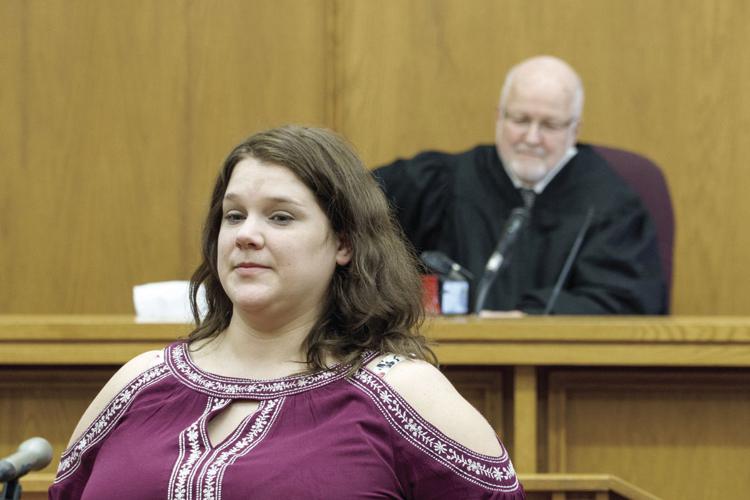
LACONIA — Tarra Bruno had to make a decision. She could either go to prison on drug charges, or she could agree to participate in a difficult program that, if she put her heart and soul into it, just might help her turn her life around.
Going into this program didn’t appeal to her at all. “I had zero desire to be under anyone’s thumb,” she said. But the alternative – serving hard time – was just too scary. So, she chose to participate in Drug Court.
Today Tarra Bruno, now 32, will tell anyone who asks that she made the right choice – the smartest choice of her life. But about a year ago she would have given a different answer. “I took it because it was my fastest way out of the system,” she explained.
Tarra is one of approximately 18 mostly young adults now participating in Drug Court in Belknap County, a sentencing alternative in which treatment is combined with ongoing supervision for nonviolent repeat offenders who have a serious drug abuse problem and who have already become familiar faces to the local criminal justice system.
It’s a program that mixes incentive and deterrence: Make a good choice, get a reward; make a bad choice, get punished. And through it all, participants undergo intensive counseling to overcome their drug use habit and other dysfunctional behaviors that have led to repeated arrests and court appearances.
Advocates don’t like the term Drug Court.
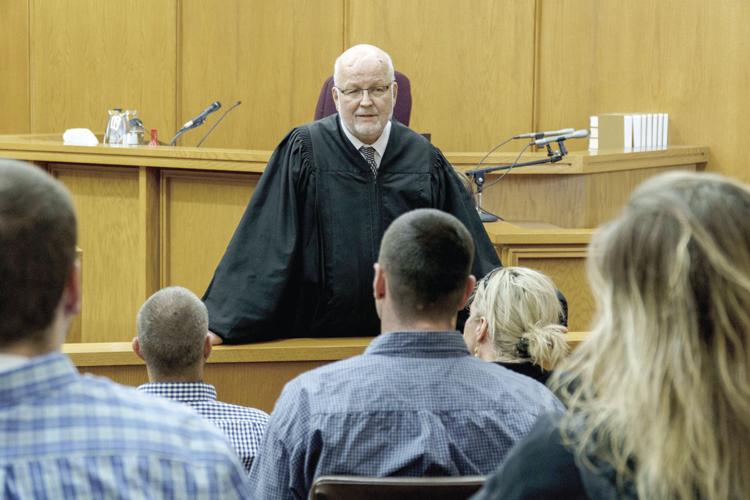
“It’s about motivation and respect,” said Circuit Court Justice James Carroll, who has been the Laconia Drug Court judge since its inception in 2012. “Drug Court makes it sound like losers’ court.”
Carroll and others involved in the program prefer to call it recovery court, believing it’s more productive to focus on a person’s potential for a better future than to dwell on their checkered past.
If the story of the Laconia Drug Court were a play, it could be broken into two acts. One would be about how a group of local officials and citizen stakeholders pooled their determination, professional expertise, and energies to bring the program to life. The other would be about the drug addicts who have come face to face with their inner demons in order to complete the program. The “cast of characters” in both acts didn’t know if the risks they were taking would pay off. But despite whatever misgivings there were, they felt they had to give it a try.
About 10 years ago in Laconia, representatives of the local judiciary, police, the sheriff’s department, state probation and parole officers, the local Public Defender’s office, bail commissioners and representatives of various counseling agencies and support organizations got together to see whether a drug court – an approach that began in 1989 in Florida – could help with the Lakes Region’s growing drug problem.
“We’d seen a revolving door” of repeat drug offenders,” said Jacqui Abikoff, executive director of Horizons Counseling Service, who has been involved with the Laconia Drug Court from those early brainstorming days.
It became clear that the system for dealing with drug offenders had to be improved.
But going from brainstorming to getting a program up and running was a challenge. There was no money to fund the start-up. However, according to Abikoff, the people involved and the organizations they represented believed enough in the program’s potential that they agreed to volunteer countless work hours to create the framework for the program. To Abikoff all the efforts to start up the Drug Court have been “a labor of love.”
“It was the luck of the draw that we had a group of individuals that covered the criminal justice systems,” Carroll said of the initiating group.
Even after all the preliminary work for the court was completed, there were still no funds to operate it. That to some seemed like an insurmountable roadblock. But Abikoff remembers Carroll recalling to the others the famous line from the baseball movie “Field of Dreams,” “If you build it, they will come.”
She was confident that funding would invariably follow once the Drug Court was up and running and prospective benefactors could learn first-hand what the program was accomplishing. Carroll and Abikoff credit attorney and retired Special District Court Justice Willard Martin with his efforts to get the initial funding through the Annette Schmitt Foundation.
At first, Drug Court was capped at 10 participants at any one time. Now that the program has finally started to receive regular funding, the capacity has been doubled to 19 defendants per group. New state funding will increase that capacity to 30.
Statistics show that Drug Courts work. While the recidivism rate (the tendency of a convicted criminal to reoffend) among those serving time on drug charges is 65 to 75 percent, the rate among those who have been through Drug Court is closer to 22 percent, said Ed Rajsteter, president of Friends of New Hampshire Drug Courts, which helps support Drug Court Programs across the state.
“It helps break the cycle of incarceration,” said Belknap County Attorney Andrew Livernois, whose office is responsible for prosecuting all felony-level drug cases in the county.
The National Association of Drug Court Professionals cites federal Justice Department statistics from a nationally representative study of more than 2,000 graduates from more than 90 Drug Courts. The average recidivism rate was only 16 percent in the first year after leaving the program, and 27 percent after the second year. That compared to favorably to recidivism rates on conventional probation, in which 46 percent commit a new offense and over 60 percent commit a probation violation.
Abikoff noted that members of the public often think that prison is the best place for drug addicts, believing that once behind bars they will no longer have access the drugs. That’s a misguided notion, she said.
“They’re sitting there waiting for the day when they can start using again,” she said. “Abstinence is not recovery.”
Also, drugs are smuggled into jails and prisons.
“There are as many drugs there as anywhere else,” Carroll said.
For the many benefits Drug Court affords, the program is not for everyone.
As Livernois sees it, Drug Court is inappropriate for people with a history of violence or what he calls “entrepreneurial” drug dealers — those who deal drugs to make money rather than just to pay for their own habit.
Also, Drug Court would not be a good fit for someone whose level of addiction is not especially serious, because the 12 to 18 months they would spend in counseling and group therapy would be more than they need and hence could actually be counter-productive. Those with a low-level criminal records would also not qualify, as would people who lack a stable support system to lean on to help them stay clean.
“The challenge is picking the right defendants,” said Livernois.
According to Carroll, the best candidates are those with a high level of addiction and the potential for serious prison time.
Abikoff said program personnel have developed a sense of who is a good fit and who is not.
Tarra Bruno was determined to be a good candidate for the program.
She started using drugs in her teens — the whole “rite of passage thing” as she recalls it.
By the time she was in her 20s, she had a lengthy record for drug possession and sale of heroin and marijuana. She started using crystal meth, and later on was shooting up suboxone. By 2012 she had been sentenced to the House of Correction for selling drugs.
It was while she was serving her sentence that she got to know another inmate who became her boyfriend. He was an avid needle drug user and introduced her to suboxone. The relationship ended when the boyfriend went back to prison, she said.
During that time she lost one job as a cashier and later another one as a housekeeper. She also lost custody of her then 4-year-old son.
In the fall of 2016, things for Tarra went from bad to worse. She was arrested on a motor vehicle charge and was free on bail. When she failed to show up at court, a warrant was issued. During arrest, police found drugs on her. She found herself back in jail.
That was then she was given the opportunity to participate in Drug Court. She agreed. But looking back on those early weeks in Drug Court she now realizes that what she was really looking for was affirmation.
“My goal at first was to make people proud of me,” she said.
Those first months were a bumpy ride.
First, the routine for program participants during the first phase is intense.
There are 3½-hour counseling sessions on Mondays, Tuesdays and Thursdays. Then there is the Drug Court session on Wednesdays, followed by a two-hour session designed to help participants to develop a range of drug-coping skills and more generalized skills related to self-management and self-control. The participants are required to check in at the county jail on Fridays, Saturdays and Sundays, and they must go to five Alcoholics Anonymous or Narcotics Anonymous meetings each week.
Armed with a cocky attitude in that early phase, she relapsed a number of times, but in each instance she admitted it to the group. But when she relapsed again after seven months into the program Carroll decided to send her a strong message. He sent her to jail for two days.
It wasn’t until last June that things finally began to click.
“I just did not want to get high anymore,” she remembers.
She realized that more than wanting other people to be proud of her, she needed to get to where she was proud of herself.
When she told members of her peer group that she hadn’t used during the last week, the others at first didn’t believe her. But something told Carroll, who knew Tarra from court appearances prior to her time in Drug Court, that she was being truthful.
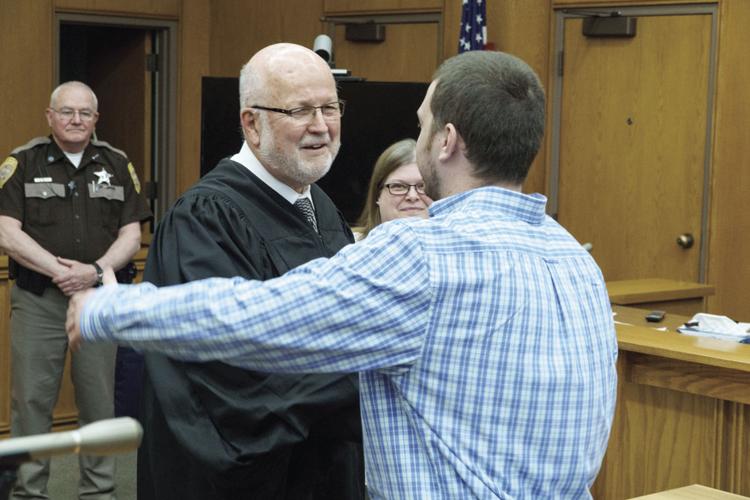
“When they get it, you can see it in their face,” he said.
Carroll readily admits that taking the measure of Drug Court participants is more art than science.
“Addicts spend a lot of time lying,” said Carroll who in his time on the bench has heard his share of dishonesty. “Sometimes I tell the person, ‘I don’t believe a word you’re saying,’ and sometimes I’m right and sometimes I’m wrong.”
Abikoff said the approach that Carroll displays is as critical to the program’s success as the participants’ accomplishments.
“Judge Carroll can be stern without it appearing that he doesn’t care about them,” Abikoff said.
The relationship between judge and Drug Court defendants is one of the critical components that has made this kind of therapeutic jurisprudence a success, says one criminal justice expert.
“In Drug Court the defendant actually gets to tell his story to the judge,” observed Christopher Bruell, an assistant professor in the Criminal Justice Department at Saint Anselm College. “That’s usually not the case. In most court cases the defendant is not that involved in the process. It’s the lawyers who do the talking.”
While Tarra Bruno says Drug Court was a life saver for her, she will also tells everyone that it’s not the end of the story. What lies ahead is the ability to accept that she will be a drug addict for the rest of her life, and that her continued success depends on continuously reaching out for positive support.
Five times a week she attends Narcotics Anonymous meetings. In addition to the meetings themselves, she has become active in the group’s activities committee. At the meetings she finds strength and inspiration, especially from those she remembers getting high with when she was on drugs.
But besides the inspiration from those who are clean, there are the ongoing temptations from those still into drugs. Tarra said that after graduating from Drug Court she got a message on her Facebook page from a former crony asking if she needed some drugs. “I said no, but I asked him, ‘Do you want to go to a meeting?’”
Carroll said situations like that are a reality that all recovering addicts will need to deal with sooner or later. He recalled a Drug Court graduate going into the local Walmart and seeing in the store three people he used to buy drugs from. He ran out of the store, wandered around the parking lot and then called his counselor. “What do I do?” he asked. “You’ve got to get out of there,” he was told. Whereupon he drove away.
Abikoff said the Lakes Region is fortunate to have so many different options for ongoing support and guidance for recovering addicts. “There are 12-step programs like AA and NA, there are cognitive-based programs, there are faith-based programs, and recovery centers like Navigating Recovery,” all of which offer critical follow-up access.
Drug Court has not only changed the lives of its participants, but also those who have guided defendants through the program. Carroll recalls one defendant coming to court one week and showing a picture of his son and his date at the junior prom. “A year later I saw this same man at his son’s high school graduation. When you see something like that it’s truly fantastic.”
Asked if his experience on Drug Court has made him a better judge, he replied, “It’s made me a better person.”





(0) comments
Welcome to the discussion.
Log In
Keep it Clean. Please avoid obscene, vulgar, lewd, racist or sexually-oriented language.
PLEASE TURN OFF YOUR CAPS LOCK.
Don't Threaten. Threats of harming another person will not be tolerated.
Be Truthful. Don't knowingly lie about anyone or anything.
Be Nice. No racism, sexism or any sort of -ism that is degrading to another person.
Be Proactive. Use the 'Report' link on each comment to let us know of abusive posts.
Share with Us. We'd love to hear eyewitness accounts, the history behind an article.