


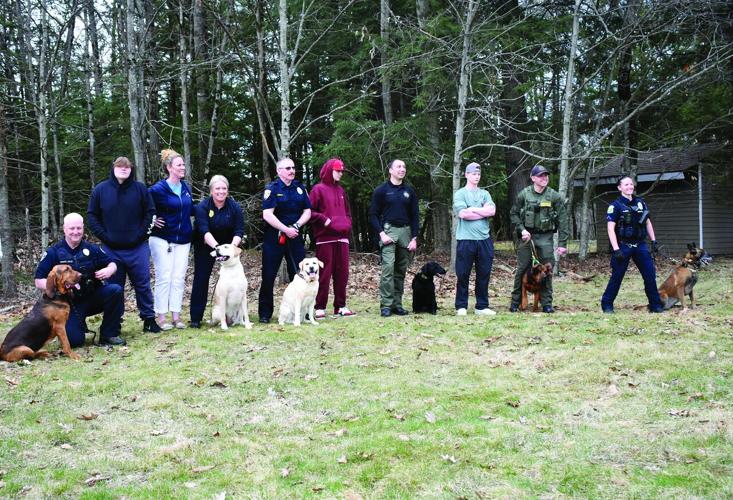
CAMPTON — Students from Mount Prospect Academy locations throughout the state learned how dogs track, find objects, detect bombs, and apprehend criminals when six K9 teams gathered for a demonstration on April 15. Representatives of the Campton, Bristol, and Conway police departments, as well as the NH State Fire Marshal’s Office and State Police, showcased their dogs’ skills, and gave students a chance to meet the dogs and ask questions.
MPA K9 Day came about through the efforts of Campton Police Det. Kristin Tracy, whose K9 Miller is a comfort dog.
“We have one of [Mount Prospect Academy’s residential] facilities here in Campton,” Tracy said, noting it serves as “the last stop before they go to the Sununu Center in Manchester. So we are called there quite a bit, for a long laundry list of different reasons, and we’ve built a pretty good rapport with the staff.”
Having a comfort dog who's served for seven years, Tracy said, “Maybe we should start being proactive, instead of always reactive, always going when they’re in crisis, or it’s always going to be a negative experience.
"So I thought, well, what better way to maybe make a positive experience with these kids, to maybe help us in the future, than with the dogs?”
Tracy’s husband is a former State Police canine handler, so she has contacts around the state. She invited other canine teams with different specialties to join her in a demonstration of their skills.
Mount Prospect Academy brought students from campuses around the state to make personal contact with each of the dogs — with the exception of Conway’s patrol and narcotics dog, trained for aggression.
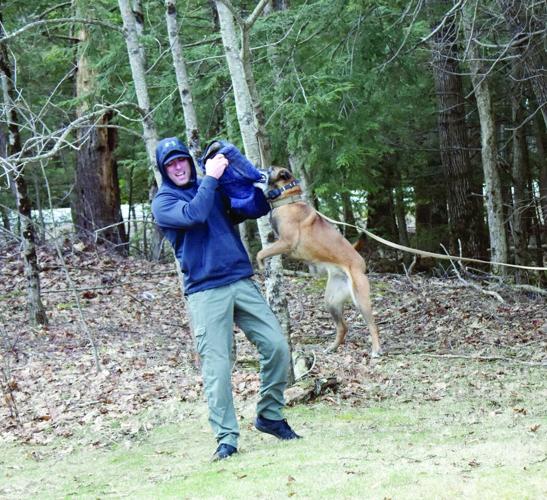
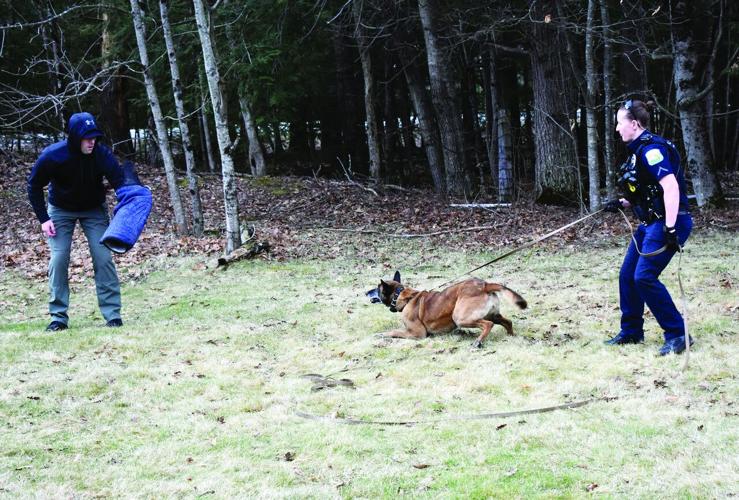
Conway Master Police Officer Morganne Sterl, and K9 Summit, a female Belgian Malinois, had assistance from Bryan Tracy, who served as “decoy” with arm protection, to demonstrate the tenacity of a dog apprehending a suspect. As Summit dangled from his arm, her teeth embedded in the bite sleeve, he advised, “You don’t want to run.”
For student Preston Chase, it was K9 Rosie, the “bomb dog” trained to detect explosives, who was most impressive.
“I liked it. They were cool,” he said.
Trooper Neil Chapdelaine of the State Police Bomb Unit said Rosie will search for the scent of gunpowder or other explosive compounds. Once found, a bomb technician will X-ray the box, or a robot will take over until the scene is safe.
During the team’s demonstration, Chapdelaine set up five cans, one containing gunpowder. Rosie passed each one until she found the correct can. Chapdelaine then asked students to rearrange the cans while Rosie was distracted, and she returned to pick out the right one again.
He said, during the 4.5 years they worked together, “She moved 25 different explosive objects, to include homemade explosives, military, and commercial.”
TJ Marsh’s favorite was K9 Hank, the search-and-rescue dog whose handler is State Trooper Tom Sandberg.
“My dog’s name is Hank, and I think bloodhounds are good-looking dogs, too,” TJ said. “They’re wicked smart.”
Sandberg said State Police have two bloodhounds. In addition helping locate people, Hank learned to perform tricks in response to hand signals, to the delight of the students.
Bristol Police Officer Mike Grier brought K9 Maybel, another bloodhound who tracks people. She demonstrated her ability to find an object thrown by one of the students.
“Her oldest track to date is a person who had been missing for three days. She was able to locate that person. Her longest track is 9.1 miles,” Grier said.
“She also does articles. She can find bullet casings, cell phones, wallets.
“She doesn’t excel in obedience. She wants to find things; that’s all she wants to do. We’ve been working together for almost a year-and-a-half. We train every week, eight hours a week, at the New Hampshire Police K-9 Academy.”
Investigator Sol Rosman of the Fire Marshal’s Office brought his partner, K9 Reeves, a yellow Labrador retriever who demonstrated how to detect flammable liquids.
“He can sniff through all that burnt fire debris, and still pick up on the odor that he’s supposed to be looking for,” Rosman said. “He’s found some ignitable liquids at some fire scenes, and we have to then send it off to the lab, because Reeves can’t go to court and testify, right? We collect it, send it off to the state lab, and then we have to see what may be present.
“One of the big questions people ask is if he wears little booties when he goes into a fire scene,” Rosman said. “Obviously, we have to make sure that it’s extinguished, but he doesn’t [wear boots]. He’ll just use his natural senses on his feet. He goes to put his paw down and feels something, he’ll just readjust his foot, but if he was wearing boots, that sharp item would probably hit him in the foot before he’d even know.
“Most of the other dogs that you’ll see, they get a toy. They have a favorite toy that they get when they find. Reeves does not. He has to work in order to get his food. He does not get treats during the day. He doesn’t get a dish of food during the day. So we train anywhere from two to six times a day so that he can get food.”
Reeves demonstrated his ability by pausing at each of a series of containers until he detected an accelerant, then sits next to it. A single drop of gasoline is enough to alert him.
“I could just randomly walk him through a crowd of people at a fire scene,” Rosman said. “People think he’s just coming through to say 'hello,' when, in fact, he’s sniffing to see whether potentially a suspect, someone may have spilled something on themselves when they were lighting that fire, and they pick up on that.”


(0) comments
Welcome to the discussion.
Log In
Keep it Clean. Please avoid obscene, vulgar, lewd, racist or sexually-oriented language.
PLEASE TURN OFF YOUR CAPS LOCK.
Don't Threaten. Threats of harming another person will not be tolerated.
Be Truthful. Don't knowingly lie about anyone or anything.
Be Nice. No racism, sexism or any sort of -ism that is degrading to another person.
Be Proactive. Use the 'Report' link on each comment to let us know of abusive posts.
Share with Us. We'd love to hear eyewitness accounts, the history behind an article.