


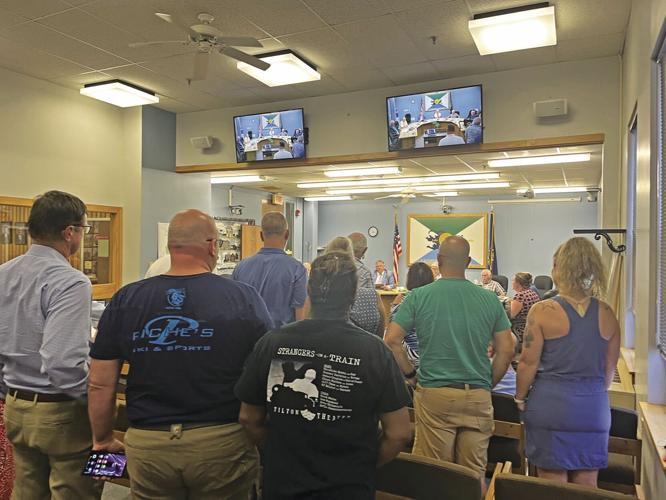
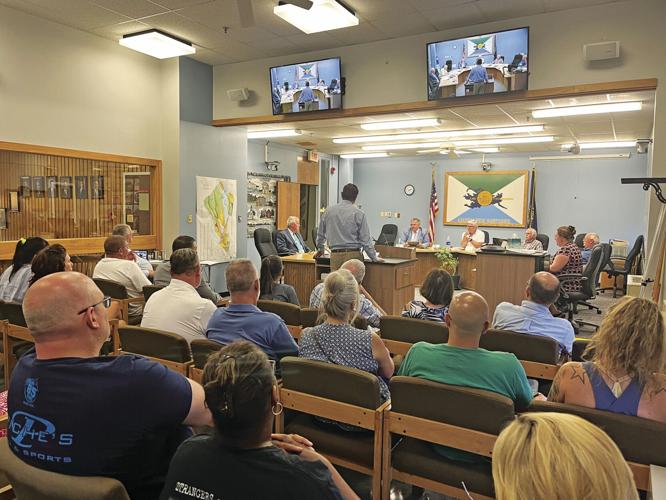
LACONIA — The city council fielded two requests for relief from residents at its Aug. 8 meeting.
The first was a request from the Windemere Ridge Homeowners Association, whose private well supply is insufficient for their growing neighborhood, to be included in the city’s water system.
The second was from the Gleason family, who appealed the council for a variance from a zoning ordinance requiring them to get rid of two pet goats.
Windemere Water
Dr. Chris Weinmann, president of Windemere Ridge, spoke to the council during public comment, as the matter was not on the council agenda, and described how the association has a private well which no longer meets its needs. Residents are now asking to be incorporated into the city water supply system.
“We’re coming to you — me, my neighbors — to express the dire need of where we’re at,” Weinmann said. “We don’t have any guarantee of finding more water, even dumping a lot of dough into the situation. City water is our solution, one way or another.”
Windemere Ridge is a development off Parade Road, adjacent to Windermere Heights and the Paugus Bay State Forest. There are currently 21 homes built on Turner Way with two in construction and nine available lots expected to become houses in the near future, according to Weinmann.
When the neighborhood was originally developed in 2004, Weinmann said, the city mandated that it construct its own water supply system. Since 2004, the construction of additional homes in the neighborhood and chronic drought in the state has stretched the neighborhood well thin. Weinmann said the system today provides just three gallons per minute; 10 gallons per minute, he added, is their target based on community need.
Weinmann outlined what they have already done to address the problem, including hiring private engineers from Meredith, applying for a water study grant with the state and looking at the costs and logistics of having water trucked in — which the state Department of Environmental Services only approves of as an emergency option. Windemere has also looked into drilling more wells, which, with each costing hundreds of thousands of dollars, would not guarantee more water.
“We’re doing our due diligence to try and fix our own problem,” Weinmann said, “but every step we go ahead we are finding that the solution is city water.”
Rob Bolduc of Turner Way said Windermere has burned out multiple well pumps in the last few years, each one costing more than $7,000, by overtaxing their well. Bolduc added that other neighborhoods in the area had expressed similar water concerns and would similarly benefit from assistance from the city.
Ben Crawford, superintendent of the city water department, said the primary solution on the table is to create a loop, extending water up from the Weirs via Hilliard Road, through Windemere and South Down neighborhoods. A loop would prevent oversupply and stagnation in the Windemere area.
The loop option is estimated, at minimum, to cost about $6.8 million. Costs for such projects, Crawford said, are usually borne by developers over 10-year periods.
Weinmann said Windemere residents would help pay for a city solution, within reason, if it guaranteed them water, which no other option so far has promised.
Councilors also discussed considering the Turner Way problem with the future of the former state school property and its water supply, especially if the property is developed residentially.
Each of the proposed solutions, the council noted, would take years. Short-term relief options also are necessary.
Ward 1 Councilor Bruce Cheney, who has brought the Turner Way supply issue to the council before and has been communicating with Windemere homeowners, expressed his belief in the city’s responsibility to ensure its residents had water and to not overburden them with costs. He emphasized that he saw the issue as an infrastructure shortcoming, one the city could solve and recoup at its own costs.
“I’m a little hard-pressed to understand how, in Laconia, with that lake sitting up there, we could be hard-pressed to get these folks some water,” Cheney said. “I know it’s going to cost money; they’re willing to help.”
“The problem is clear,” said Mayor Andrew Hosmer. “The options are, we’ve only got a couple.”
The council, Crawford, and Windemere residents worked out a path forward seeking solutions from both private and public experts: Windemere would share the private consultation research that had already been conducted with the city, who would maintain a dialogue with the Department of Environmental Services.
Garfield Street goats
Elizabeth Gleason’s daughter is seriously allergic to traditional pets; the family instead has raised two goats, Mocha and Moonlight, since their infancy. The two female dwarf Nigerian goats, which typically grow to a height less than two feet, are dehorned, hypoallergenic and kept outside in a fenced pen in the Gleason’s yard. Gleason said — and neighbors affirmed — that the goats are quiet and clean; they are washed weekly and bathed monthly, and their waste is taken to a farm.
City zoning codes do not allow single family residences such as the Gleasons’ to keep livestock. Their request for a variance, or exception, was denied by the zoning board at its July 18 meeting out of concern for setting a precedent that would allow future requests to keep chickens. A change in the ordinance’s terminology to create a distinction between pets and farm animals would fall under the purview of the council.
The Gleasons, without intervention, will have to get rid of their goats, which Elizabeth described as part of their family. The zoning board has said, as long as there is an ongoing process to address the matter, they will not take immediate action.
At both the zoning board and council meetings, several neighbors stepped forward to affirm that the goats were not a nuisance — and even had been enjoyed and beloved by other families in the neighborhood.
“It wasn’t a problem,” in the neighborhood, Gleason said, “until somebody else wanted chickens and couldn’t have them and they said something.”
Councilor Robert Hamel, Ward 5, expressed concern that making an exception for the goats would “open up a can of worms” with regard to chickens. “They’ve already had someone approach the city: because [the Gleasons] have goats, they want chickens,” Hamel said. He said he thought “thousands” of people would apply to keep chickens.
Ward 4 Councilor Mark Haynes expressed support for the goats. Haynes did say the zoning board’s concern about terminology was justified, and impressed the importance of creating an exception based on the status of the animals as pets, which the variance as presented does not do.
Ward 6 Councilor Tony Felch and Ward 3 Councilor Henry Lipman advocated sending the request to committee, where the language defining agriculture could be refined and clarified. The council voted to do so.
Gleason was visibly displeased with this outcome and left the meeting after the vote. City Manager Scott Myers urged the committee to act quickly on this matter.
Neighbor Robert Mayo, after the meeting adjourned, told the council he found their demeanor and “smirks” during Gleason’s comments disrespectful and unprofessional. The council appeared sympathetic and lighthearted yet wary during discussion. Hosmer responded that he felt Mayo misunderstood what sending the matter to committee meant.
Councilors did chuckle during this part of the meeting but largely at themselves, such as when Hamel, who attended the meeting remotely, spoke while muted.


(0) comments
Welcome to the discussion.
Log In
Keep it Clean. Please avoid obscene, vulgar, lewd, racist or sexually-oriented language.
PLEASE TURN OFF YOUR CAPS LOCK.
Don't Threaten. Threats of harming another person will not be tolerated.
Be Truthful. Don't knowingly lie about anyone or anything.
Be Nice. No racism, sexism or any sort of -ism that is degrading to another person.
Be Proactive. Use the 'Report' link on each comment to let us know of abusive posts.
Share with Us. We'd love to hear eyewitness accounts, the history behind an article.