


FRANKLIN — Inside St. Gabriel Parish Center on Elkins Street, in a section that once housed St. Mary’s Catholic School, Compass Classical Academy — a public charter school — is changing student futures, one by one.
Its strategy is a mix of innovation, tradition, structure, creativity and small classes where at-risk kids are held to clear, increasing challenges — without any running in place.
In Franklin, the state's smallest city, considered a miniaturized version of Manchester with nearly identical social and economic challenges, Compass has a compelling mission: 60% of the families it serves are considered low income, and 30% of its students have special needs. Drawing pupils from Tilton, Northfield, Franklin, Belmont, Laconia, Grafton and Manchester, it includes some of the state’s least financially advantaged children, and others for whom learning in traditional settings and larger classes remains a struggle — or an insurmountable peak.
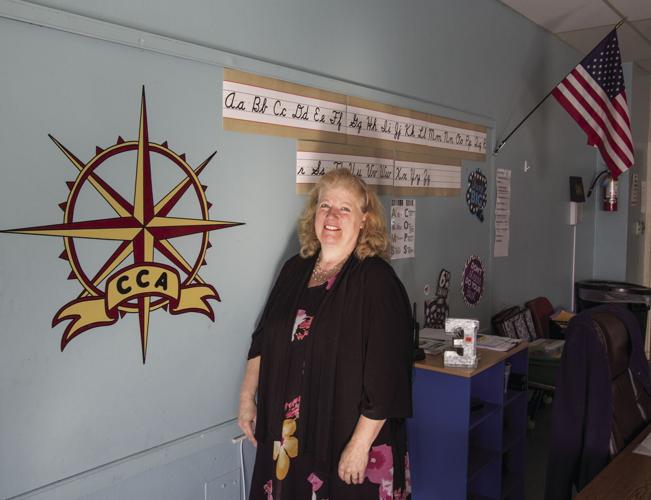
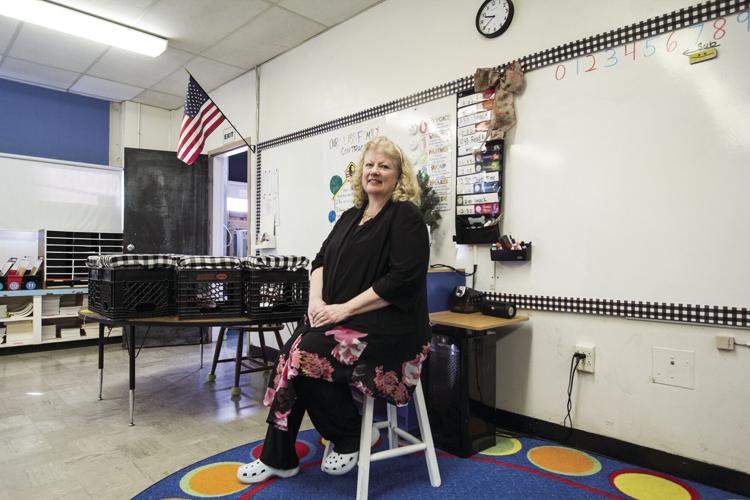
Donna Dube, who taught math for many years at Winnisquam Regional High School, left a job at the state Department of Education to become the Title 1 teacher at Compass.
“I believe in this school, and see a need and a purpose for a charter school in this area,” said Dube, who commutes daily from Campton. “Every day’s a new day with a student. Where are you today? What do you need to get to tomorrow and graduate? We have to stop the blame game,” she said. “They come with enough baggage” — including not having dependable meals, enough winter clothes or peace at home.
Dube’s goal is to help students seize a bright spot on the horizon by teaching them what they need to get there, including for standardized tests.
One of her former students who joined the U.S. Marines Corps told her, “You are the only one who helped" me.
Compass Classical Academy’s first senior class graduates in June.
Shannon Hill’s daughter, who has attention deficit disorder, left Franklin Middle School after fourth grade, where she fell behind and brought home straight F's. Her missed assignments piled up but were usually forgiven and forgotten, her mother said. At Compass, with stiffer demands, more accountability, one-on-one help, and practicing until she was ready to move forward, she scored B's and C's, then later, A's and B's. Today, as a high school junior, she works hard, reads regularly and manages her course load — and she thinks of herself as a scholar, not a failure.
“They never gave up on her,” Hill said. “She’d have fallen through the cracks if I didn’t make that move. She has a hard time learning and retaining information. With the push they gave her, she’s doing really, really well. She’s not sure what she wants to do yet, but she’s thinking.”
Today, New Hampshire’s 30 public charter schools serve borderline students who might flounder and lose interest in conventional teach-to-the-middle range classrooms — and eventually give up and drop out. That includes kids who thrive in much smaller settings and others who flourish with tougher challenges in a classroom with peers with similar skills and interests, including in science, math and technology. Each public charter school is evaluated every five years and must prove that it is living up to its stated mission.
“It’s not a general-ed mission of everything to everybody,” said New Hampshire Education Commissioner Frank Edelblut. “Individuals for whom that mission makes sense are able to find a home. We’re building an innovative learning environment that’s going to reach kids.”
The kids served best by the state’s tuition-free charter schools are “round pegs. We keep trying to put them in a square hole,” Edelblut said.
Today, New Hampshire’s public charter school enrollment represents slightly less than 3% of the state’s public elementary and secondary school enrollment.
Judy Tilton, a public school paraeducator with a teaching background in early education, started Compass seven years ago after attending an information session on charter schools, and with encouragement from the parent of a special needs student. Today, the school serves 55 children in grades 9 through 12, and 100 in kindergarten through grade 8 — up from a total of 30 kids when it opened in 2015. The name "Compass" represents guiding students to excellence, she said.
“The big thing is small class sizes. It’s a small school and their children won’t get lost,” said Tilton, the school’s director.
Kathy Rago’s son with Down’s syndrome aged out of public school when he turned 18 in June. Before transferring from a special education program in a public school to Compass, “he spent most of his time swinging in a room,” Rago said.
At Compass, speech and occupational therapy improved his oral and fine motor skills. He took mainstream academics such as science and history in classes with students without disabilities.
“It’s a safe place with strong academics,” said Rago. “In class, they could have him read and other kids were patient with him. He was incorporated into the school and treated just like the other kids.”
Now, with a busy life that includes working at Smitty’s Cinema in Tilton — where he rolls silverware, cleans menus, vacuums the carpet and washes down arcade games — plus his volunteer days at a food pantry, a thrift shop and a small farm where he feeds chicken — “He’s a happy adult,” Rago said. “All of his experiences have given him confidence. He likes to get out and do things and meet people.”
Compass’ mission is to prepare students for life.
“Whether for the military, the workforce, two- or four-year colleges, we try to create good citizens,” Tilton said.
Modeled after a traditional approach to academics and studies of Western civilization — including studying original texts — pioneered at Hillsdale College in Michigan, which accepts no federal funding, it’s a close-knit environment with clear expectations and a focus on nurturing a work ethic.
During an unannounced visit by a reporter to the school, a student carried out a bag of trash while three others swept the hallway stairs.
Some kids ask for chores to pass the time if they’re bored during study hall. All students are charged with cleaning and vacuuming their classrooms at the end of the day, which teaches responsibility and saves money on maintenance, Tilton said.
The school’s main outside source of revenue comes from Thursday night bingo in the gym. A banner on the wall reads “Caller, caller, make me holler!” The kids do set up and tear down for the weekly game, which draws bingo regulars who hop between venues on successive nights.
Another source of income is the Compass Classical Academy Thrift Store on Main Street in Tilton, where Compass students volunteer arranging clothing, operating the cash register and opening and closing the shop, which is open Thursday through Saturday. For many, it functions as vocational education.
The students raise money for special extracurricular activities and out-of-town excursions. Last year, the school launched a FIRST LEGO League called the Classical City Shapers.
The school’s more advanced robotics team designed an underwater robot that navigated an obstacle course and completed tasks such as opening a box, which required creating a lever or hook plus a turning nob.
“It gives them a little bit more challenge,” said Beverly Learned, the school’s administrator and robotics head. “It’s taking normal hardware things and showing them they can build these crazy robots.”
This year, five middle and high schoolers on the school’s “Sea Perch” underwater robotics team placed 13th out of 26 schools in an international competition in Maryland, which included contestants from Korea, Japan, New Zealand, Qatar, plus schools across the country. The Compass students raised $5,000 in five weeks to pay for their trip by asking local businesses to sponsor them, putting out donation cans at local convenience stores, and holding raffles and bake sales.
“The children were competing with some other children who were sponsored by the Navy, including some kids in fatigues,” said Tilton. “More than the competition, it was the camaraderie and sportsmanship that was amazing.”
This year, Compass Classical Academy took a field trip to Castle in the Clouds in Moultonborough, a mountaintop estate turned event venue. To prepare they researched English Tudor history, came up with characters they wanted to portray, and made costumes after learning to sew. They spent the day talking and interacting in character while pretending the castle was their workplace or home.
At Compass, they wear uniforms, which includes a polo shirt with the school’s logo.
“Uniforms level the playing field,” Tilton said. “Children aren’t bullied or picked on for their clothing choices.”
The gymnasium is split into a cafeteria at one end, with second-hand lunch tables donated by the Oyster River School District and a Catholic school in Sanford, Maine.
On the gym’s stage, behind a plywood wall, are racks of uniforms that children can trade up to without having to buy new ones each year.
The school functions as a food pantry site for the New Hampshire Food Bank. This came about after Tilton asked a young student why he wasn’t opening his milk carton at lunch. He answered, “If I can bring home four of these, we’ll have enough to have cereal for dinner.” Now, the kids raise money for food baskets that go to homes at Thanksgiving and Christmas.
After school, some students head to sports and activities in their local school districts. But the majority stay to participate in the school’s 4-H program.
A banner on the gym wall lists each year’s school winners of the National Geography Bee. The annual champions progress to a state competition, and the winner heads to the nationals.
In the younger grades, technology use is kept to a minimum. The emphasis is on pen and pencil work. Studies have shown this increases learning and retention by deepening the brain’s connection with the subject matter. Kids also learn to write in cursive.
“We teach off the founding documents. If you can’t read cursive, you can’t read the Declaration of Independence and the Constitution,” Tilton said.
Resting in the school office, Tilton’s two cinnamon-colored Nova Scotia duck tolling retrievers function as therapy dogs for students who need a break from class and like to read to them. The American Kennel Club provided books.
In 2020, at the start of COVID, the school purchased a 103-acre farm in Sanbornton for $389,000, where Tilton hopes eventually to build a larger school. In the meantime, the site is used for archery, beekeeping, and tapping trees for maple syrup, all activities that are part of 4-H.
For the school’s science teachers, the farm is a laboratory for exploring plant and animal life. A telescope is set up to view the night sky. An astronomy professor at Plymouth State University drives from his home in Twin Mountain to lead Compass students on a tour of the heavens.
Realizing it will take years to raise money to construct a school on site, and because the academy is running out of space at the St. Gabriel Parish Center, Compass put in a bid in June to buy the empty Union Sanborn School in Northfield, which was later evaluated at $4.2 million. The early-1900s-era school building needs as much as $2 million in repairs and upgrades, according to a report from the Winnisquam school board, which has tabled Compass’s more modest offer. By law, charter schools must be considered to purchase abandoned public school buildings in New Hampshire.
During her spare moments, Tilton looks wistfully at an aerial view of the farm, which hangs like a trophy and a reminder of money well spent — plus endless possibilities for the future, many of which can be realized now.
“Introduce them to everything and they can decide what they want to do later,” Tilton said, after listing activities the kids enjoy doing there, like gardening. “You never know what will capture their imagination.”


(0) comments
Welcome to the discussion.
Log In
Keep it Clean. Please avoid obscene, vulgar, lewd, racist or sexually-oriented language.
PLEASE TURN OFF YOUR CAPS LOCK.
Don't Threaten. Threats of harming another person will not be tolerated.
Be Truthful. Don't knowingly lie about anyone or anything.
Be Nice. No racism, sexism or any sort of -ism that is degrading to another person.
Be Proactive. Use the 'Report' link on each comment to let us know of abusive posts.
Share with Us. We'd love to hear eyewitness accounts, the history behind an article.