


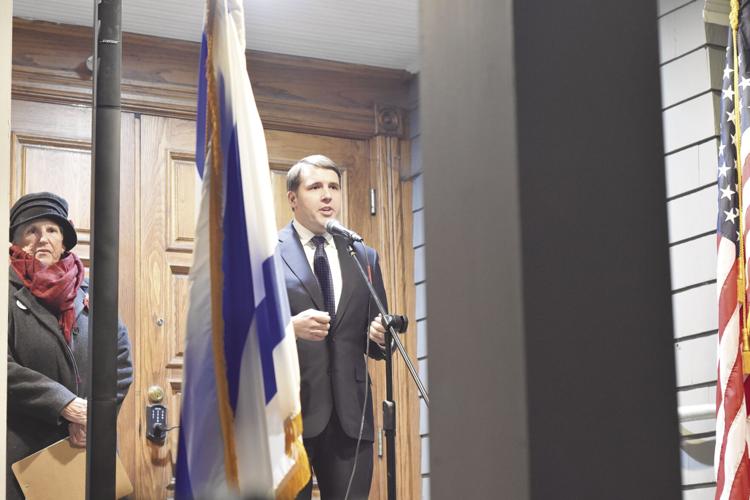
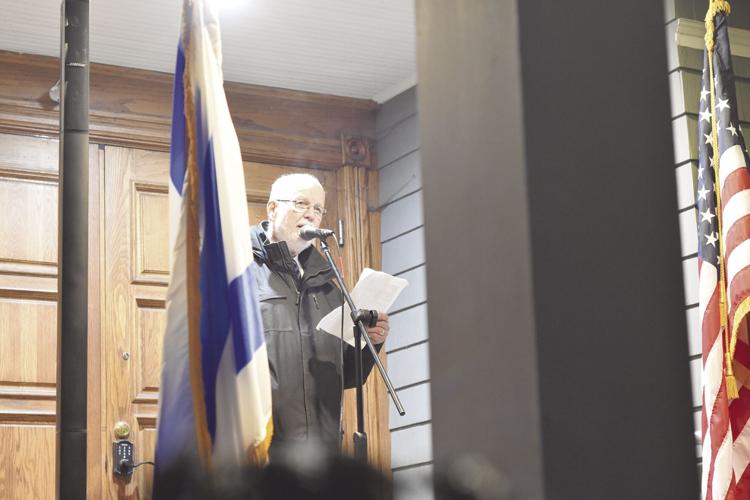

LACONIA — The atrocities that occurred on “Kristallnacht” took place in Germany 85 years ago, but for the speakers who addressed a crowd of about 60 at Temple B’nai Israel on Thursday evening, the violence of that night didn’t seem terribly long ago, or far away.
“Kristallnacht,” often translated as “The Night of Broken Glass,” refers to a wave of vandalism and assaults against Jews, synagogues and Jewish-owned owned properties on Nov. 9-10, 1938. While it was presented by Nazis as a spontaneous eruption of anger by the public, in response to the shooting of a diplomat in Paris days earlier, the U.S. Holocaust Memorial Museum describes it as an engineered campaign, instigated by Nazis, which marked the beginning of the Third Reich’s systematic oppression of the Jewish population.
Rabbi Jan Katz, whose address was read by temple President Ira Keltz, referred to the phrase by George Santayana, “Those who do not learn from history are doomed to repeat it.”
Katz wrote that as the Nazi purge of Jews was beginning to take shape, American leaders, and even Jewish Americans, were largely silent, though Kristallnacht was “Germany’s bloodiest assault on Jews since the Middle Ages.”
“Thankfully times have changed,” Katz wrote, and when antisemitic graffiti was discovered in the city earlier this year, there was quick and loud condemnation, both from faith communities as well as from public officials.
Yet, some things have brought echoes of history. Since the outbreak of war between Israel and Hamas, antisemitism has been rising worldwide, leading some to consider hiding their ethnic identity to avoid attracting hatred — much the same as was done decades ago.
“At this moment in time, antisemitic acts have been ignited in the U.S. and all around the world, and they are increasing at a staggering pace,” Katz wrote. Such acts were not tolerated immediately after the Holocaust, “but today it has been given free license by power-hungry demagogues and those who would rather denounce others who are different in any way at all rather than acknowledge them as part of the human family,” Katz wrote.
“Yet, here in Laconia and in the Lakes Region, we know we are not alone. You are with us and show us the power of empathy. Let us forge ahead together as a resource to our communities, to speak about and to model kindness, calm and thinking reactions, restraint of anger, revenge and violent behavior. With empathy we can water the seeds of what we hope will be,” Katz wrote. “As we say in Jewish tradition, kein yihiye ratzoni — may this come to pass.”
Those gathered on the front lawn of the temple, on a cold, wet night, included several representatives of city government, including Councilor Mark Haynes and Planning Board Chair and state Rep. Charlie St. Clair, as well as representatives of community organizations. The list of speakers included David Stamps of the Laconia Human Relations Committee, and pastors from the Unitarian-Universalist Society of Laconia and the Congregational Church of Laconia.
Mayor Andrew Hosmer wrote a message of support, which was read to the crowd by Steve Tucker, superintendent of schools. The message was about how education was employed as a tool of propaganda and indoctrination by the Nazis, which is contrasted by the local vision of education.
“Children learn better when they feel safe and feel like they belong. Isn't that what we want in Laconia, in New Hampshire, and in the United States?”
Rep. Chris Pappas, who represents Laconia as part of the state’s 1st Congressional District, said that it’s tempting to think that intolerance is something that happens elsewhere — but that it’s still a possibility anywhere.
“There’s hatred in our community. And unfortunately, we have seen antisemitism rear its ugly head, even here in Laconia. And I’m just grateful about the way that the community has pulled together in response to that, and said, with one voice, that there is no place for hatred and intolerance, whether it’s here in Laconia, or any other community across our great country or around the world. Thank you for being part of that response.”
Pappas referred to the words of the late Tom Lantos, a Holocaust survivor who went on to serve in Congress as a representative of California.
“He would often speak about human rights, and about democracy and about the need to understand how fragile what we have is,” Pappas said. “What Tom Lantos often said is that the veneer of civilization is paper-thin, and we are its guardians, and we can never rest.”
The lesson from history, Pappas said, “starts with stamping out history where we see it, and not repeating the mistakes of the past, including those from 85 years ago, when too much of the world was silent when the Jewish people were subjected to horrific atrocities in Eastern Europe. So we all have to say ‘never again,’ and pledge to continue to work together to created a better future, a brighter future for everyone.”





(0) comments
Welcome to the discussion.
Log In
Keep it Clean. Please avoid obscene, vulgar, lewd, racist or sexually-oriented language.
PLEASE TURN OFF YOUR CAPS LOCK.
Don't Threaten. Threats of harming another person will not be tolerated.
Be Truthful. Don't knowingly lie about anyone or anything.
Be Nice. No racism, sexism or any sort of -ism that is degrading to another person.
Be Proactive. Use the 'Report' link on each comment to let us know of abusive posts.
Share with Us. We'd love to hear eyewitness accounts, the history behind an article.