


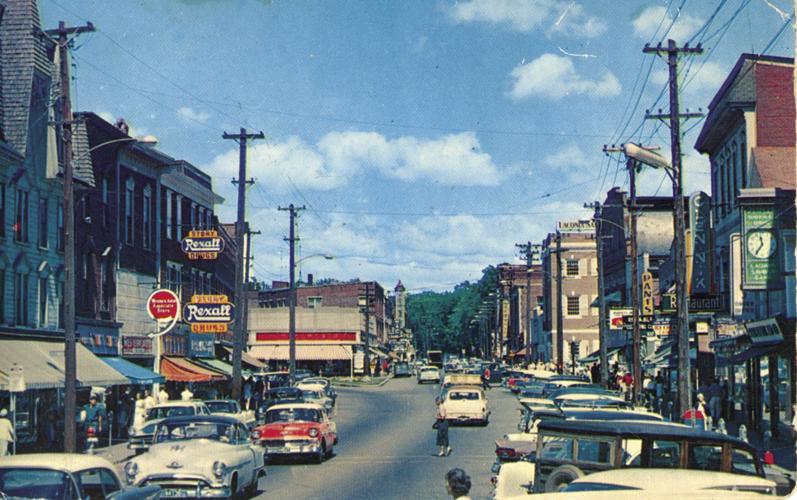
LACONIA — Today’s festivities mark the 125th anniversary of this community’s incorporation as a city — bringing to mind a wealth of events and changes that have occurred during the century and a quarter since 1893.
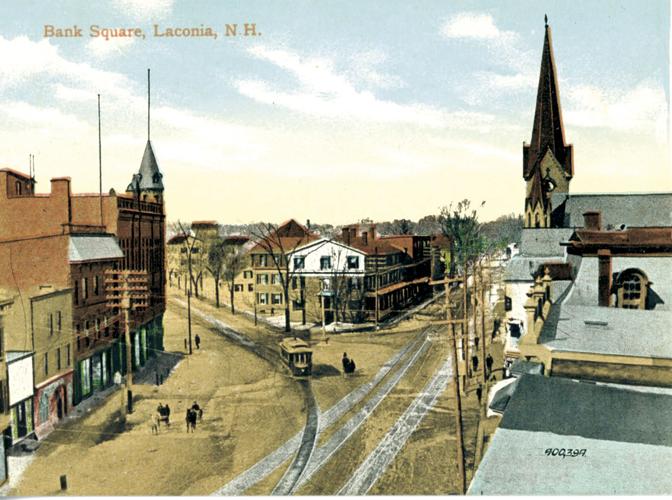
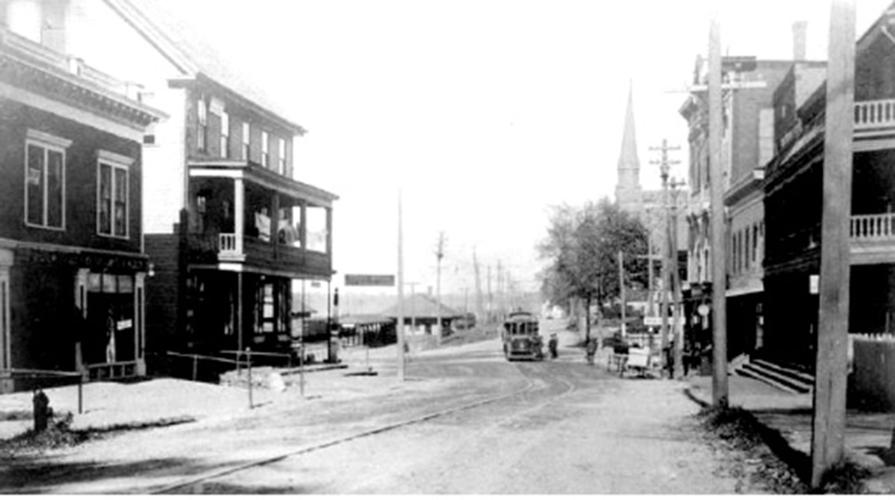
For one thing, back in 1893, the streets were mostly unpaved and clouds of dust rose in the summer while mud puddles plagued pedestrians when it rained.
Outside the city, the roads were primitive at best, narrow, rutted, largely unmarked, twisting and turning, crossing narrow bridges. To the south, Route 106 was still a long time in the future and highway traffic to Boston generally went via Franklin and its long wooden covered bridge.
Motive power was the horse and the ox; automobiles did not become common until well after 1910 and, even then, were usually put up on blocks for the winter.
Most houses throughout the city had a barn, primarily to accommodate a horse or horses, but often other livestock as well.
Transportation by rail — which had reached Laconia in 1848 — was the preferred means for both people and goods, especially over long distances.
The Lake Shore Railroad, opened in 1890, connected Lakeport with the Seacoast, via Alton, for the next 45 years until the last of its passenger trains pulled into Lakeport in 1935 and the rails were taken up.
Long-distance road traffic effectively ceased during the winters, when roads were “rolled” to compact the snow for sleighs; opening the road to Boston in the spring was a significant event well into the 1920s.
It was only in the 1960s that the Interstate Highway system reached Exit 20 in Tilton.
Between 1963-68, a Laconia Bypass was constructed from Route 3 to Route 11 near the airport.
Industry, Urban Renewal, wars
Over its years as a city, Laconia has seen large-scale production of railroad and trolley cars, knitting machinery and needles, hosiery, shoes, skis, wood products and industrial components of many kinds. Today, the residual operations from the past have been joined by aerospace and high-tech products such as heat sinks, industrial-grade ball bearings and parts for space ships and nuclear submarines.
Long a center of retail, service and professional activity, the city continues these functions, along with governmental functions at the city and county levels.
Increasingly, tourism and related industries have become a larger part of the economic mix.
Fifty years ago, the city underwent an Urban Renewal Program, designed to strengthen local business and improve housing for residents. At the same time, other forces, such as the development of malls and strip malls — and, more recently, the digital revolution of the last part of the 20th century and first part of the 21st — the Internet, electronic banking and shopping, etc. — have had an impact on the traditional Downtown, here as well as elsewhere.
In any event, the face of Downtown Laconia was forever changed by its Urban Renewal Program and by a second, similar, effort in the 1980s, called the Downtown Revitalization Program, which created a large parking lot in the middle of the northern half of the business district and modernization of infrastructure and utilities.
A few short years after Laconia became a city, once again its citizens were called upon — as had generations before them — to take part in the Spanish-American War. The city’s Company K of the National Guard served in Georgia while awaiting a call to overseas service that never came. Nonetheless, several members died of disease during their period of service.
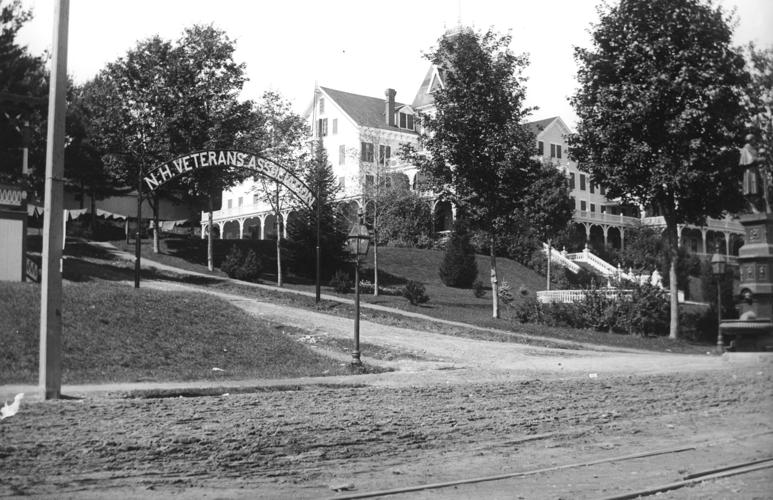
World Wars I and II, Korea, Vietnam, Iraq and Afghanistan, as well as other military actions, all called on Laconians to serve — many to make the supreme sacrifice. The Memorial Park in Veterans Square names many of these, while veterans of the Revolution, War of 1812, Mexican-American and Civil wars are remembered elsewhere.
The stock market crash of 1929 and the Great Depression that followed had their effect on Laconia, but to a far lesser extent than in the major metropolitan areas. Nonetheless, city and county “relief” were administered throughout the period and major efforts were made to put as many people to work as possible. The CCC, WPA and the rest of the alphabet-soup agencies of the New Deal became everyday facts of life.
City manager, departments
Coincident with the Urban Renewal Program, the city changed, in March 1971, from the mayor and council form of government to the city manager-council system. During the ensuing nearly five decades, there have been four permanent managers — Kenneth Boehner, Daniel McKeever, Eileen Cabanel and Scott Myers — in addition to several officials who acted in an interim capacity.
Another branch of city government marked by long tenures has been the Department of Public Works, whose directors have often tended to come from a military background and who have served for decades. Army Lt. Col. Charles French, who paved and plowed city roads and built bridges from 1906 to 1941, may have had the longest tenure, but Arnold O’Mara, Marine Col. Frank DeNormandie, Army Col. Frank Tilton and Paul Moynihan all held the post for many years.
Probably no official, elected or appointed, could match the tenure of Fire Chief Arthur W. Spring, whose service had spanned almost the entire first half of the 20th century, when he retired on June 1, 1949. He had joined the Fire Department in 1898, becoming chief in 1904.
Other chiefs since Chief Spring have included Merle Sargent, Louis “Bud” Wool, George Landry and Kenneth Erickson.
A forthcoming book by Laconia’s Gerald Bourgeois will trace the history of the LFD from its beginnings to the present; publication is expected this summer.
The Laconia Police Department has likewise known a series of longtime city marshals and chiefs, including Charles A. Harvell, George Hubbard, Charles “Mickey” Dunleavy, Harold Knowlton and Bruce Cheney and, in recent years, Bob Babineau, Bill Baker, Mike Moyer, Chris Adams and Matt Canfield.
Since 1893, the city has seen the building and replacement of several elementary schools, the building and rebuilding of a Middle School and the building, and several expansions of, the High School — the most recent being the addition of the J. Oliva Huot vocational-technical center wing in 1983, with a new building in 2013.
From 1965-1969, Gunstock Junior College conducted classes in Lakeport; and, since 1968, the two-year institution now known as Lakes Region Community College has conferred associate’s degrees and certificates on thousands of students.
Hospital, transportation
When Laconia became a city, there was no hospital and house calls by doctors were the norm. The first move in providing a centralized place for medical care came five years later, in 1898, with the opening of a cottage hospital on Court Street in a former dwelling. (It’s still there, at No. 118.)
Land for a new medical facility was given in 1905 and the Laconia Hospital opened, at the top of Elliot Street, in 1908.
That building, much added to, now no longer exists, but Lakes Region General Hospital has undergone numerous expansions over the years. Until 1969, the hospital also conducted a school of nursing.
Until well into the fourth decade of the 20th century, doctors maintained offices in their homes or in business blocks but, in 1937, eight local physicians organized the Laconia Clinic, just north of the railroad tracks in Downtown Laconia. Eventually, the Clinic became a part of Lakes Region General Hospital.
In 1966, with one staff member and a $39,000 budget, the Lakes Region Mental Health Center opened. Five decades later, as Genesis Behavioral Health, having ministered to the mental health needs of the community in a number of scattered locations, the nonprofit organization renovated and remodeled several former bank buildings into a consolidated facility in the heart of Downtown and took back its earlier name.
Transportation within the city in 1893 was by foot, horseback or wagon, or by the Laconia and Lake Village Horse Railway, whose rails started on South Main Street and extended to Lakeport Square.
In 1898, the line was electrified and, in 1899, extended to The Weirs, together with a rudimentary Weirs Boulevard along the shore of Lake Paugus. It would be another 20-25 years before the boulevard was improved significantly.
Water, Sanitation, Trash
In 1885, eight years before Laconia became a city, a private water company began operations at Lakeport. The city voted to purchase the utility in 1955 and it has been the Water Department since then. Covering the open-air reservoir off Stark Street and installation of a state-of-the-art water treatment plant in 1989, with an upgrade in 2015, have markedly increased the security and quality of the city’s water supply.
The city’s sewer system was just beginning to function in 1893, having seen the first connections, at the Laconia end of the city, just the previous year.
It would be decades before Weirs Beach was connected to the city sewer and water systems, in 1967 and 1990, respectively.
In this regard, although the town of Laconia began installation of a sewer system in 1892, and a primitive treatment plant was built at The Weirs early in the 20th century (dumping the effluent directly into the Weirs channel and, thus, Lake Paugus), the first overall treatment plant was not built until 1952 but, even then, the resulting effluent was discharged directly into Lake Winnisquam for the next 25 years until completion of the Winnipesaukee River Basin Project in 1979, which conveys sewage to Franklin Falls for treatment.
The actions of a local group of concerned citizens, The Lakes Region Clean Waters Association (among whom Laconia’s Peter Karagianis and Esther B. Peters were prominent members) to clean up Lake Winnisquam led to the creation of the Winnipesaukee River Basin Program, resulting in construction of a public sewage disposal pipeline system and facilities serving portions of the Winnipesaukee River Basin communities of Center Harbor, Meredith, Laconia, Gilford, Belmont, Sanbornton, Tilton, Northfield, and Franklin.
Following passage of the Clean Waters Act in 1972, the EPA and its administrator, William Ruckelshaus, were “looking for a demonstration project and the Lakes Region effort was a natural fit.”
Construction of the Winnipesaukee River Basin Project was among the first to be funded by the then-new Environmental Protection Agency, which had been established in 1970, and became a model for other similar systems.
Airports, industrial parks
Meanwhile, travel by air gradually expanded locally from Harry Atwood’s first exhibition flights during a 10-day visit in July 1912 at The Weirs to construction of an airstrip off North Main Street in Laconia in 1934-35 and a larger and more sophisticated Laconia Airport at Sawyer’s Meadow in Gilford in 1940. Over the years since then, the facilities and capacity of the airport have been expanded, now accommodating jet aircraft.
Another 1960s development saw the first buildings in the O’Shea Industrial Park, north of the city on land earlier part of the Belknap County Farm holdings. In the early 2000s, a Lakes Industrial Park was built to the south, partly in Gilford as well as Laconia. Yet a third such facility, the Blaisdell Avenue Industrial Park, was developed near McIntyre Circle.
The headquarters of the White Mountain National Forest called Laconia home from the 1920s until it relocated to Campton in 2009. In 1939, a WMNF Forestry Building was erected on North Main Street, opposite the Laconia Clinic. Later renamed the Federal Building, the structure is now home to Lakes Region Family Services.
Among the city’s other public edifices, the Gale Memorial Building of the Laconia Public Library was dedicated in 1903, with an addition in 1957 that was removed in 2004, redesigned and rebuilt — with a grand reopening in 2005.
City offices made do in a sequence of already existing buildings from 1893 to 1972, when the first City Hall designed for the purpose was erected at the current site. Expansion and redesign occurred in 1985-1986, along with installation of an elevator and handicapped facilities.
A series of Central Fire Stations and satellite facilities were built and occupied over the years, but renovation and expansion of the 1974 structure on North Main Street were completed in 2015.
Likewise, the Police Department occupied makeshift quarters in a number of venues until its first, specifically-designed-for-it, building opened in 2003.
The Public Works Department, as well, had various homes in addition to an office in the various city halls before centralizing its activities on Bisson Avenue in 2003.
Arts, music, culture, sports
From the days before the town became a city, Laconia sported two opera houses playing host to plays, concerts, lectures, graduations and other events, including silent movies with piano accompaniment.
In 1914, the Colonial Theater opened on Main Street and, in 1927, the Gardens Theater began screening films across the street in the Pemaco Block.
In 1949, a drive-in theater opened at The Weirs and, at this writing — one of a vanishing breed — is still projecting current movies.
Also at The Weirs, a series of music halls — and, later, Irwin’s Winnipesaukee Gardens — provided dancing, movies, bowling and other amusements and, on Sundays during the summers, even church services.
From 1950 until its demise in the early 1980s, the Lakes Region Playhouse, in Gilford, offered straw-hat summer theater.
Successor to earlier little theater groups, the Streetcar Company began production of plays and musicals in 1972. In addition to the standard repertoire, Streetcar premiered and has restaged “The Great Winnipesaukee Steamboat Race and Musical Talent Contest,” at least eight times. Former Citizen reporter Bob Kinerk wrote the lyrics and Andrew Rosenthal, the music.
The city has a long history of dance studios and instruction.
The Laconia (now Lakes Region) Art Group has nurtured painters and other visual artists. For many years, Frates Creative Arts offered instruction on Canal Street until Proprietor Larry Frates moved to the Belknap Mill in 2016 as artist-in-residence.
Over the years, the city has seen many musicians, and composers, bands, orchestras and combos, classical, pop, rock and beyond. The churches of the city contain a number of fine pipe organs.
Laconia people were prominent among the founders of the New Hampshire Music Festival in 1952. The festival opens its 2018 season at Plymouth State University’s Silver Cultural Arts Center this month.
Generations of Laconians remember the Laconia Bowling Alleys, originally on Mill Street but for many years in the basement of the Tilton Block.
Motorcycle Weekend and Motorcycle Week have been a part of June in Laconia since 1938.
Beginning in 1927, annual championship sled dog races have been scheduled each February.
Winter carnivals, featuring ice skating, skiing and ski jumping, were popular during the 1930s and, starting in the late 1930s with the construction of the Belknap Mountains Recreation Area (now Gunstock), winter ski jumping championships were a recurring event and ski trains brought winter sports enthusiasts from Boston several times each season. During the 1940s and 1950s, summer ski jumping on crushed ice was another novelty.
During winters with appropriate snow cover, the sport of snowmobiling has become popular. Two fishing derbies on nearby lakes are also conducted.
One of the recent additions to the physical fitness scene — in addition to a proliferation of health clubs and gyms — has been the Winnipesaukee-Opechee-Winnisquam Trail, which currently runs from near Mosquito Bridge in Winnisquam to Lakeport Square.
Newspapers had existed here since at least 1831, and the weekly editions of The Laconia Democrat and The News and Critic served the new city into the 1940s. Several efforts toward publishing a daily newspaper had brief runs but, in 1926, Edward J. Gallagher began publication of The Laconia Evening Citizen, which continued for 90 years until its farewell edition, Sept. 30, 2016.
Meanwhile, a free daily, The Laconia Daily Sun, issued its first edition in 2000 and continues today.
Laconia had one of the earliest radio stations in the country, WKAV in 1922, which became WLNH in 1934.
Television came to Laconia, along with the rest of the country, after World War II. The city had one of the earliest cable providers in Community TV which, in 1951-52, erected an antenna on Mount Belknap, from which the TV signals were conveyed to individual homes.
Public Access Television made its debut, in 1999, on Channel 25, from a studio at Laconia High School.
Video stores in the 1980s and the increasingly-permeating influence of the Internet and the rest of the digital revolution have come to the city, the region and the world.


(0) comments
Welcome to the discussion.
Log In
Keep it Clean. Please avoid obscene, vulgar, lewd, racist or sexually-oriented language.
PLEASE TURN OFF YOUR CAPS LOCK.
Don't Threaten. Threats of harming another person will not be tolerated.
Be Truthful. Don't knowingly lie about anyone or anything.
Be Nice. No racism, sexism or any sort of -ism that is degrading to another person.
Be Proactive. Use the 'Report' link on each comment to let us know of abusive posts.
Share with Us. We'd love to hear eyewitness accounts, the history behind an article.