


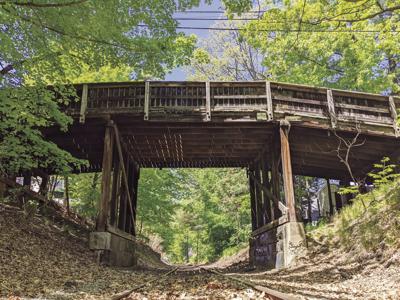
LACONIA — The Centenary Avenue bridge could soon be renovated or replaced, providing more reliable access to the Weirs' campground neighborhood.
Residents expressed concern that without the bridge in service, the only other point of access through the summer to the neighborhood is via Centenary Avenue's intersection with Lakeside Avenue near Akwa Marina, and the road is often blocked by large delivery trucks or other traffic.
The Centenary Avenue bridge, which was rebuilt in 1940 and is the last timber bridge in the city, provides a narrow and steep crossing over a Patriot Rail line between Lakeside Avenue and Weeks Street. The wooden deck was replaced between 2016 and 2017, and the bridge is eligible for historic status. Residents have expressed difficulties using the bridge in the past.
“We have a lot of covered bridges in New Hampshire, they’re covered to prevent water from getting on the wooden boards. So this is an uncovered bridge, so it is subject to that water causing advanced deterioration of wooden components,” Chris Fournier, HEB Engineers vice president of structural engineering, said during a public meeting on the evening of May 15 to discuss the early stages of the project.
Throughout the process, the city has come to an understanding with the New Hampshire Department of Transportation, which owns the Centenary Avenue bridge, whereby the city would take ownership of the bridge following renovations and assume responsibility for future maintenance. The bridge was added to the state’s “red list” in 1991, meaning it is overdue for repair and rated 3 out of 9, defining it as in “serious” condition.
“The state’s plan was to take the bridge down, everyone here came to the meeting and convinced the state that was a bad idea and the executive council member convinced DOT to keep the bridge, but part of the deal was the only way they’d do it is if they turned it over to us,” Public Works Director Wes Anderson said. “That’s why we got 100% funding, because they want us to take over maintenance after that. It was your efforts back during that 10-year plan that resulted in keeping the bridge.”
The project, still in its infancy, will be funded by the federal government at no expense to the city. The city must manage the project through all stages and NHDOT must review and approve each phase.
“New Hampshire DOT ... is administering the project on behalf of the Federal Highway Administration. And Federal Highway, they’re committing 100% of funding of this project, so it is completely federally funded,” Fournier said. “I don’t see that very often at all, so it’s a pretty fortunate situation for the city."
The seven-span bridge has 18 feet of clearance over the railroad and — because of the steep approach — is not accessible during the winter months. The Weeks Street end of the bridge is sloped at 14%. It’s 121 feet long and measures just 22.6 feet wide. Any renovation to the bridge will likely need to increase its load-bearing capacity from seven to 40 tons.
“The timbers, they’re not in great shape. I think that’s just a blanket statement for the entirety of the construction,” Fournier said.
State law requires bridges to maintain 22.5 feet of clearance over railways, but the city may be able to retain the status quo because Patriot Rail operates a scenic railroad, not one intended to move freight cars.
The process will be drawn out and intricate. The city's next steps include working with the engineering team to establish a need statement; identifying design standards; evaluating multiple alternatives; selecting an option; another public information meeting in late summer or early fall; and finally the design process.
The city must follow these steps to the letter in order to satisfy federal funding requirements.
“Because it is a city managed project but 100% federally funded, it is the city’s decision on what to do, but it must check all of the boxes of the purpose statement,” Fournier said. “It’s very important to get that purpose and need right because it will dictate the preferred alternative for the project.”
The plan cannot be revealed until the process is complete, but city employees expressed their intent to work with the community to ensure minimal disruption to daily life to complete the project.
“Preferences would be winter time, when no one is up there,” Anderson said. “We’re doing Academy Street bridge replacement, we’re doing that in the summertime, so we don’t have to worry about school buses trying to cross over. We try to plan it based on what makes sense for the city’s residents.”
Assistant Public Works Director Nate Guerette said the project could be completed quickly or could end up being long and drawn out, depending on its specific design and construction requirements.
“It will be more than three months, less than three years,” Guerette said.
The project cannot be confirmed until the federal process is completed, but city leaders expressed strong interest in renovating or replacing the bridge.
“We still have to go through the full federal process, which means we have to look at all other options,” Anderson said. “We can’t say we’re keeping the bridge until we finish the process. ... We have to consider certain options, because that’s what the federal government says in their process.”


(0) comments
Welcome to the discussion.
Log In
Keep it Clean. Please avoid obscene, vulgar, lewd, racist or sexually-oriented language.
PLEASE TURN OFF YOUR CAPS LOCK.
Don't Threaten. Threats of harming another person will not be tolerated.
Be Truthful. Don't knowingly lie about anyone or anything.
Be Nice. No racism, sexism or any sort of -ism that is degrading to another person.
Be Proactive. Use the 'Report' link on each comment to let us know of abusive posts.
Share with Us. We'd love to hear eyewitness accounts, the history behind an article.