


(Editor's note: This is the second of a three-part series on Chinooks in honor of the breed's 100th anniversary.)
By ROGER AMSDEN, for THE LACONIA DAILY SUN
TAMWORTH — Arthur Walden, the one-time freight dog handler during the Alaskan Gold Rush, had reached new heights after returning to Kate Sleeper's Wonalancet Farm and Inn in 1902 and marrying Sleeper. He had successfully started a new line of dogs, known as Chinooks, and had gained fame as a sled dog racer and became the first president of the New England Sled Dog Club in 1924.
But, after his team of Chinook dogs proved no match for Leonhard Seppala's Siberian Huskies in a race in January of 1927 in Poland Spring, Maine, Walden went seeking his next adventure. He and his wife had brought electricity and telephone service to Wonalancet and the first hydroelectric dam to Carroll County. Despite his achievements, the bug of exploration was still strong in Walden according to Rick Skoglund, owner of the Perry Greene Kennels in Waldoboro Maine, where the Chinook breed was kept alive.
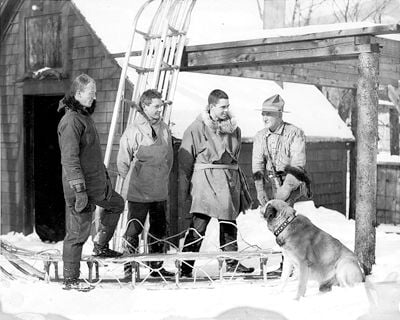
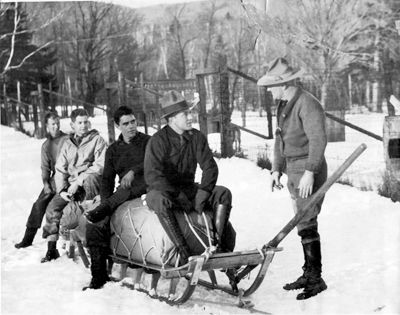
Skoglund writes, "When hearing about the imminent Byrd Antarctic Expedition, Walden applied, though at age 56 was over the maximum age. He was given the duties of lead driver and trainer of all the dogs to be used on the expedition. Walden was also assigned to lead the three men, Norman Vaughan, Freddie Crockett and Eddie Goodale, who helped with the dog teams. Dogs were obtained and sent to Walden's home in New Hampshire. During the winter months of late 1927 and early 1928, dogs and drivers were assembled at Walden's Wonalancet Farm, and training began. Winter survival gear was also evaluated there, in the harsh conditions of New Hampshire's White Mountains.Together the drivers worked for one year training dogs and testing tents and supplies. By this time Chinook was nearing his 12th birthday."
Of the 100 dogs trained for the expedition, half of them were sired by Chinook.
"When the expedition reached the shore of Antarctica in late 1928, there remained little time to unload the ships and prepare a safe living area for the men for the next year before winter set in. All the dogs were worked beyond capacity. Walden's dog teams broke records during that time for amount of loads carried as well as the weight of each load. Admiral Byrd wrote 'Walden's team was the backbone of our transport." When needed, Chinook was put into harness for his help. It was shortly afterwards that Chinook was lost. Many speculated that he left the camp and wandered off, knowing he was dying. Another story speculated that he befell a grave accident, fell into a crevasse and died. In any case, Walden had lost his best friend. Tragically, Walden had wanted to bury his friend in harness, but Chinook was never found."
Chinook's death was written up in newspapers around the world, including The New York Times, which carried the story on the front page, just as it had when Chinook won the first international sled dog race in Berlin, New Hampshire, in 1922.
In an article which appeared in the September 1929 issue of Popular Mechanics, Walden said he believed Chinook had just wandered off to die after having had his sense of leadership of the other dogs broken by a fight with three Huskies several days before he disappeared. Walden said Chinook had been able to fend off his three attackers initially, but Walden himself had to intervene at the end to save Chinook's life. He said that on the day Chinook went missing he had taken him off the lead after passing the worst of the crevasses on the return from the base at Little America with an empty sled, and that Chinook had lagged behind and eventually was not seen.
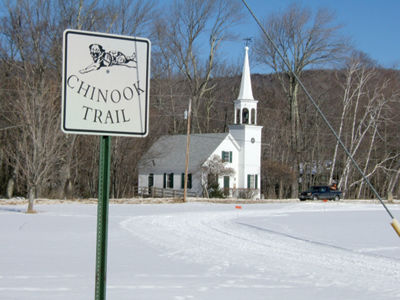
Skoglund writes, "Upon Walden's return home, the people of the area wanted to rename the road that connected the town of Tamworth with Wonalancet to Waldens' Road. He asked that instead they honor Chinook by naming it the Chinook Trail, the name which it still bears today.
"Byrd's expeditionary returned home in mid 1930 to find their families in the middle of the Great Depression, and Walden had returned to hard times as well. Not only was Wonalancet Farm in financial trouble, but Kate Walden, who had always been of frail health, was not well. Walden had brought in Milton and Eva Seeley as kennel managers in 1927 and sold them half interest in his Chinook Kennel before leaving for Antarctica, and the Seeleys had been attempting to care for Kate Walden and keep Wonalancet Farm together in his absence. In settling their accounts upon Walden's return, the Seeleys took complete control of Chinook Kennel, including the dogs and the kennel name, and relocated the operation to a nearby piece of property. While continuing to be active in the sled dog world, the Seeleys put their efforts mainly into breeding Alaskan Malamutes and Siberian Huskies, and discontinued the breeding of Chinooks altogether.
"Julia Lombard, a neighbor of the Waldens, had been captivated early on by the companionable nature of the "Chinook dogs," and Walden was in the habit of occasionally giving Lombard a few choice puppies to raise for him, presumably so that his breeding program would survive epidemics such as he suffered in 1923. Prior to his departure for Antarctica, Walden had given her three puppies: a son of Chinook who carried 25 percent German shepherd blood, and a son and daughter of Chinook who carried 50 percent Belgian shepherd blood. With these three offspring of Chinook, Arthur T. Walden as her kennel director, financial support from the Hubbard family (who operated a small pet food factory in Gloucester, Massachusetts), and later, Ed Moody (a veteran dog driver from Byrd's second expedition) as trainer and driver, Mrs. Julia P. Lombard's Wonalancet - Hubbard Kennel came into being. The bloodlines from these three foundation dogs were crossed, and then selective inbreedings done in the mid 1930s to create dogs consistent with Walden's earlier breeding program, and to create what Mrs. Lombard would call her "purebred Chinooks." Lombard promoted her Chinooks as recreational sled dogs, putting as much emphasis on their companionable nature as their working ability. Lombard also worked two Chinook teams that continued to be seen in the local sportsman shows, and on the winter racing circuit as well."
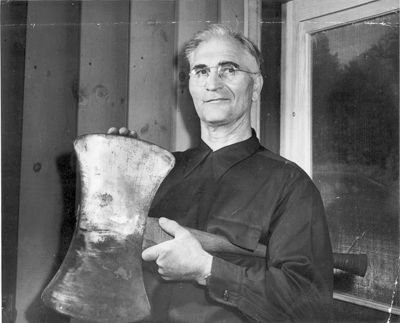
"Lombard (Wonalancet Hubbard Kennels) sold the stock of Chinooks to Perry Greene in October 1940. Greene bought 20 Chinooks and five sleds for the sum of $500. Greene, a legendary Maine woodsman known for his skills with a double-edged ax, then moved the Chinooks to Warren, Maine. During January 1941, Perry and his stepson, Johnny Gephart and seven Chinooks (Walden's trained team) hauled 800 pounds of equipment via dog sled from Fort Kent to Kittery, Maine. They traveled 502 miles in 90 hours, the longest sled dog trek ever made entirely within the United States at the time. Walden's Riki I was lead dog and Trondek, Kima, Erica, Endure, Savik and Salvo completed the team. In 1946 construction of a new facility for the Chinooks was undertaken. In January 1947, Perry and Johnny Gephart completed construction of a log lodge, kennel and store in Waldoboro, Maine. The Chinooks were moved to this location and for the first time were all under one roof.
"During March of 1947, Arthur Walden succumbed to injuries sustained while rescuing his wife, Kate, from a fire in their home. After rescuing his wife, Walden succumbed to smoke inhalation in attempt to extinguish the fire. He died as he lived, a hero, a monument to an era gone by. Walden was buried next to the Union Chapel on the Chinook Trail.
"Perry Greene and his wife, Honey, promoted the breed for many years. Unlike Walden the Greene's did not promote the Chinook as a recreational sled dog but as the "ideal companion dog." They created a mystery surrounding the breed and set up many requirements for those wishing to own a Chinook. If a person wanted a Chinook, he had to stay at the kennels for at least 24 hours. If Perrys' house dogs didn't care for the person, he went home empty handed. Should he need to wash his hands after petting the dogs, he didn't get one either. To ensure that the Greens were the sole breeders of Chinook, an unaltered female was never allowed to leave the kennel and no one person could own more than two Chinooks at one time."
The third and final installment of the history of the Chinooks will detail how the breed nearly became extinct and the extraordinary efforts that went into saving the breed.
Arthur Walden and Chinook with “The Three Musketeers,” Norman Vaughan, Freddie Crockett and Eddie Goodale. (Perry Greene collection)
Perry Greene, famed Maine woodsman noted for his skills with a double-edged ax, built a kennel where he raised Chinooks. (Perry Greene collection)
Admiral Byrd is seated on sled, with Arthur Walden and “The Three Musketeers,” Norman Vaughan, Freddie Crockett and Eddie Goodale. (Perry Greene collection)
This Chinook Trail sign in Tamworth is near the chapel in Wonalancet, which is located a short distance away from the place where Chinook was born in 1917. (Courtesy photo)


(0) comments
Welcome to the discussion.
Log In
Keep it Clean. Please avoid obscene, vulgar, lewd, racist or sexually-oriented language.
PLEASE TURN OFF YOUR CAPS LOCK.
Don't Threaten. Threats of harming another person will not be tolerated.
Be Truthful. Don't knowingly lie about anyone or anything.
Be Nice. No racism, sexism or any sort of -ism that is degrading to another person.
Be Proactive. Use the 'Report' link on each comment to let us know of abusive posts.
Share with Us. We'd love to hear eyewitness accounts, the history behind an article.