


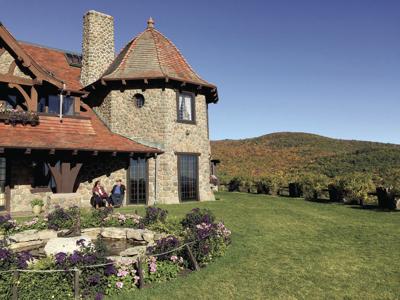
MOULTONBOROUGH — The U.S. Secretary of the Interior has named Lucknow – best known as “Castle in the Clouds” – to the National Register of Historic Places.
Lucknow was the estate of Thomas Plant, a self-made French-Canadian industrialist from Bath, Maine. In 1909, Thomas G. Plant Company was one of the 10 largest shoe manufacturers in the country, and the largest factory in the world dedicated to manufacturing women’s shoes.
Plant purchased several properties to create the more than 5,000-acre estate, which offers 75-mile views across Lake Winnipesaukee and mountains to the west. He personally oversaw construction of several buildings between 1913-14, including the main house, or "castle," a 1-1/2 story building with a clay tile roof which is an outstanding example of the Arts and Crafts architectural movement.
Its exterior incorporates hand-cut brown, gray and salmon stone veneer with hand-hewn white oak timbers secured by mortise and tenon joinery and exposed oak pegs. The front entrance overlooks the Ossipee mountains and is sheltered by a second-story gable-roofed porch.
Lucknow’s floor plan has not changed since it was built. The first floor’s main hall, library and dining room incorporate quarter-sawn oak paneled walls, built-in benches and Italian marble fireplace surrounds. Decorative features include carved woodwork, ornamental iron hardware, bronze lighting features and a plaster ceiling with relief wisteria flowers, leaves and vines. Painted roundels and the second floor’s seven skylights — the largest is attributed to Tiffany Studios — bring the surrounding landscape inside.
Much of the original furniture is still in place and components of the Western Electric Interphone system that connected the main building to the stable survive.
Lucknow’s landscape also contributes to the property’s national significance. It includes a two-mile entry drive and driveway with stone posts and retaining walls, gardens and lawns, a small lake, 40 miles of mountain roads and bridle paths, and terraces linked by stone steps. Family cemeteries, farmhouse cellar holes and stone walls associated with 19th century farming settlement also still exist on the property.
Two conservation easements protect all but 67 of Lucknow’s 5,294 acres. Written agreements ensure that all of the property’s historic buildings, landscape features and acreage will be protected and professionally managed in perpetuity.
Administered by the National Park Service, which is part of the U.S. Department of the Interior, the National Register of Historic Places is the nation’s official list of cultural resources worthy of preservation and is part of a national program to coordinate and support public and private efforts to identify, evaluate and protect historic and archaeological resources.
Listing to the National Register does not impose any new or additional restrictions on the use of private or non-federal properties, but the listing can serve as an educational tool and increase heritage tourism opportunities. The rehabilitation of National Register-listed commercial or industrial buildings may qualify for federal tax provisions.


(0) comments
Welcome to the discussion.
Log In
Keep it Clean. Please avoid obscene, vulgar, lewd, racist or sexually-oriented language.
PLEASE TURN OFF YOUR CAPS LOCK.
Don't Threaten. Threats of harming another person will not be tolerated.
Be Truthful. Don't knowingly lie about anyone or anything.
Be Nice. No racism, sexism or any sort of -ism that is degrading to another person.
Be Proactive. Use the 'Report' link on each comment to let us know of abusive posts.
Share with Us. We'd love to hear eyewitness accounts, the history behind an article.