


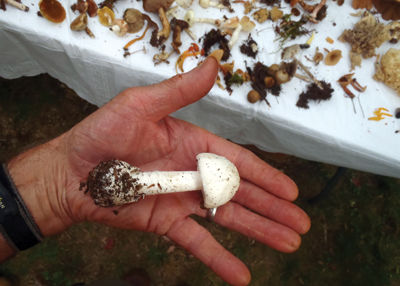
Can you eat it? In this case, NO! The common name for this beautiful white mushroom is the Destroying Angel. See why it’s important to know which mushrooms are safe to eat? (TIM JONES PHOTO)
By TIM JONES, for THE LACONIA DAILY SUN
"Can you eat it?"
That's the first question most people ask when they find a mushroom in the woods or on their lawn. The answer is, you can eat absolutely any mushroom you find. Once. ... Some of those mushrooms will taste awful. Some will send you into psychic neverland. Some will kill you. And some will taste like ambrosia and leave you wanting more. The trick is to know which mushrooms are which. Especially the ones that are both tasty and safe, and the ones that contain deadly poisons.
With that in mind, it was hard to resist the teaser put out by the New Hampshire Mushroom Company for the "Can You Eat It?" mushroom hunting classes they run in the late summer and fall: "Join us here at the farm for a half day mushroom class. Start off with an introduction to mushrooming basics and light appetizers before heading off into the woods to forage for mushrooms. After a good amount of field time we head back for a buffet style mushroom-themed dinner featuring our local organic cultivated mushrooms. The expert mycologist on hand will wrap up the class with an overview of the mushrooms we collected. Please bring water, good hiking shoes, and a basket for collecting."
Sign me up for that! Whether you are an experienced mushroom forager, or just curious about it, the best way to learn about collecting mushrooms (or any other wild edibles) is by going afield with experts. And the promise of excellent eats afterwards, well that's just a bonus!
Located on Gardner Hill Road in Tamworth, the New Hampshire Mushroom Company is a newish barn structure surrounded at this time of year by piles of wood. It could be firewood, and, in this case, it is. They use that wood to heat their structures in the winter. To grow their mushrooms, they get red oak sawdust from a mill a few miles down the road to use as "substrate." Mushroom food, in other words. After the mushrooms are grown and harvested, the used substrate is sold as a soil conditioner.
If you are interested in what it takes to grow mushrooms commercially, the New Hampshire Mushroom Company gives free tours of the farm every Sunday at noon. They produce about 1,200 pounds a week (which is A LOT of mushrooms), selling them to various restaurants and markets around New England. In the Mount Washington Valley, you can find their products at The Local Grocer (nhlocalgrocer.com) in North Conway and at the Tamworth Farmers' Market (tamworthfarmersmarket.org). In the Lakes Region, they sell to E.M Heath Supermarket (heathsmarket.com) in Center Harbor, Sunflower Natural Foods (sunflowernaturalfoods.typepad.com) in Laconia and the Tilton Winter Farmers' Market (tiltonwinterfarmersmarket.com). They are also available New England-wide at Whole Foods Market (wholefoodsmarket.com).
But on this Sunday, at least for the dozen or so participants in the "Can You Eat It" class, the focus was on wild mushrooms, the kind you find and pick yourself. Before we headed for the woods, we got an overview of mushrooms in general and some of the ones we were likely to find that day.
Our expert for the day was Noah Siegel, a Massachusetts native who travels all of North America identifying various fungi and their roles in the larger ecosystem. Noah is co-author (with Christian Schwarz) of Mushrooms of the Redwood Coast, a comprehensive guide to the fungi of coastal northern California.
Among the tidbits Noah offered in his prep talk:
• Fungi are everywhere, and that's a good thing, because life on earth as we know it would not be possible without them. Fungi take plant material (like oak sawdust) and help break it down and recycle it back into the soil where it can grow new plants and new trees. There are fungi to help break down almost everything—including old mushrooms.
• Many edible mushrooms are associated with the specific tree species. To find the mushrooms, you have to be able to find and identify the trees.
• Nobody knows exactly how many different kinds of fungi there are in any given area because new ones are always being discovered. Fortunately, if all you are interested in is mushrooms to eat, you only have to pay attention to the "macro fungi" the ones big enough to see easily and substantial enough to make a meal (or, at least, an appetizer). You only need to be able to identify a few mushrooms to pick and eat them safely.
• The mushrooms we see are just the fruiting bodies of a much larger organism (called the mycelium) that spreads its tendrils through rotting wood or forest duff. Most of the fungus is hidden. Imagine if a giant oak tree was buried in the ground and all you could see was the tiny flowers it sprouts in the spring. The mushrooms you see are the flowers.
• The largest living single organism ever found in the world, known affectionately among mycologists as "the humongous fungus," is the mycelium of a honey mushroom (Armillaria) that measures 2.4 miles (3.8 km) across in the Blue Mountains of Oregon. Yes, honey mushrooms are edible—for most people. About 1 in 20 people has an allergic reaction and gets sick. (I've eaten honey mushrooms without any ill effect, so you can give them to me if you don't dare try them!)
• The one absolute rule to remember is not to eat any mushroom you can't positively identify. "When in doubt, throw it out."
After the lecture, we sampled some wonderful mushroom themed snacks and Chaga tea, which is not unpleasantly flavored (some people like it) and reputed to be medicinal. Then it was off to the forest to actually hunt for mushrooms. We car pooled about 2 miles to the Big Pines Natural Area on Route 113A in Tamworth where, before most of us had gotten out of our cars, Noah had found a couple of interesting-if-inedible fungi to show us. In the first 100 feet of trail, we stopped four or five different times to gather around and learn new things about the specific fungi we'd found.
Then it was off, gathering baskets in hand (baskets don't break or smush the mushrooms the way a bag would) to look for mushrooms on our own. We were somewhat handicapped by the recent dry weather. Many mushrooms only sprout after a heavy rain. It had rained a bit that morning, but not enough, apparently, to bring on the mushrooms.
I have to admit here that I got distracted by the fact that one of largest white pine trees in the northeast is in this stand of woods. Instead of concentrating entirely on mushrooms, I made a short detour to visit the big tree which, at more than 4 feet in diameter and 14 feet in circumference at breast height is truly impressive.
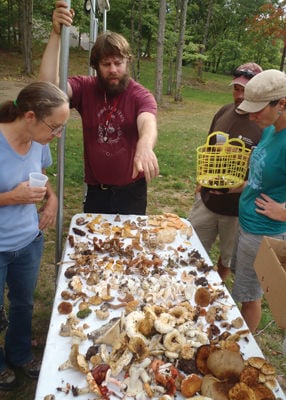
After roughly an hour of wandering on our own we returned to the trailhead and carpooled back the mushroom farm, where we spread our gatherings on a large table. Despite the poor picking conditions, our group had gathered about 70 different species of fungi ranging from tiny to large.
Noah went over each one, explained its distinguishing characteristics, and whether or not it was edible. One appealing-looking mushroom we found in abundance was the pure white Amanita virosa, otherwise known by its common name "The Destroying Angel." One of the more deadly of the poisonous species (Noah explained that it first made you violently sick, then killed you by destroying your liver. Ouch). Fortunately, the Destroying Angel is really easy to identify and avoid. Not so easy to sort out was the category known among mycologists as Little Brown Mushrooms (LBMs) which contains a number of deadly poisonous and some hallucinogenic species. No one eats LBMs.
Several of the other mushrooms we found were poisonous or questionable as well—a reminder to never, ever eat any mushroom you can't positively identify.
What was lacking in our treasure trove was enough edible mushrooms to even make a decent omelet. So we had to settle for a five-course feast (including dessert) prepared using local ingredients and the mushrooms grown at the farm.
Oh well, maybe next time we go fungi foraging we'll get some rain and all those "choice edible" mushrooms will start popping. At least we know some of the ones it's safe to eat.
-----
Mushroom Resources:
• New Hampshire Mushroom Company, 153 Gardner Hill Road, Tamworth, NH 03886.
Phone: (603) 323-0097, Web: http://www.nhmushrooms.com; email: info@nhmushrooms.com
• In addition to free farm tours and $60 "Can You Eat It" classes, they also offer the Saturday Supper Club, a 5-course prix fixe meal ($50) prepared by Chef Kaylon Sweet with organic local mushrooms and local from the Tamworth Farmers Market.
• White Mountain Mushrooms, Web: http://www.whitemountainmushrooms.com; email: contact@whitemountainmushrooms.com
• Brothers Jimmie and Parker Veitch are professional foragers, educators and all-around mushroom fanatics. They offer classes, mushroom walks, mushroom identification, and on-site assessments of potential mushrooming hotspots.
• White Mountain Mycolgical Society. Web: http://www.meetup.com/WhiteMountainMycologicalSociety/, a meetup group dedicated to all things mushroom. As the old joke says, these are really "fun guys."
• The web offers a host of resources for finding and identifying mushrooms. I have found the Field Guide to Common Macrofungi in Eastern Forests and Their Ecosystem Functions by Michael E. Ostry Neil A. Anderson Joseph G. O'Brien
from the US Forest Service to be particularly interesting and useful: http://www.fs.fed.us/nrs/pubs/gtr/gtr_nrs79.pdf
The Harvest: With the booty spread out on a table at the end of the day, mycologist Noah Siegel begins explaining what we found—and whether or not we can eait it. (TIM JONES PHOTO)


(0) comments
Welcome to the discussion.
Log In
Keep it Clean. Please avoid obscene, vulgar, lewd, racist or sexually-oriented language.
PLEASE TURN OFF YOUR CAPS LOCK.
Don't Threaten. Threats of harming another person will not be tolerated.
Be Truthful. Don't knowingly lie about anyone or anything.
Be Nice. No racism, sexism or any sort of -ism that is degrading to another person.
Be Proactive. Use the 'Report' link on each comment to let us know of abusive posts.
Share with Us. We'd love to hear eyewitness accounts, the history behind an article.