


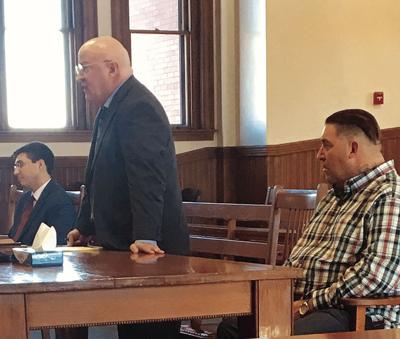
LACONIA — The lawyer for an Alton man convicted of endangering the life of a local police officer when he blew powdered fentanyl into the air asked the trial judge to throw out the verdict, arguing it is a “myth” that mere casual contact with the opiate drug is life-threatening.
Attorney Harry Starbranch, who is defending Eric Weil, 50, of 6 Gilmans Corner Road, in Alton, argued before Judge James D. O’Neill III Monday that prosecutors had failed to make their case against his client because during the trial they never put an expert witness on the stand to testify that being in the presence of fentanyl is by its nature dangerous. He said that without such evidence prosecutors failed to make their case that fentanyl is in and of itself a dangerous weapon.
A jury found Weil guilty on Sept. 13, of reckless conduct. Weil was accused of blowing a powdered substance — later analyzed to be fentanyl — in the direction of Alton police Officer Jameson Fellows who, along with two other officers, had gone to Weil’s home to remove a house guest who had been found using drugs. The prosecution had argued that purposely exposing someone to the dust makes fentanyl, in essence, a deadly weapon.
“The state encouraged the jury to infer whether fentanyl was a dangerous weapon,” Starbranch said during the 30 minute hearing in Belknap Superior Court.
But Assistant Belknap County Attorney Adam Woods countered that during the course of the trial the prosecution had asked to apply their common sense “about the dangers of fentanyl.” “It is an reasonable inference for the jury that blowing fentanyl in this way can cause death,” he said.
“It’s a myth that touching fentanyl is going to hurt you,” Starbrach said. “The medical community is leaning away from the danger to touching,” he continued, adding: “(The prosecution) needs an expert to say this exposure is deadly.”
Starbranch pointed to what he called a difference between using opioid drugs such as fentanyl and “incidental contact.”
But Woods said that the way Fellows was exposed to the fentanyl dust was not incidental, due to Weil’s deliberate action.
O’Neill rejected Starbranch’s attempt to introduce recent medical studies on the dangers of incidental fentanyl exposure. Wood’s objected, arguing that would essentially amount to retrying the case.
O’Neill took the attorneys’ arguments under advisement, but gave no indicated when he would issue his ruling.





(0) comments
Welcome to the discussion.
Log In
Keep it Clean. Please avoid obscene, vulgar, lewd, racist or sexually-oriented language.
PLEASE TURN OFF YOUR CAPS LOCK.
Don't Threaten. Threats of harming another person will not be tolerated.
Be Truthful. Don't knowingly lie about anyone or anything.
Be Nice. No racism, sexism or any sort of -ism that is degrading to another person.
Be Proactive. Use the 'Report' link on each comment to let us know of abusive posts.
Share with Us. We'd love to hear eyewitness accounts, the history behind an article.