


LACONIA — The need for action to address the city's housing shortage seems to be nearly universally accepted, and the data is clear that the lack of housing, especially for those at the lowest end of the economic spectrum, is a critical part of the problem.
But, as the planning board meeting held on July 11 shows, bringing a solution to the problem is a steep challenge.
That meeting was the most recent of several visits before the planning board for a project at 17-19 Bay St., proposed by Lakes Region Community Developers. It won’t be the last, though, as the planning board tabled the proposal, finding the parking plan to be problematic.
The project, which would take place on a lot slightly larger than a quarter acre, would construct a 6,000-square-foot, two-story building, containing 12 efficiency apartments. Each apartment would be strictly single-occupancy, said Carmen Lorentz, executive director of the nonprofit agency.
Like other LRCD properties, The Hodges Companies would manage the site, and each tenant would be screened for suitability, including criminal background check, and Lakes Region Mental Health Center would partner to provide supportive services to the residents that need them.
“These [apartments] are for people who are either experiencing or are at risk of homelessness,” said Lorentz. The apartment project is designed to be affordable for people who make less than $20,000 per year.
In addition to the residences, the plans also call for the construction of an office, which would be staffed by case managers from Lakes Region Mental Health Center from 8 a.m. to 4 p.m. on weekdays, in order to support residents.
To get such a density of residences onto such a small lot, LRCD achieved approval through performance zoning, a process adopted by the city in 2019 which allows developers to propose projects outside of normal zoning parameters. As the name implies, this alternative avenue allows projects to be considered based on how the development will perform in relation to the rest of the community.
Peter Brunette, planning board chair, noted that several other projects have succeeded through the use of performance zoning, but this is the first that would directly serve low-income residents.
LRCD is also asking for leniency when it comes to parking. Zoning requirements normally call for 1.5 parking spaces per occupant, which equates to 18 parking spaces for a 12-occupancy building. Instead, LRCD was asking to get by with 12 total spaces — six on site, and six more about 100 feet away at LRCD headquarters at 193 Court St.
However, with 12 total parking spaces at the LRCD office, reserving half of them for the proposed apartment residents would put the office into noncompliance, for lack of enough dedicated parking.
The board voted to table the measure and, in an email after the meeting, Lorentz said her organization would pursue a variance through the zoning board of adjustment to allow LRCD to reduce its parking capacity to six, thereby freeing up the other six to be available for the exclusive use of apartment dwellers.
Public input
Several abutters spoke about the project. Many were critical, particularly of the density proposed, and spoke of their wariness after dealing with previous residents of the property.
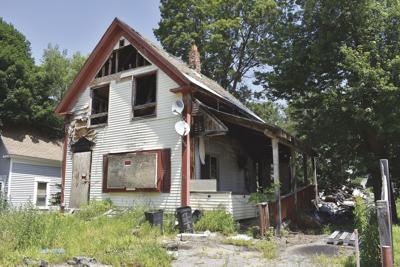
The building that currently stands at 16-18 Bay St. burned down over a year ago, and residents said that prior to the fire, there were as many as 10 people living there — dispersed through the main home and an outbuilding — most of whom were formerly experiencing homelessness, and that there was drug activity and other behaviors that made neighbors feel intimidated or unsafe.
Tammy Griffin, who lives across the street, said she asked police for a record of calls to that property over the last five years, and was given a stack of records 19 pages deep.
“Our neighborhood has been through hell with that building. To think that you’re putting that many more people in there, you’re putting us at risk again,” Griffin said. “If you do that, I’ve got to move. I’m not going to do this again.”
Rep. Harry Bean (R-Gilford), whose family owns many rental properties throughout the city, criticized the project based on what he saw as special consideration that a private developer wouldn’t be given.
“I don’t get to have any special exceptions. I have to go by the rules every time,” Bean said. Brunette countered that he would be welcome to apply for the same variances as anyone else can.
“I object to the 12 units, there’s not enough space there,” Bean said. “If I did that, they’d lock me up and throw away the key.”
Chris Cass, a resident of the neighborhood, said he’s been embarrassed to have friends and family over to his property because of the behaviors on display before the building burned. Since the fire, “It’s been quiet. I love that burned-out house, it’s been prettier than any other building I’ve seen there.”
Cass said he feared that a dense apartment building would invite a return of the unwanted behavior. “It seems like a lot of people in one spot,” Cass said.
Several others, including people involved in social service work, spoke in favor of the project.
Freeman Toth, who manages housing stabilization and street outreach for the Community Action Program of Belknap and Merrimack Counties, noted the city’s rental vacancy rate comes in at 0.1%, when a healthy market would have a 5% vacancy rate.
“My team, in Laconia, has dispersed $221,000 in rental assistance in this program year,” Toth said. “I think we need this, I think they have put in a lot of thought and planning.” Parking is a legitimate concern, he noted, but so are mental illness and housing insecurity. He also noted the proposal calls for residents to be screened before they get a lease, are supported by mental health case managers, and will be held to a standard of behavior — all of which was not in place during the property’s prior occupancy.
“Either we choose to continue to step over people on Main Street, complain about crime and defecation on doorsteps, or we need to choose to take a bold, unilateral action now,” Toth said.
Don House, president of the board of directors for the nearby Belknap House, noted that property has 19 residents in one building, without any negative impacts on the neighborhood.
“The difference is case management and who’s managing it,” House said. “I hope Laconia approves this process and this planning, it will make a difference in Laconia.”
Cathy Bowler of Laconia Housing Authority listed the wait lists for various properties her agency manages: 220 for Perley Pond, 512 for Sunrise Towers, 142 for The Tavern, 720 at Normandin Square.
“Those are real numbers of people who have applied for housing, and we don’t have housing for,” Bowler said.
Reuben Basset and Cory Hoyt, both on the board for LRCD, urged the planning board to consider the track record of their organization, especially when it comes to the impact their projects have on local neighborhoods.
Daisy Pierce, executive director for Navigating Recovery, noted her organization often works within the same demographic the project aims to serve, and it’s rare for parking to be an issue because their clients can’t afford cars. Pierce said, “This supportive housing is an incredible opportunity for the people who live there.”


(0) comments
Welcome to the discussion.
Log In
Keep it Clean. Please avoid obscene, vulgar, lewd, racist or sexually-oriented language.
PLEASE TURN OFF YOUR CAPS LOCK.
Don't Threaten. Threats of harming another person will not be tolerated.
Be Truthful. Don't knowingly lie about anyone or anything.
Be Nice. No racism, sexism or any sort of -ism that is degrading to another person.
Be Proactive. Use the 'Report' link on each comment to let us know of abusive posts.
Share with Us. We'd love to hear eyewitness accounts, the history behind an article.