


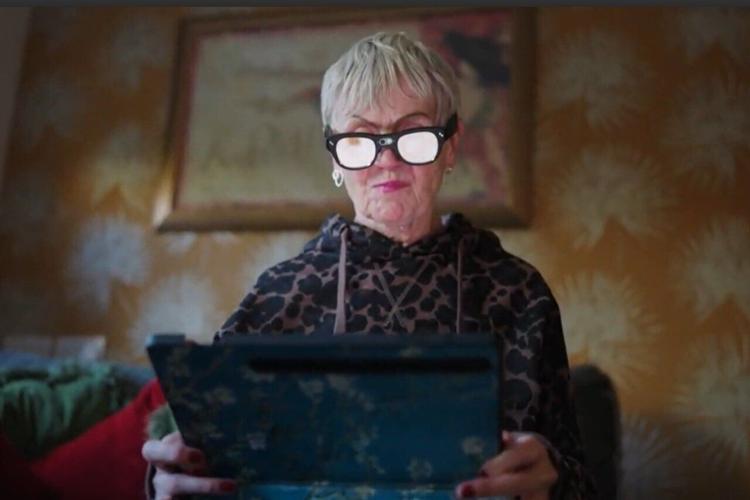


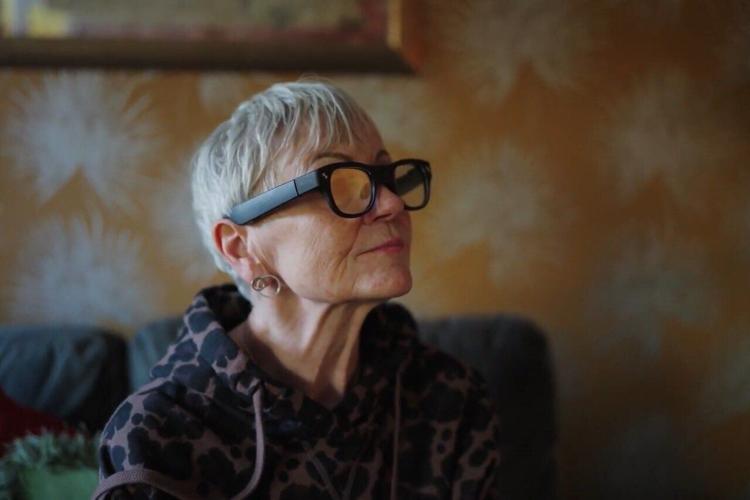

Carole Grieg, 70, had a chance to trial the new AI glasses for people with dementia. (CrossSense via SWNS)
By Sam McEvans
New artificial intelligence glasses for people with dementia 'see' objects and project visual prompts onto the lenses to help them live independently - and they could be available on the NHS soon.
They have already wowed test users and a panel of judges after supporting patients in their homes.
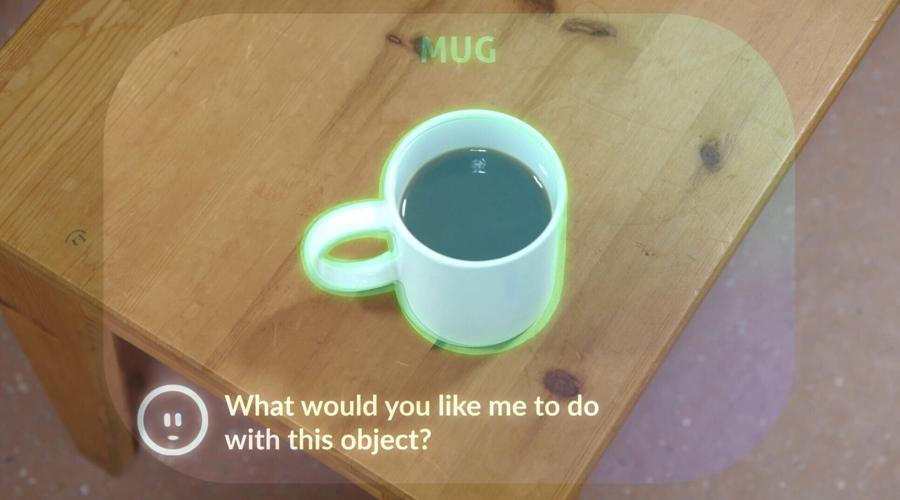
The glasses can guide people living with early-stage dementia through daily activities by identifying everyday objects and providing audio commentary and projecting visual prompts onto the lenses.
Being released more widely in early 2027, creators hope the gadget will be used by local authorities, care providers, and NHS memory clinics.

The AI smart glasses being worn. (CrossSense via SWNS)
Weighing just 75g, the specs work with prescription lens inserts and are hearing aid compatible. A built-in battery lasts for one hour and a portable power bank can keep them running all day long.
By asking gentle questions, the glasses’ AI companion, called 'Wispy', understands and learns a person’s unique way of doing things, with the AI adapting to each user’s needs as their dementia progresses. Wispy will even talk through what to do when a person cannot remember a particular step in a process.
In test trials, three out of four patients reported a significant improvement to their quality of life due to Wispy’s tips.
Spending over a decade creating and tweaking prototypes of the gadget, Wispy’s team of AI engineers trained the glasses with dozens of everyday activities including getting dressed, managing household chores safely, making a cup of tea and interacting with loved ones.
The specs also capture the environment of the person living with dementia and the AI interprets that information to help the user to do the things that define independence.
This includes feeling confident in their own home, taking good care of themselves, planning the day ahead, completing planned activities and hosting friends and family.

The glasses can guide people living with early-stage dementia through daily activities. (CrossSense via SWNS)
On Wednesday evening, the London-based team behind the technology, CrossSense, were handed the prestigious Longitude Prize on Dementia.
The prize’s panel of international expert judges agreed that the winning solution was a genuine breakthrough technology with revolutionary potential for people living with dementia and their families.


The £1m grand prize pot is funded by Alzheimer’s Society and Innovate UK, and CrossSense say they will use the cash to accelerate their research and to make the gadget publicly available within the next year.
Professor Fiona Carragher, chief policy and research officer at Alzheimer’s Society, said: “Rapid advancements in AI will give people affected by early-stage dementia the opportunity to stay safely in their own homes for longer and lead more independent, fulfilled lives.

The view through the AI smart glasses. (CrossSense via SWNS)
“These smart glasses are a prime example of harnessing technology to develop intuitive personal support that complements care given by humans.
"By anticipating people’s needs as their condition progresses, easing daily living challenges and providing additional reassurance to families, this revolutionary tech will allow people with dementia to maintain their independence for longer within the familiar environment of home.”
Dementia is a progressive condition and there is currently no cure.
Around one million people in the UK are living with dementia and this number is projected to rise to 1.4 million by 2040. The number of people worldwide living with dementia is projected to rise significantly from approximately 57 million in 2019 to over 150 million by 2050.
Lord Vallance, UK Minister for Science, said: “Dementia is a dreadful condition which affects millions of people and their loved ones in all parts of the UK, and I'm proud of how innovators and scientists across the country are making breakthroughs which deliver the dignity, care, and support people deserve.
“CrossSense’s work will help people living with dementia lead more independent lives in confidence.

Carole Grieg, 70, had a chance to trial the new AI glasses for people with dementia. (CrossSense via SWNS)
"Their work is a brilliant example of how British-led research can deliver real and life-transforming benefits.”
Carole Grieg, 70, from Sutton, London, tried the new glasses.
She is convinced the gadget could help dementia patients maintain their independence and hopes they will help her personally as her own condition develops.
Carole said: “For many of us, our world slowly becomes smaller as the condition progresses. Innovations like this offer real hope, and I know that as my own circumstances change, I will certainly be relying on them.
"I thought it was an amazing concept, with the potential to provide real, reliable support for people like me, helping to compensate for the cognitive skills we gradually lose as dementia progresses.”
Carole founded a support group, ForgetMeNots, and works closely with Age UK Sutton, and has contributed to dementia research with King's College London and the NHS.


(0) comments
Welcome to the discussion.
Log In
Keep it Clean. Please avoid obscene, vulgar, lewd, racist or sexually-oriented language.
PLEASE TURN OFF YOUR CAPS LOCK.
Don't Threaten. Threats of harming another person will not be tolerated.
Be Truthful. Don't knowingly lie about anyone or anything.
Be Nice. No racism, sexism or any sort of -ism that is degrading to another person.
Be Proactive. Use the 'Report' link on each comment to let us know of abusive posts.
Share with Us. We'd love to hear eyewitness accounts, the history behind an article.