



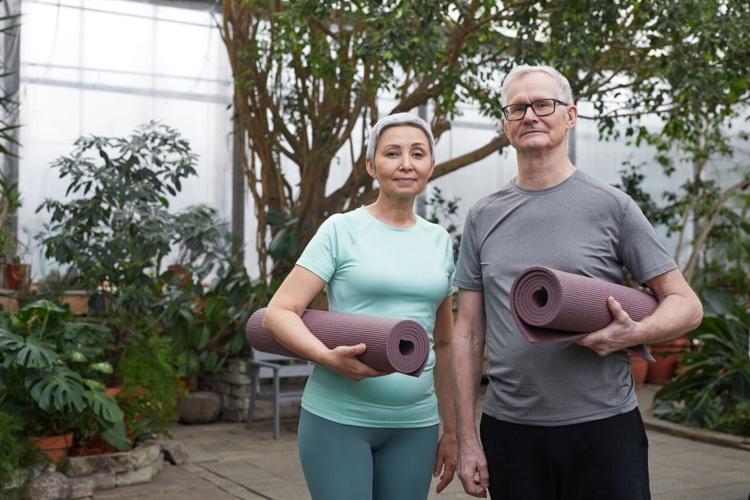

Photo by Kampus Production via Pexels
By Lauren Wilkin
A new study has proved that almost half of the population over 65 improves mentally and physically as they age.
Published by Yale, the researchers analyzed cognitive and physical ability in more than 11,000 older adults and found that 45% improved over time.
“Many people equate aging with an inevitable and continuous loss of physical and cognitive abilities,” said Becca Levy, the lead author on the study and an international expert on psychosocial determinants of aging health.
“What we found is that improvement in later life is not rare, it’s common, and it should be included in our understanding of the aging process.”
The participants were involved in the Health and Retirement Study, a federally funded long-term survey of older Americans.
They were followed for up to 12 years and both their cognitive ability and physical ability were monitored.
During that period, 45% showed improvement in at least one of these two areas.
Participants were given a global cognitive assessment to determine mental ability and their walking speed was measured to determine physical ability — which is often used as an indicator of overall health in the geriatric community.

Photo by Marcus Aurelius via Pexels


Approximately 32% improved cognitively, while 28% improved physically.
This is a strong positive correlation, and the researchers noted that if they included those who stayed at the same ability — showing no decline or improvement — the statistic would have surpassed 50% of the population.
The results are being likened to 'Benjamin Button' — a character who appears progressively younger as they age.
As researchers tried to find a reason behind this improvement, it became clear that beliefs around aging played a huge role.
Older adults with more positive beliefs about aging were significantly more likely to improve in both cognitive performance and walking speed.
Previous studies led by Levy found that negative beliefs about aging are associated with poorer memory, slower walking speed, increased cardiovascular risk, and biomarkers linked to Alzheimer’s disease.
But this study has proved that the opposite can be true, too.
“Our findings suggest there is often a reserve capacity for improvement in later life,” Levy said.
“And because age beliefs are modifiable, this opens the door to interventions at both the individual and societal level.”
The authors hope their findings will reverse the popular perception that decline in older age is inevitable.





(0) comments
Welcome to the discussion.
Log In
Keep it Clean. Please avoid obscene, vulgar, lewd, racist or sexually-oriented language.
PLEASE TURN OFF YOUR CAPS LOCK.
Don't Threaten. Threats of harming another person will not be tolerated.
Be Truthful. Don't knowingly lie about anyone or anything.
Be Nice. No racism, sexism or any sort of -ism that is degrading to another person.
Be Proactive. Use the 'Report' link on each comment to let us know of abusive posts.
Share with Us. We'd love to hear eyewitness accounts, the history behind an article.