


The second season of House of David is finally available to Prime Video subscribers, and all eight episodes of the Biblical and historical drama are packed with action and consequences for David (Michael Iskander), King Saul (Ali Suliman), their families, friends, and foes. Spoilers ahead for House of David Season 2.
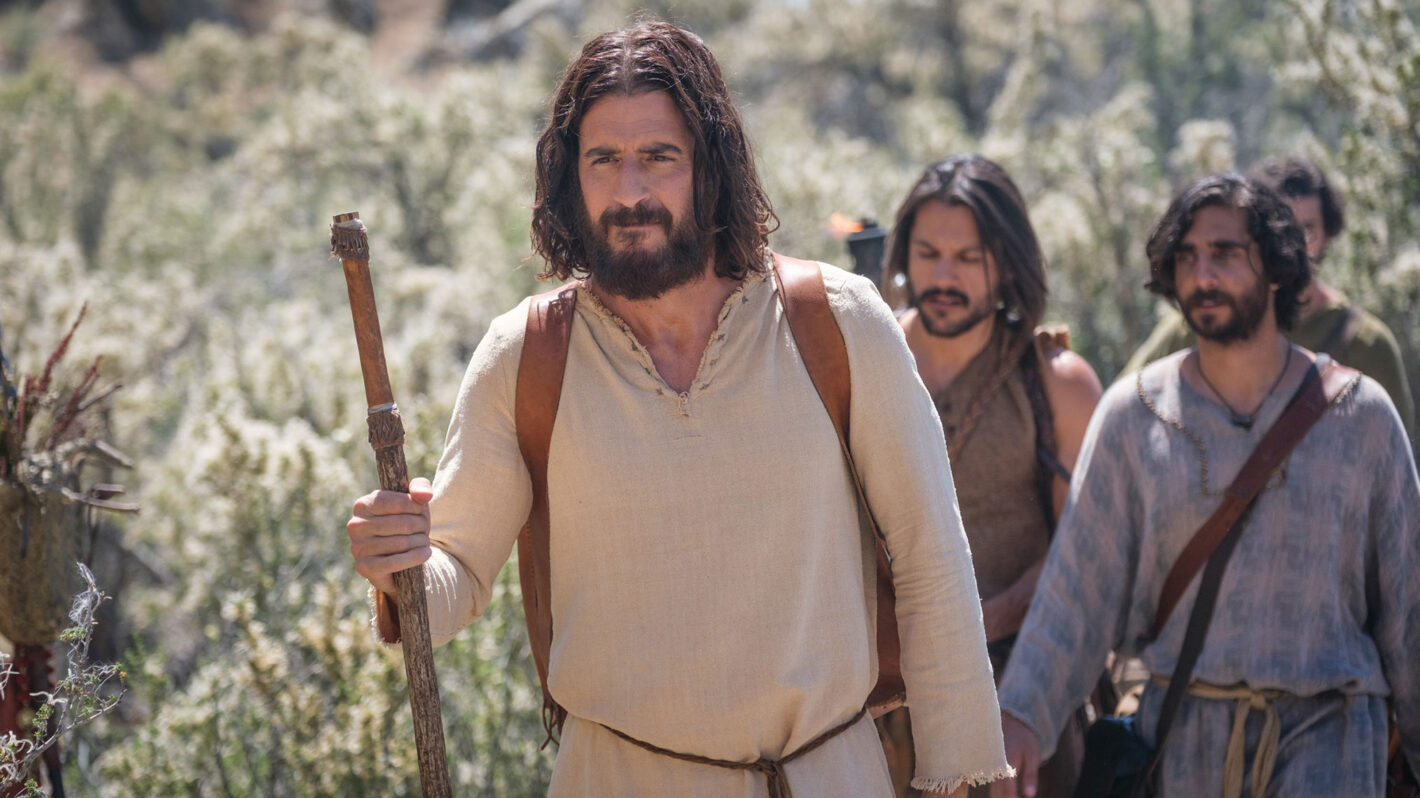
The season picks up where Season 1 left off: David has defeated Goliath (Martyn Ford) and thus turned the tide of the war with the Philistines. As a reward, he’s named a commander by his gracious king and continues to serve at his side, despite being anointed by Samuel (Stephen Lang). He’s also given David permission (read: an order) to marry Merab (Yali Topol Margalith), despite his love for her sister Mychal (Indy Lewis), and David has to fight for the right to wed the sister he wants to — a suggestion that Saul’s wife makes to ensure he doesn’t come back.
In the end, David realizes the depth of Saul’s betrayal and, with the help of his brother Eliab (Davood Ghadami) and others faithful to him, sets out on his own.
To discuss the heightened scale and biggest moments of the season, TV Insider caught up with star Michael Iskander and cocreator Jon Gunn during 2026 ChosenCon (in separate interviews, combined here for ease of reading).
In Season 2, everything’s so cinematic. What was it like for you to return and have that scale just revved up so much?
Michael Iskander: It’s really cool because Season 1, we’re building up to Season 2. We’re building up to the David and Goliath fight, but then everything is clashing into each other. And so Season 2 is filled with so much. Every episode has something immense that happens in it. So it’s, yeah, it’s just really amazing to finally get to have those conflicts.
Jon Gunn: Season 1 was the story of David the shepherd. Season 2 is David the warrior, so we knew there was going to be more battle. And honestly, we learned a lot in Season 1. I’d never shot that kind of battle stuff before in any of my movies. So Jon [Erwin] and I really, with our stunt team and our amazing camera crew, cinematographers, we learned enough in Season 1 that, ‘Oh, we can do more than we think.’
So for Season 2, we decided we were really going to come out of the gate. I mean, the first episode of Season 2 is a 40-minute battle, and it takes a tremendous amount of coordinating, a lot of pre-planning, a very, very talented crew of horse specialists and stunt guys and choreographers, and it’s really, really fun to do, and the challenge is always the time… Our assistant director did an incredible job scheduling so that we could always put in three hours a day on these battles or like two solid weeks of being on that battlefield, shooting some of it out in the land, some of it on a sound stage, every conceivable way that we could maximize the time we have to get the story points of these battles. And that’s what was important.
Every episode that has a battle, which is just about every episode, there’s a particular reason for the battle, and there’s a story and a character arc built into it. So that becomes the really wonderful challenge and opportunity of saying, “What story are we telling with this battle in this moment? What is David learning as a leader and as a warrior?”

Prime Video
What was it like to film in Greece?
Gunn: First of all, Greece was an incredible country for us to shoot in. And I think we’re the largest show that’s ever shot there. I think 700 people work on the show. And it was really important to us. We were there for the land. I mean, this is a show in many ways, the origins of Israel. The land is an important part of the character, the rolling hills and the landscape, and so we fought really hard to go to those difficult locations and to build our sets on the locations.
Very oftentimes, these shows are almost entirely in sound stages, or with a lot of blue screen and visual effects. We built as little as possible in sound stages. We have interiors for some of the palaces, but a lot of our locations were just built out on the hills in the land. For Jesse’s house, we just found a place and built a homestead for them, and that way, you feel the difference because you’re out there, the wind is blowing through the windows of those homes…. It really does transport you in a really meaningful way. I believe a lot in that. We almost never had a blue screen on our set… Our production design just did this incredible job of, with authenticity, building these structures and designing these environments so that you feel like you’re there.
So that, to me, was one of the greatest joys, to have an incredible team that crafts… how proud they were of the work they did. I mean, we showed Season 1. There was a moment where we, early on, just wanted to show the footage to the crew so they could see what we’re making. We showed a sizzle reel, and they were crying, “Thank you for letting us show the world that we can do this kind of work.” So we really do put a lot of pride into the level of detail, and almost everything is handmade, because nothing exists from the Bronze Age. And it’s so much a part of the DNA of the show: the wardrobe, real beards, real hair, real sweat. We do our best to put as much real stuff in there, and I think you feel that.
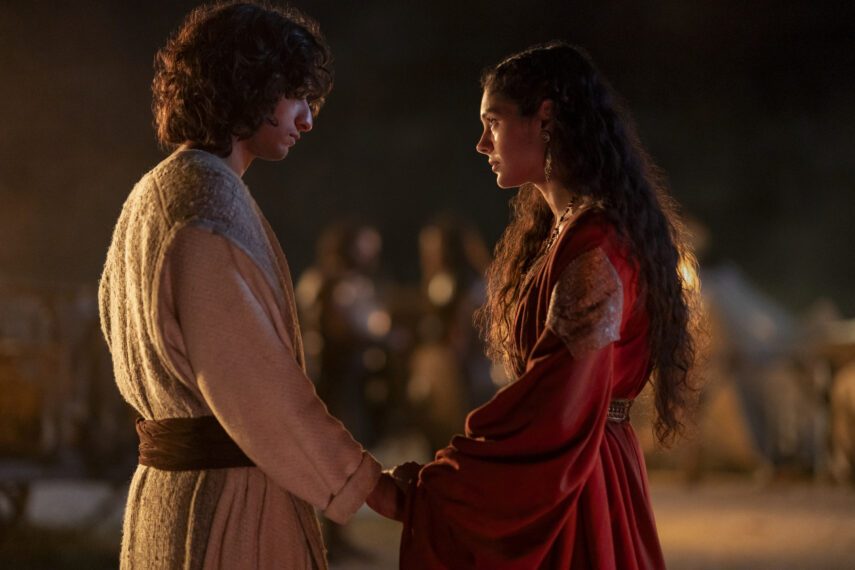
A lot of the story in Season 2 is anchored by that emotional arc with David and Mychal. When you were looking into the story, what made you decide to center it on his devotion to her and what he would be willing to do?
Gunn: The second season really [hinges on] these two core relationships for David. One of them is the love story with Mychal, of course, because, in the Bible, it talks about the love between them, but it doesn’t give you a lot of that love story. And so that was a wonderful opportunity to say, “Let’s dedicate and build this beautiful love story between these two people who had incredible obstacles to overcome to come together.” And that was also going to speak to David as a character, his growth through that relationship.
The other core relationship was Jonathan, who’s a fascinating friendship — and arguably the most famous friendship in the Bible. And such a beautiful heart that Jonathan had to say, “I believe that God has anointed David, and therefore I’m going to train the man who is going to take the throne from me to be the leader that God wants him to be.”
The challenge, the complexity, and the humility of that, and the beautiful bond between the two of them, was something we knew that was going to anchor this season as well.
Prime Video
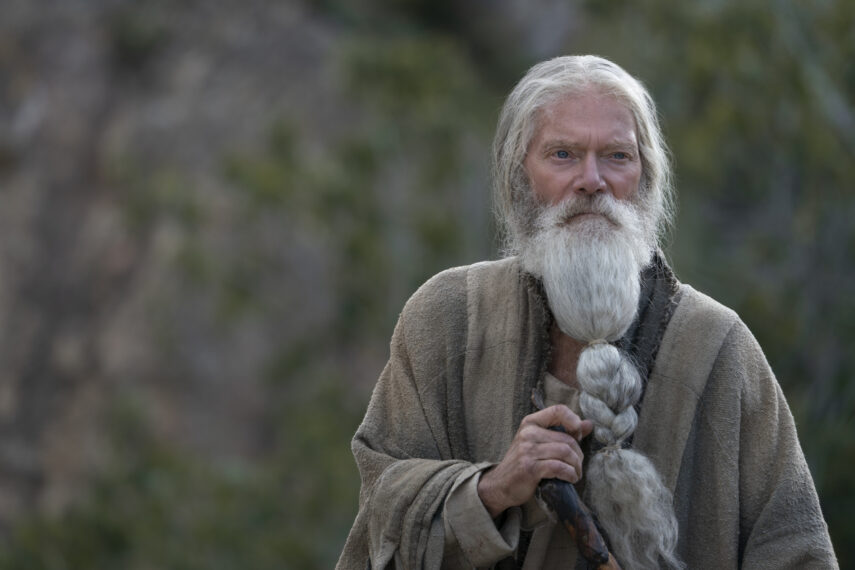
Samuel goes through a big arc. First, he’s captured, but then he has his big stand. Can you just talk about the momentousness of that?
Gunn: It’s funny. The strength of his character, the conviction of his character, and yet at the same time, he feels the weight of it. The show deals, thematically, so much with the cost of destiny. Samuel’s life is in service of the calling of God. From the time he was a child, he spent time hearing from God, often news that was not good news to share with other people. And so the burden that has on him, and yet the conviction that he has to continue to live his purpose, creates a very compelling character who does have his own moments of doubt and heartbreak, but also the pure joy he gets from watching David.
It’s like a parent with a child that God has anointed, this boy, and truthfully, Stephen Lang has that love for Michael. Every day, he said, “He brings me joy to watch him, to look at him, and for David to sing to him.” We would literally light a fire and set our actors up at the fire and then just let them live together and sing his songs, tell his stories, and look at him. And there were moments like that because David truly is Michael. Truly is such a beautiful singer.
There was a scene in Season 1 where he sits around when he asks Samuel about the visions he’s been having, and Samuel tells him the story of Joshua, and he asks him to play for him, and we just let David [go]. It wasn’t playback. It wasn’t pre-recorded. We just let Michael sit and play the song, and I watched Samuel’s face for three and a half minutes, just moved by, like, “That is the voice of God. It is God speaking and singing through him.” And those were very powerful moments because we’ve got these people who are really inhabiting the truth of their character. So that was a real joy. And Samuel’s journey this season, yeah, comes again to the cost of destiny. For him, it is to give everything he’s got to protect David and God’s anointing.
Another character who has an interesting journey in Season 2 is Saul, who defeats his demon but then creates his own.
Gunn: Saul really is a tragic character. I think we talk a lot about when we think through to the end of his life, if there’s a third season that takes us the end of his life, the idea of the remorse, the regret that I think he had so many opportunities to release what was no longer his and could have lived out his life with his family and had joy, but he just can’t let it go. And so his torment evolves. In Season 1, it is this outer force of something in the street, but then it internalizes, and he tells himself he’s healed from it, but he’s not, and there’s a poison living inside of him that grows and manifests worse and worse as time goes on.

When Saul sent David into battle for the right to marry Mychal, do you think he knew David knew his true intentions at that time?
Iskander: No, not initially. I don’t think David knew — otherwise, he wouldn’t have gone. But regardless, David is not afraid of a fight, and you know he goes in trying to do as he must. He follows the king’s orders, and he’s going to get his bridal price. And even when he finds out that the king betrayed him, he not only fulfills the bridal price, he gets double.
Funny story about that bag: Famously, we know what’s in the bag, but it originally wasn’t going to be in the show. And I knew that scene just needed something. I was reading it, and I’m like, “How do we prove that he killed these people?” So I called Jon Erwin, and I said, “I really feel like we shouldn’t shy away from this. It’s in the Bible, and I know we can’t really say exactly what it is, but I think for those who know the Scripture, why don’t we just give me a bag, bloody it up, and just let me do my thing?”
I really think it elevated that scene. Beyond just being a gag, it’s the tension. That’s the rubber band in that whole scene, and it really triggers Saul into everything that he goes to after, kicking the queen out of the kingdom.
Do you think David would’ve remained loyal to Saul still if he did know?
Gunn: I mean, I think that David has so much reverence for Saul, first of all, because David has so much reverence for God, and Saul is God’s anointed. So David was raised believing, “This man, God chose this man,” and David is so true to his faith in God and his belief that he turns away every opportunity to kill Saul. The idea that he’s meant to take the throne, he does not want to take the throne by blood. He does not want to. So it puts David in a very difficult position of being told he’s meant for the throne, but not being given the map as to how he’s ready to get there. And that really is the delight and drama of our entire series. It’s like, “What is the path to getting there?” Samuel didn’t often have that answer for him, and he’s not going to have Samuel around for his whole life, and that is the truth for all of us: “I have a vision for where I want to get to that I don’t know how to get there.” And that’s where real trust comes in, real faith comes in, real doubt comes in, big mistakes can happen in those moments. That’s great drama.
The scene when he’s surrounded by Philistines, it’s an eerie shot. He’s walking out there, and it’s just him in a kind of Game of Thrones “Battle of the Bastards” type of moment where he’s all alone. Do you think that if his brother and Jonathan and all of them hadn’t shown up, that he would have just kept fighting, one on a thousand?
Iskander: Oh yeah, 100% he would have kept fighting. I think David, in that moment, was ready to die. He’s like, “I will do anything.” But I think he was filled with this righteous rage. He knew that he has been betrayed, and he’s fighting… the people who stand up against his own God. So there’s nothing that’s going to stop him from defending his God. And I think that’s where David always comes from. He’s not bloodthirsty. He’s defending his people, and he’s defending the name of his Lord.
David hurts Merab in the process of winning Mychal’s hand. But do you think he knew that that would happen, or do you think he really believed that it was just not meant to be?
Iskander: It’s actually interesting. So scripturally, David was actually supposed to be married to Merab first, and then Mychal gets mentioned later…. We always try to find, “What might have this been like?” So we don’t actually know. But in the story of the show, it’s Merab that triggers this. She’s the one that triggers the king into wanting to marry David first. And so I feel like, from David’s perspective, she kind of brought this upon her own. He really doesn’t love her, and he would be doing her a disservice if he married her, and he didn’t truly love her. And so really, it’s Merab bringing this upon herself and taking away something that was her sister’s. I think it’s kind of a lesson that something that’s meant for us will come to us when we take it by force. Sometimes it ends up backfiring.
Prime Video
One of the last scenes is when David escapes, and Mychal doesn’t come. What do you think that does to him?
Iskander: This is a really good question. I think this moment is the trigger for what we see happen later on in David’s life. Famously, David marries like eight women, ends up cheating on all of them with Bathsheba. But as his rise to become king, as he’s growing and he’s getting all these wives, part of his peace deal with Israel was that he wanted his wife back. He wanted Mychal back instead of being married to Bathsheba. And when she comes back, that relationship is severed. It’s not the same as it was. And I feel like marrying all these other women, it was trying to fill this hole inside of him. And when Mychal comes, he thinks this hole is going to be filled, and yet, no, there’s still this hole. And so he’s yearning for this love that he once had, and for the rest of his life, he’s trying to fulfill.
It sounds like you’re ready to chew on all of that.
Iskander: We’ll see. We’ll see, I hope so.
The finale has obviously the heartbreaking moment of David saying goodbye to Jonathan. How was that for you? It must have been difficult to film, given how much time you guys spent together.
Iskander: Yeah, it was. I love Ethan, the actor who plays Jonathan. I love him so much, and we still play video games together, but I remember the first time reading that moment in scripture, and every time I read, I just get teary-eyed. You know, it’s just so heartbreaking. These two best friends — all they want to do is be best friends, and they can’t. So I remember filming that scene and looking at Ethan, and for the moment, I was looking through David’s eyes, and I saw Jonathan in front of me, and I saw what that moment might have actually been like, and it just really struck me. And Ethan does such a phenomenal job that you can’t help but see Jonathan in him. So it’s a blessing for me to get to act alongside him, and having watched back that scene, I think that moment is the culmination of the David and Jonathan storyline. It shows true friendship, true brotherhood. And it’s my favorite moment of Season 2.
Contrary to that, is when Eliab’s brother comes in and finally submits. That scene was very powerful. Can you just talk about reaching that dynamic and making that moment sing?
Iskander: Well, likewise. I mean, honestly, I could talk for hours about every actor in the cast, but Davood, the actor who plays Eliab, he truly is an older brother on the inside, and he’s filled with so much love. And so I can’t help but love him as a person. And yet, you see Eliab making these decisions, and you’re like, “Oh, I wish you would just understand. I wish you would get it.” And I think that’s also David’s mentality throughout all of this. He sees his brother, he sees his brother’s heart, and the whole time he’s just like, “Please, please don’t do this. You’re fighting against yourself.” And so that moment when Eliab finally submits to David, he’s not just submitting to David, he’s submitting to God. And I think that’s what strikes David so much. He’s like, “Oh, finally, you have a relationship with God. You finally get it.” And it always goes back to God. Every character in the show is wrestling in their relationship with God.
We already talked a little bit about Season 3. The arc of David, as you mentioned, gets meaty at the end. What are you most looking forward to doing if the show returns for Season 3?
Iskander: I don’t know what is to come for Season 3. But, I mean, famously, we know from scripture the three phases of David: shepherd, warrior, and king. We’ve seen the shepherd. You’ve seen the warrior now. What does it look like to be a king? What does it look like to be a leader? What does it look like to show other people around you the way to go? Famously, when I was doing my shepherd training, a shepherd told me, he said, “A good shepherd is the one who leads the flock and is in front of it, not behind it.” So I think doing Season 3 would be the culmination of that, which is learning what it is to actually truly lead a flock and be in the front, be the one taking the risks, being the one to show them the way to go, being the one that is the light.
Gunn: I have thought an awful lot about Season 3, and I don’t think we’re sharing any information yet about what that might be, but yes, absolutely know with certainty what Season 3 would be. There’s always been a sense of the trilogy of David’s rise from shepherd to king. Season 1 was David the shepherd. Season 3 is David the warrior. Season 3 would be David the king, making his way to the throne. So I’m very excited about what a Season 3 could be.
House of David, Season 2, Streaming now, Prime Video
More Headlines:
- ‘Tracker’ Sneak Peek: Will a Desperate Father Cause Problems for Colter? (VIDEO)
- ‘House of David’: Michael Iskander & Creator Talk Season 2’s Epic Ending & More
- Did Lo Bosworth Skip the ‘Laguna Beach’ Reunion? Her Absence, Explained
- ‘Summer House’ Season 11: Will the Show Return in 2027?
- April 2026 Streaming Guide: What’s New on Netflix, Hulu & More




(0) comments
Welcome to the discussion.
Log In
Keep it Clean. Please avoid obscene, vulgar, lewd, racist or sexually-oriented language.
PLEASE TURN OFF YOUR CAPS LOCK.
Don't Threaten. Threats of harming another person will not be tolerated.
Be Truthful. Don't knowingly lie about anyone or anything.
Be Nice. No racism, sexism or any sort of -ism that is degrading to another person.
Be Proactive. Use the 'Report' link on each comment to let us know of abusive posts.
Share with Us. We'd love to hear eyewitness accounts, the history behind an article.