


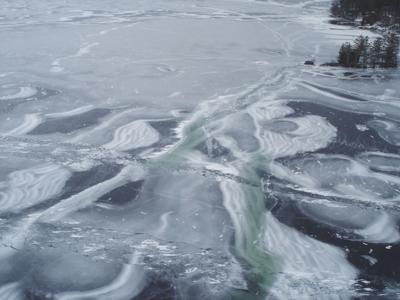
Have you ever stood out on a frozen lake, looked out across the icy bay and wondered what was happening beneath your feet? As we wait for Lake Winnipesaukee to freeze over, let’s explore what will happen to the lake’s ecosystem under the ice.
Last fall, the Lake Winnipesaukee Association published an article in the Laconia Daily Sun discussing the phenomenon known as lake turnover, which in Winni occurs once in the fall and once in the spring. To briefly sum it up, lake turnover is the seasonal mixing of the entire water column. The process of lakes turning over is critical to a lake’s ecosystem, as it’s the turnover period that distributes oxygen throughout the entire water column. Once ice forms across the entire surface of a lake, the body of water is essentially sealed off from atmospheric oxygen exchange and the snow-ice coverage blocks out light that is necessary for aquatic plants and phytoplankton to produce oxygen within the lake. Therefore, oxygen availability becomes more limited during the winter which can pose a threat to aquatic species. In fact, lakes can sometimes experience “winterkill” where the oxygen levels become too low for fish to survive. So, how do aquatic species survive the winter under the ice?
Fish have several adaptations to survive a winter under the ice. Fish are cold blooded, meaning their body temperature is regulated by outside influences and matches their environment. In the winter, they must modify their behavior to regulate and maintain their body temperature. To do this, fish slow down their metabolic processes, such as respiration, digestion and activity level. Some fish species will also enter a state known as “diapause”, where they have an extremely low heart rate. By slowing down their metabolism, fish are able to survive on fewer calories. If feeding does occur, fish will consume a variety of hatching insects and smaller fish.
Where fish overwinter in the water column depends on the fish species. Fish are classified as cold water, cool water, and warm water species. During the winter time, cold water species stay more active throughout the water column and prey on other organisms. Meanwhile, warm water species seek out the warmest water, which is often found at the bottom of the lake. They will hunker down in these areas and enter a state of torpor, where their respiration is reduced and they use as little energy as possible. There are some warm water species that will also burrow into the lakebed for warmth.
Of course, fish aren’t the only species in the lake that have winter survival techniques. Phytoplankton (algae/cyanobacteria) can produce thick-walled resistant cells that will settle to the bottom of the lake where they overwinter. Some phytoplankton remain productive during the winter by utilizing the small amount of light that penetrates through the ice and snow covering the lake’s surface. Zooplankton have similar overwintering strategies as phytoplankton. Zooplankton enter a special resting stage that allows them to survive the winter burrowed in the warmer lake sediments. Once the spring arrives and the lake turns over, and more light is able to penetrate into the water column, these resting stages become active again. As for aquatic plants, many die back during the winter. However, their root systems remain intact and store energy to subsequently produce new vegetation in the spring. And finally for our amphibious friends, they seek out protected areas and burrow down into the sediment, where they enter a state of hibernation.
Winter is a quiet time in and around the lake as species hunker down waiting for the spring. While we humans survive the winter by bundling up and cranking the heat, most of our aquatic friends enjoy a long winter’s nap. Me? Jealous? Well…maybe a little!
•••
Jacquelyn Bellefontaine is the conservation outreach manager for the Lake Winnipesaukee Association. She manages communications and outreach initiatives. Jackie can be reached at jbellefontaine@winnipesaukee.org.
The Lake Winnipesaukee Association is a nonprofit dedicated to protecting the water quality and natural resources of the lake and its watershed. To learn more, visit winnipesaukee.org.


(0) comments
Welcome to the discussion.
Log In
Keep it Clean. Please avoid obscene, vulgar, lewd, racist or sexually-oriented language.
PLEASE TURN OFF YOUR CAPS LOCK.
Don't Threaten. Threats of harming another person will not be tolerated.
Be Truthful. Don't knowingly lie about anyone or anything.
Be Nice. No racism, sexism or any sort of -ism that is degrading to another person.
Be Proactive. Use the 'Report' link on each comment to let us know of abusive posts.
Share with Us. We'd love to hear eyewitness accounts, the history behind an article.