


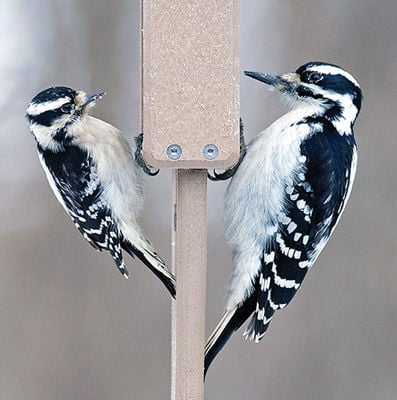
Photo courtesy of Project FeederWatch
By STEVE WHITE, Columnist
One of the most common woodpeckers in all of North America is the downy woodpecker. It is our smallest woodpecker and a frequent visitor at suet feeders and regular feeders that are filled with no-shell sunflower seeds. Male and female “downies” look alike, with the female being all black and white and the male being similar except for a noticeable red patch on the back of his head.
Many novice backyard birders mistakenly believe that the downy woodpecker is the offspring or baby of the larger hairy woodpecker. Each is an independent species. Both have the same male/female markings. The hairy, however, is twice the size of the smaller downy and the hairy beak is twice as long as that of the downy woodpecker. If you ever have the privilege of seeing both species side by side, you will immediately notice these distinct characteristics.
The downy feeds on insects that live on the outer surface of tree bark. It uses its small, chisel-like bill to chip away bits of wood to expose the insects. It is hard to tell where a downy has been feeding, since so little wood is removed. However, its bill is also used to excavate a nesting cavity. The downy excavates only in dead wood, never live trees. It uses the drumming technique to determine if the interior wood of any tree is hard or soft. A soft core indicates a decaying tree, no matter how alive this tree may appear on the outside to human eyes.
It first makes an entrance hole about 1 ½ inches in diameter and excavates down for about 8-10 inches. Both the male and female excavate the nest hole.
The downy woodpecker also uses its bill to rapidly drum on resonant trees. This is done in spring and early summer by both the male and female and is a communication that helps define a breeding territory. When a downy drums, no wood is pecked away, it is like a drummer playing with drumsticks on a wood block.
Pairs of downies usually stay together on their range throughout the year, except during the winter season when they are associated with mixed flocks of chickadees, nuthatches and titmice. As you watch downy woodpeckers, look for specific behavior related to corresponding seasons as their relationship changes throughout the year.Enjoy your birds!
Wild Bird Depot is located on Rt 11 in Gilford, NH. Steve White is a contributing author in major publications, a guest lecturer at major conventions in Atlanta and St. Louis as well as the host of WEZS 1350AM radio show “Bird Calls” with Lakes Region Newsday @ 8:30AM. Wild Bird Depot has donated over $5,000 to local rehabilitators and local nature centers since 1996. Be sure to check out our website www.wildbirddepot.com. Like us on Facebook for great contests and prizes.


(0) comments
Welcome to the discussion.
Log In
Keep it Clean. Please avoid obscene, vulgar, lewd, racist or sexually-oriented language.
PLEASE TURN OFF YOUR CAPS LOCK.
Don't Threaten. Threats of harming another person will not be tolerated.
Be Truthful. Don't knowingly lie about anyone or anything.
Be Nice. No racism, sexism or any sort of -ism that is degrading to another person.
Be Proactive. Use the 'Report' link on each comment to let us know of abusive posts.
Share with Us. We'd love to hear eyewitness accounts, the history behind an article.