


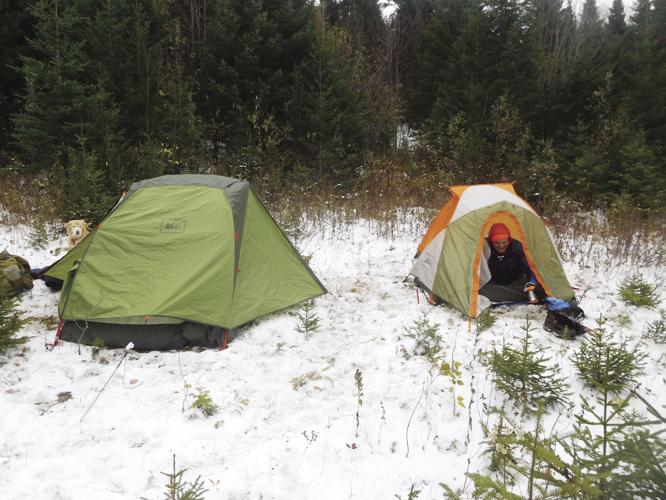
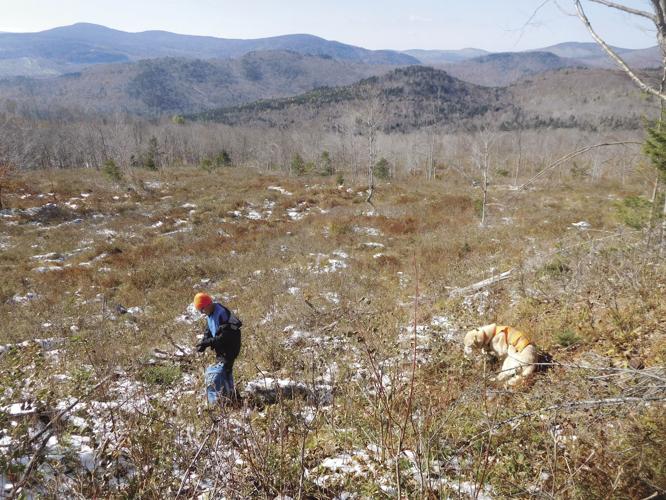
The phrase, “If you don’t like the weather in New England now, just wait a few minutes,” attributed to Mark Twain, rang true when I rolled out of my sleeping bag to a bright, warming sun. The previous day Fran, Reuben and I were hiking in 20-degree temperatures with snow blowing in our faces. Now the snow was melting around our campsite, puddles were forming in the logging road and the trees were freeing themselves from a coating of white. When we planned this trip to New Hampshire’s North Country we assumed we would be hiking in seasonable autumn weather, not winter conditions. As I peeked my head out of the tent a warming breeze blew across my face. A new day arrived, bringing with it changing conditions. I was hopeful we could complete our goal.
Fran, Reuben and I were in the northern wilderness for two days to bushwhack to the summits of four peaks: Crystal Mountain Northwest, Blue Ridge North Peak, Crystal Mountain South Peak and Black Mountain Northwest Peak. These four mountains, north of the notches, along with many others are not well-known and rarely climbed. With the exception of North Country natives and hunters, only a handful of hikers or peak baggers are aware that these mountains exist. Both of us have spent several years hiking to remote mountain peaks throughout the state, and now we were about to complete our goal of summiting the last four mountains on the list of the highest 200 in New Hampshire.
When we started our drive to Dixville Notch, we questioned our decision to even begin our journey, facing snow and gusty wind. In addition there was another concern: The only way to access the mountains was from logging roads, built many years ago by the paper companies to provide wood pulp for the paper mills in Berlin and Groveton. There was a good chance that these rutted roads would be choked with snow and covered with ice. Would we even be able to reach the start of our planned bushwhacks? Nevertheless, we knew we had a small window of time to complete our goal and we would have to take our chances. Winter was closing in and soon the logging roads would be inaccessible. As we traveled through Franconia Notch, Twin Mountain, Lancaster, Groveton and Colebrook, the snow continued to fall, but at least conditions weren’t getting worse. When we arrived at Coarser Brook Road, a gravel logging road off Route 26, we saw only a few inches of snow cover, and headed into the wilderness.
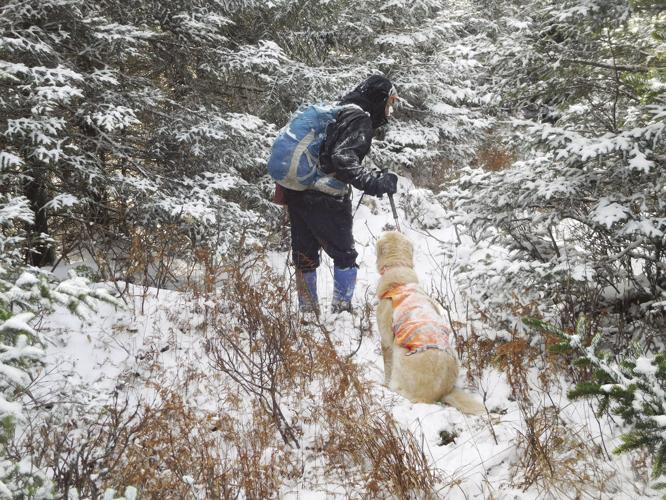
Fran inched his truck down steep grades and over deep ruts for 12 miles, finally arriving at the start of our bushwhack to Blue Ridge, North Peak (3,009 feet). The snow continued to fall and the wind picked up as we climbed higher on the mountain. We weren’t totally prepared for hiking in winter conditions, but were determined to reach the summit. Within four hours, we had summited Blue Ridge North and were beginning our second climb of the day to Crystal Mountain, Northwest (3,230 feet). With darkness approaching we needed to reach the peak and return to the truck to set up camp for the night. The snow was beginning to lighten, but the wind continued to howl, sending snow off the trees into our faces. It was a long, arduous trek to the summit and back, but we made it just in time to set up our tents under the dimming light of the setting sun. After our meal, Reuben, Fran and I hunkered down in our sleeping bags for the evening (Reuben’s sleeping bag is his pink blanket). As the skies cleared during the night, the moon appeared, shining through the tent with an eerie light. The weather was changing.
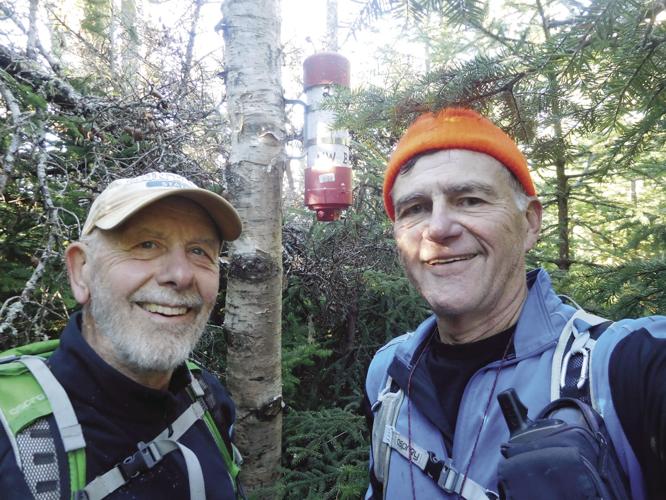
The next day arrived with clearing skies and warming temperatures, a new day at daylight. We quickly tore down our tents, packed up our supplies and equipment and began driving Roaring Brook Road to our next destination, the base of Crystal Mountain, South Peak (2,960 feet). As with many of our north woods treks, we would have to wend our way through a logged-out forest, full of slash, briars and hobble bush. Hiking through the maze of stubby growth, we continually looked for open woods. As we climbed higher on the mountain, the logged area gave way to open woods interspersed with bands of small spruce. These spruce bands stood like ramparts of a castle blocking our track. We had to fight relentlessly through the forest wall, while Reuben always seemed to find a narrow tunnel leading to a small clearing, a moose bed or patch of moss where he could rest. Finally reaching the summit, my legs aching with fatigue, we signed the register located in the canister and said together, “Three down and one to go,” Black Mountain, Northwest Peak (2,944 feet).
We hustled down the mountain (it’s much easier pushing through the spruce bands going downhill). My body no longer felt drained as I anticipated our finish. I think the hormones were pumping through my body, making me feel lightheaded and joyful. Black Northwest was our final peak of the trip and the last mountain we had to climb to reach our goal of summiting the 200 highest peaks in New Hampshire. When we reached the truck to begin our drive to Black NW, Reuben looked at me as if to say, “Are we going home now”? I told him, “One more climb.” His ears collapsed around his head and he reluctantly climbed into the truck.
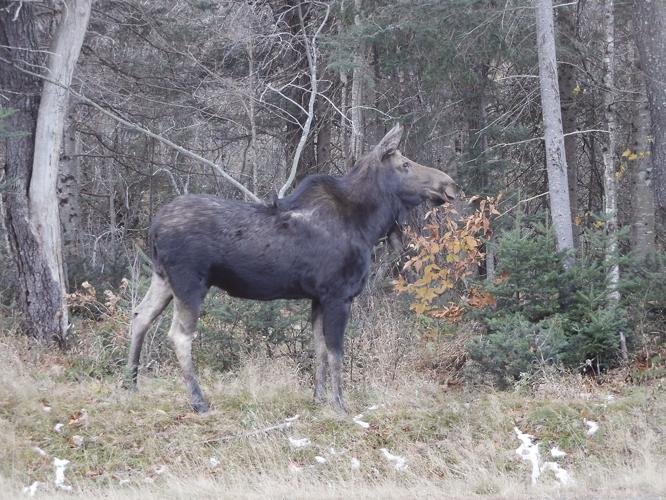
The sun was now directly overhead, beaming down its warming rays. Today was a complete turn-around from yesterday’s freezing temperatures, snow and biting wind. We struck out through another logged-out area, scrambling through thickets of briars and hobble bush before we reached a beautiful glade of mature birch and maple. Fran was a wizard with his GPS taking us directly to the peak. When we found the canister, marking the true summit, we celebrated with a “high-five.” signed the register and headed back down the mountain. Our mission was successful, despite the weather conditions we encountered on our first day. Like Mark Twain said, “If you don’t like the weather in New England now, just wait a few minutes.” (In our case it was wait a day). Shortly after turning onto Route 26, just east of Dixville Notch, we were greeted by a female moose and her offspring, leisurely grazing along the highway, capping off our two-day expedition to the wildness of New Hampshire’s North Country.
For questions or comments contact Gordon at forestpd@metrocast.net.
On Tuesday, Nov. 15, at 7 p.m. at the Gordon-Nash Library in New Hampton, Gordon will be presenting a slide-lecture program, Hiking Historical New Hampshire. Gordon will be highlighting six historical sites he has visited via wilderness trails. The program is sponsored by the New Hampton Historical Society as part of its lecture series on New Hampshire’s past. The program is free and light refreshments will be served following Gordon’s presentation.


(0) comments
Welcome to the discussion.
Log In
Keep it Clean. Please avoid obscene, vulgar, lewd, racist or sexually-oriented language.
PLEASE TURN OFF YOUR CAPS LOCK.
Don't Threaten. Threats of harming another person will not be tolerated.
Be Truthful. Don't knowingly lie about anyone or anything.
Be Nice. No racism, sexism or any sort of -ism that is degrading to another person.
Be Proactive. Use the 'Report' link on each comment to let us know of abusive posts.
Share with Us. We'd love to hear eyewitness accounts, the history behind an article.