


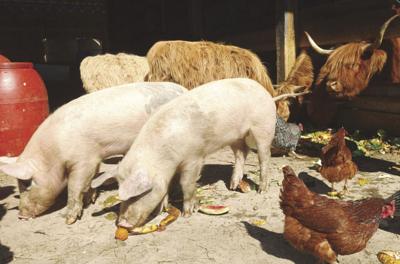
With most farmers markets closed, you might feel badly for the farmer who normally sells at the market. And farmers who depend solely on that venue will be in poor shape. But there's more than one way to skin a cat. (It's just an expression. I hope.)
Some of us are marketing our wares online or offering a safe in-person retail experience. At a time when so many small business are shut down or struggling, Miles Smith Farm is busy. It makes me feel a little guilty, because I know what it's like to have a delicately-balanced budget knocked sideways by circumstances not under my control.
Gloved and masked customers are visiting the uncrowded farm store, driving into the barnyard where we put their merchandise in the trunk, or opting for home delivery. One customer told me, “I’ve been meaning to buy your meat but never did. I’m so glad you are here and I will be a regular customer.” Music to my ears.
Many other local farms are experiencing the same Covid-19 boost in sales. I like to think that folks have finally realized that their old habits of meat-buying is not sustainable. Most of America's meat is supplied by a massive but fragile system that relies on six big processors: Tyson, Perdue, Koch Foods, JBS, Smithfield, and National Beef Packing Co. Several plants recently have closed, which means less meat in the grocery stores.
Even though might be less meat available, there are still lots of animals. Plant closures mean that farmers are stuck with huge and growing numbers of animals. Automobile parts can sit on a shelf; livestock can’t. Animals need to be fed – at great expense.
With the recent closing of the Smithfield’s pork processing plant in Sioux Falls, 20,000 pigs a day now have nowhere to go. In two weeks, that’s almost a quarter of a million pigs. Commercial hogs are raised in a just-in-time inventory system and they are accumulating on farms, leaving farmers with terrible no-win choices to make. Dairy producers can dump milk. Fruit and vegetable growers can dump produce. What are hog farmers to do?
The current system is not sustainable because when it breaks, as it has in this pandemic, there might be less meat to buy, and farmers have animals they may need to euthanize.
The alternative to the “Big Six” is – and has been for awhile – small, local farms, like those we are fortunate to have in New England.
Maybe after this is over (it will end, won’t it?) people will stick with local farmers, having realized that it’s not as hard as they thought to eat food from here instead of from away.
•••
Carole Soule is co-owner of Miles Smith Farm (www.milessmithfarm.com), where she raises and sells pastured pork, lamb, eggs, and grass-fed beef. She can be reached at cas@milessmithfarm.com.




(0) comments
Welcome to the discussion.
Log In
Keep it Clean. Please avoid obscene, vulgar, lewd, racist or sexually-oriented language.
PLEASE TURN OFF YOUR CAPS LOCK.
Don't Threaten. Threats of harming another person will not be tolerated.
Be Truthful. Don't knowingly lie about anyone or anything.
Be Nice. No racism, sexism or any sort of -ism that is degrading to another person.
Be Proactive. Use the 'Report' link on each comment to let us know of abusive posts.
Share with Us. We'd love to hear eyewitness accounts, the history behind an article.