


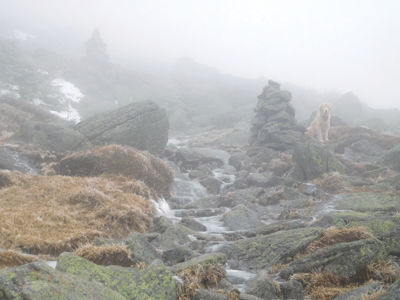
Reuben leading the way to the summit of Mt. Madison
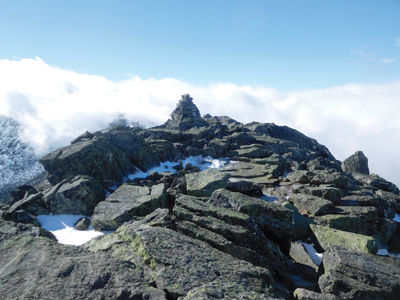
Cloud cover dissipating over Mt. Madison summit cone
By Gordon DuBois
On February 15, 2015, in the darkness of early morning, Kate Matrosova left her husband, Charlie Farhoodi, at the Appalachia Parking lot. Kate disappeared into the predawn hours as she made her way to the Valley Way Trail. That morning would be the last time Charlie would see Kate alive. She hiked into a tempest that would take her life on the side of Mt. Adams. This was one of many tragedies that occur in the White Mountains almost annually, but Kate’s death is beyond understanding. Just below tree line a sign along the Valley Way Trail reads, “STOP, The area ahead has the worst weather in America. Many have died there from exposure, even in the summer. Turn back now if the weather is bad.” Kate most likely read this sign, and continued on. She believed that the uninhabitable weather system that was racing toward the White Mountains would arrive later in the day, when she would be safely below tree line on the Ammonoosuc Trail. She was prepared physically to hike fast and she carried only essential items for a fast day hike.
Kate was an accomplished climber and had summited some of the highest mountains in the world, Kilimanjaro, Elbrus, Aconcagua and Denali. She was also a very successful stock trader and had an insatiable appetite for challenges, both in the business world and the arena of mountaineering. She was a strong hiker and her plan to hike the Northern Presidential Range in winter was not beyond her ability. What she didn’t plan for was the extreme weather that was about to hit while she was making her way up the Valley Way Trail. On the higher summits temperatures would be falling to -35 degrees F., winds would soar to over 80 MPH with wind chills of -88 degrees F. Anyone caught in these conditions had little chance for survival.
Kate’s attempt to complete the Northern Presidential Traverse ended on Mt. Adams where her body was found the next day by search and rescue teams from Androscoggin Valley Search & Rescue, NH Dept. of Fish and Game and Mountain Rescue Service. They began the search on the evening of the 15th, when Farhoodie notified authorities that Kate hadn’t returned. Rescue teams began the search in the full force of the storm, risking their lives, hoping to find Kate and bring her down off the mountain. Unable to continue the search that evening they resumed the following day in the face of continuing high wind and extreme cold. After hours of searching, getting blown around, sinking into chest deep snow, and facing frostbite, they found Kate’s body. The rescue turned into a recovery.
I too was planning to hike in the mountains the same day Kate started up Valley Way Trail. I heard the weather forecast and abandoned my plans. A few days later I learned of the search and recovery efforts. I read accounts of the events and watched a video of rescuers. There have been numerous interpretations of those two days written in journals, the Internet and print publications. Sandy Stott wrote two excellent articles in Appalachia (Winter/Spring, 2016 and Summer/Fall, 2016). Ty Gagne recently wrote an in depth account in his recently published book, Where You’ll Find Me, Risks, Decisions, and the Last Climb of Kate Matrosova.
After reading Mr. Gagne’s book I wanted to honor the search and rescue teams who cast aside their own welfare and put their lives at risk in hopes to save a life. I also had an inherent need to relive Kate Matrosova’s trek that took her to the summits of Mt Madison and Adams. I wanted to understand what drove her in her attempt to cross the Northern Presidential Range in the face of a furious storm. Her decision- making was foolhardy. Her determination and fortitude remarkable.
I asked several friends to join me, but for various reasons the only hiking partner I could round-up was my faithful companion Reuben. He never refuses to hike with me or anyone else for that matter. Reuben and I arrived at the Valley Way trail head early on the morning of February 14th, the date before Kate began her trek in 2015. Clouds hung low over the mountains and there was an eeriness to the day. The Mount Washington Observatory was predicting a cloud cover over higher elevations and winds up to 55 mph with gust hitting 70 mph. With this forecast in mind, my plan was altered to hike only to tree line, have lunch at Madison Hut and return. I wasn’t about to repeat mistakes made by others, trying to summit in severe wind and fog. Nevertheless, I wanted to experience, to some degree, the conditions that Kate faced, as well as the rescue teams. In order to commemorate those fateful days on the mountains I needed to put myself in their place, without taking any undo risks.
Reuben and I began the gentle grade of the Valley Way Trail as it gradually climbed 3.8 miles to the AMC Madison Springs Hut. The trail was packed down. No snowshoes needed, just trail crampons. While I stomped along, crunching the snow beneath my boots, I heard the wind roaring above. The tree tops were swaying wildly. This was an indication that the fierce winds forecast for the day would only get stronger the higher I climbed. When I reached tree line I was confronted by the sign warning me to turn back if the weather was bad. I considered turning back, but knew the Madison Springs Hut, although closed for the winter, would offer protection against the howling winds. Reuben and I found shelter close to a wall of the hut, protecting us against the gale. Fortunately the temperatures were mild, in the twenties, making the wild chill less severe than expected. I settled in to eat my lunch quickly and planned to head back down the trail.
After Kate had summited Mt. Madison she returned to the shelter of the hut, maybe where I was eating my lunch. Here she hesitated for some time, probably reevaluating her attempt at the traverse. For some reason she chose to forge ahead in the face of hurricane force winds and sub-zero temperatures to begin the climb of Mt. Adams, where she eventually died of hypothermia. As Ty Gagne surmised in his book, Where You’ll Find Me, had hypothermia already begun to alter her thinking? The wind and temperature I was experiencing were nowhere near those that Kate was battling in 2015, but I felt somewhat allied with her endeavor to push on, that inner force challenging me to my limits. I wanted to climb Mt. Madison and continue on to Mt. Adams, but my rational side said no. Kate’s inner call pulled her onward, in opposition to her rational, calculating side. Isn’t this a conundrum for many of us?
As I was packing up getting ready to leave my haven, I gazed upward. The clouds were breaking up and the winds were lessening. I reconsidered my options. I wasn’t sure if it was totally safe to climb, but Reuben looked at me and his eyes said, “Let’s go!” We began to climb, and as we did, the overhanging clouds continued to break apart. Then the skies suddenly cleared and the sun burst forth. We continued to climb upward, scrambling over and around massive boulders under bright, cloudless skies. I peered toward Mt. Adams and billowing clouds were rolling over the summit. The entire Presidential Range was clearing. It seemed mystical. Why did the skies clear just as I was considering abandoning my climb to Madison? As Reuben and I battled fifty mph winds, we crawled the last fifty yards to the Mt. Madison summit. I kept thinking of Kate and what she must have endured on this mountain. I thought of the rescue teams and their resolve to rescue Kate, before she perished; their hope that somehow she would still be alive, however unlikely. For some strange reason I felt their presence as I began my retreat back to the hut.
When I reached the hut I thought about climbing Adams. I found the the Star Lake Trail and continued on. When I reached Star Lake, a small alpine pond, I realized I didn’t have enough time to summit Adams and return safely. I retreated back to the Valley Way Trail and descended the mountain, returning to the Appalachia Parking Lot just as darkness was falling. Driving home I continued to mull over in my mind Kate’s attempt at the northern Presidential traverse in the face of killing wind and cold. I kept returning to the question why? My thoughts also turned to the bravery and courage of the rescuers. I recalled a Buddhist saying that courage is, “Not the absence of fear or despair, but the strength to conquer them.” Their commitment and resolve to rescue Kate and many other hikers is a testament to their mission. We are fortunate to have such people willing to put their lives on the line without fanfare or accolades.


(0) comments
Welcome to the discussion.
Log In
Keep it Clean. Please avoid obscene, vulgar, lewd, racist or sexually-oriented language.
PLEASE TURN OFF YOUR CAPS LOCK.
Don't Threaten. Threats of harming another person will not be tolerated.
Be Truthful. Don't knowingly lie about anyone or anything.
Be Nice. No racism, sexism or any sort of -ism that is degrading to another person.
Be Proactive. Use the 'Report' link on each comment to let us know of abusive posts.
Share with Us. We'd love to hear eyewitness accounts, the history behind an article.