


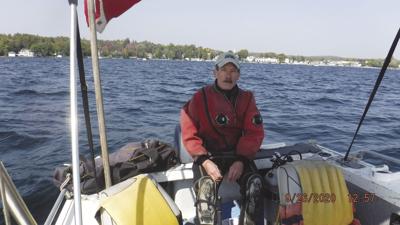
LACONIA — People are interested in people, the past and how we once lived.
That is the reason the public is fascinated by the objects and stories of diver Hans Hug. Beyond the technical gear he uses to thoroughly search the bottom of a body of water, what fascinates most is the mystery of “what’s down there” left by people who came before us.
Hug is also very interested in what people have left behind. His diving, which could be called a business or a hobby, has revealed items in lakes, rivers, and even the ocean waters of New Hampshire and beyond.
“I read a lot of history books,” he said. Historical books offer clues for places Hug will dive to look for pieces of the past, from old bottles to more significant things such as old Model Ts and other items cast off or lost for various reasons.
Hug grew up in Massachusetts, went to the State University of New York, and has a career as an insurance broker. He has lived in Exeter for 25 years, but his work as a diver takes him all over New England.
After seeing his brother, Chris, lobster diving in the 1980s, Hug took a course in open-water diving and has been an avid diver for over 30 years. Diving is also Hug’s passion on a personal level when he dives and looks for things that were discarded in the water a few hundred years ago or more recently.
His water searches have led to the location of a missing woman who disappeared nearly 40 years ago, car and all, in Massachusetts. Her body and car were recovered from the Concord River in Billerica, Massachusetts after Hug undertook a search for her. He is currently working on two dive searches to locate more missing persons.
Recently, Hug was part of a three-person operation to locate a jet plane missing in Lake Champlain in upstate Vermont for 53 years.
“It was another cold case,” Hug said. The story is fascinating, handled by Hug and two experienced colleagues who do underwater searches. Three men – Garry Kozak, of GK Consulting in Goffstown, who led the search; Hug with his EdgeTech model 4125 side scan sonar equipment owned by his business Sonar Search and Recovery; and a Remotely Operated Vehicle/ROV run by Tim McDonald, the owner of Marine Solutions in Meredith. It was initially Kozak’s idea to undertake the project as a sales engineer at sonar manufacturer EdgeTech Corp. in West Wareham, Massachusetts. Hans said his side scan sonar equipment could be likened to an ultrasound on steroids.
Kozak started the project by obtaining and carefully analyzing decades-old side scan sonar data made by Middlebury College and the Lake Champlain Maritime Museum and observed three anomalies that needed scrutiny. He brought in Hug and McDonald to help with the search on Lake Champlain.
The Rockwell Jet Commander disappeared in 1971 shortly after takeoff from Burlington International Airport with five passengers on board. It was never located and widely assumed to have crashed into Lake Champlain with no survivors. Others tried unsuccessfully to find the plane, but it was not until May 19 that Kozak, Hug, and McDonald located it.
Recalling the grueling search done on a volunteer basis, Hug said, “We made 11 trips at 400 miles per day towing my boat and eventually found the jet using his side scan sonar, and confirmed it a week later with Tim’s ROV (Remotely Operated Vehicle).”
The jet was found in this order: Kozak’s detailed research to assess the decades-old side scan sonar data and identify the possible search area; Hug’s side scan sonar to locate the jet; and McDonald’s ROV to confirm with 100% certainty (using underwater photos and video footage) that they had found the missing plane. After reporting their find to the Federal Aviation Administration and National Transportation Safety Board, the team has kept the jet’s location confidential because they feel it is the final resting place of five souls and should be private.
The find made the national news, but Hug shrugs off the success, focusing instead on future searches with his side scan sonar – and future diving explorations.
Hug dives as often as possible, usually out of curiosity and an interest in the past. He said the adage “one man’s trash is another’s treasure” is true in his case.
“The water near railroad tracks and old mills is great for diving,” he said. “Over the years, people working in the mills tossed things away, even throwing unwanted items out factory windows and into a river. I’ve found old bottles, inkwells, and lots of old glass, to name but a few things. When I find things during a dive, I open a window into another time.”
One example is a ferry crossing in New Hampshire that Hug was determined to explore. It was from the 1780s, and no one had dived at the spot. He said, “It was littered with old stuff, things just tossed into the water, long before the term littering was used.”
Those on or near lakes, such as Winnipesaukee, love to hear what Hug has found in his dives. He gives a yearly presentation at the Lake Winnipesaukee Historical Society & Museum in Weirs Beach to share his diving experiences with others. The programs are standing room only, and this year, Hug spoke about The Wrecks of Winnipesaukee, showing videos and sonar images of shipwrecks seen while diving, as well as artifacts from below the surface of the lake.
Many people wonder what would be found if people could drain the lake (of course, refilling it afterward). Hug said, “I am just one guy, but in 20 years of diving/searching Winnipesaukee, I have found at least 70 shipwrecks there. If you drain the lake, you might find 200 or more wrecks and a lot of other items.”
He said, “People love the lake, but few people get to dive and see what I see.”
Hug’s most incredible find done with his side scan sonar equipment: two massive paddlewheels from the original M/S Mount Washington, which burned in 1939. One stands upright on its edge like a donut.
“I plan to keep diving until I can’t anymore. It’s too much fun to stop. I’ll keep diving in Lake Winnipesaukee and the Merrimack and Connecticut Rivers. I love it,” he said.
Hug stresses caution for those who want to explore a river with a fast-moving current or other potentially dangerous waterways. Be aware of the water conditions and do not attempt such areas if you are not experienced.
For more information, visit sonarsar.com.


(0) comments
Welcome to the discussion.
Log In
Keep it Clean. Please avoid obscene, vulgar, lewd, racist or sexually-oriented language.
PLEASE TURN OFF YOUR CAPS LOCK.
Don't Threaten. Threats of harming another person will not be tolerated.
Be Truthful. Don't knowingly lie about anyone or anything.
Be Nice. No racism, sexism or any sort of -ism that is degrading to another person.
Be Proactive. Use the 'Report' link on each comment to let us know of abusive posts.
Share with Us. We'd love to hear eyewitness accounts, the history behind an article.