


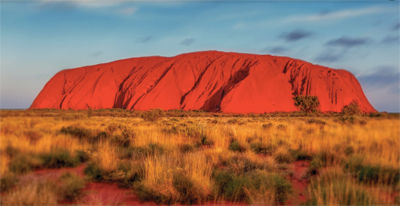
Uluru, also known as Ayers Rock, is a large sandstone rock formation in the southern part of the Northern Territory in central Australia. Uluru is sacred to the the Aboriginal people of the area. (Courtesy photo)
By PAULA HIUSER
Uluru, also known as Ayer’s rock, is an iconic monolith is in the center of Australia’s famous Outback. It is a 450 km drive from Alice Springs, the closest town, which is also in the middle of nowhere. This is where I saw the sign that pointed to Uluru and said with classic Australian humor, “Uluru, it’s a Bloody Long Way.”
We decided to take the Ghan to Alice Springs from Adelaide and a small plane from Alice to Uluru. The Ghan, short for Afghan after the camel trains that first used this route, is Australia’s iconic train. It takes 48 hours to get to Alice on the Ghan, but it has comfy berths with big windows, good food, and great company. In 48 hours you can develop a whole new group of friends and Aussies are fun people to hang out with. They love a good party, and everyone seems to have a special hangover cure – if that is any indication at all.
There is plenty of time to take in the vastness of this country. The Outback is a harsh and unforgiving landscape. The only life we saw were kangaroos, scrub, and the wild camels that were let loose when the trains replaced them.
After a quick stop in Alice Springs, we flew to Uluru. The thing that is hard to convey about Uluru is just how massive it is. There is no way to grasp the scale of this thing from a picture. It stands 348 meters high and is 10 km around its base. It is enormous, it is old, and it is sacred to the Aborigines who have been here for 22,000 years. There are sacred caves and drawings and the Aborigines still practice rituals here, so some places are off limits for cameras. The right to make the famous climb up the rock has been in dispute for a long time due to the sacred nature of this place to the Aborigines. To climb or not to climb – that was the big question?
It rained the day I was at Uluru. Spectacular pop-up waterfalls looked like fresh milk was being poured over the rock. You cannot climb in the rain as the ascent is too steep and slick and requires a chain rope at the steepest part to hold onto. Thirty-five people have fallen to their deaths – so it is not to be taken lightly. You cannot climb if the winds pick up, on top they could sweep you right over the edge. You cannot climb if there might be lightning – obviously.
The rock dried with enough time for us to make the ascent, so we decided to go up. The top of the rock is beautiful, other-worldly, and gives you a spectacular 360-degree view of the red center of Australia. The wind at the top stole words right out of your mouth. I could hear the conversations of people behind me, but I couldn’t hear the person beside me as their words were carried forward. The most miraculous thing was that the small rain-filled rock pools at the top had come to life. Tiny brine and shield shrimp that look like teensy horseshoe crabs had already hatched from eggs that lie dormant until water wakes them. Imagine shrimp at the top of this enormous rock in the baking heat of the Outback. They live until the pools dry up, long enough to lay the eggs for the next generation. My favorite line from Jurassic Park is that ‘life will find a way’ and here is the perfect example. The rock was pure magic, and the descent, well – don’t look down.
It has been about 15 years since I climbed Uluru. The climate has changed, politically and environmentally. In late 2019, the climb will be closed forever. Though I cherish the experience, I think this is for the best, out of respect for the Aborigines, and for the delicate balance of life on the rock. Inevitably, we impact every place we touch. People are careless, and it is believed that a species of shrimp has become extinct due to people urinating into the pools. As extinctions skyrocket, perhaps we need to reevaluate where humans should tread, and respect the knowledge of indigenous people who evolved with the land. The decision to finally close the climb was a big win for the Aborigines. Perhaps the sign should now say, “Uluru, you’ve come a Bloody Long Way.”


(0) comments
Welcome to the discussion.
Log In
Keep it Clean. Please avoid obscene, vulgar, lewd, racist or sexually-oriented language.
PLEASE TURN OFF YOUR CAPS LOCK.
Don't Threaten. Threats of harming another person will not be tolerated.
Be Truthful. Don't knowingly lie about anyone or anything.
Be Nice. No racism, sexism or any sort of -ism that is degrading to another person.
Be Proactive. Use the 'Report' link on each comment to let us know of abusive posts.
Share with Us. We'd love to hear eyewitness accounts, the history behind an article.