


A Dust of Snow
By Robert Frost
The way a crow
Shook down on me
The dust of snow
From a hemlock tree
Has given my heart
A change of mood
And saved some part
Of a day I had rued.
•••
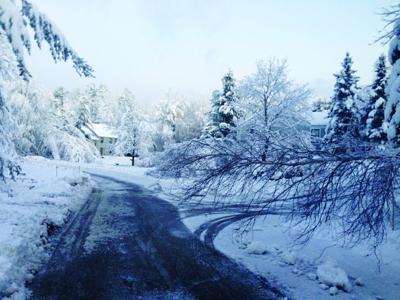
I often recall walking along a country road after a snowfall blanketed the landscape — when the sky is black, the moon is casting a yellow glow and the only sound is the crunching of snow under our boots. That moment when you can almost see and feel the individual white crystals.
What is snow?
I have learned it “consists of individual ice crystals that grow while suspended in the atmosphere — usually within clouds — and then fall, accumulating on the ground where they undergo further changes.”
Over the last few winter months, I have been reading Korean author Han Kang, who was awarded the 2024 Nobel Prize in Literature “for her intense poetic prose that confronts historical traumas and exposes the fragility of human life.”
We read the translations of her writing, after the books have been published in Korea. The “White Book,” a delicate book, was my introduction to her writing. The narrative, written in short fragments, relates to the birth of her mother’s first child and then the death of the child, hours after she was delivered. A girl who would have been Han Kang’s older sister. There are references throughout the narrative to 65 white objects, both material and natural. I have kept the book on the corner of my desk, often just opening it to read one or two of the pages.
Then I began reading Han Kang’s other books. “The Vegetarian,” which was awarded the Booker Prize in 2016; “Greek Lessons,” published in the United States in 2023; “Human Acts,” which looks at the uprising in Gwangju, South Korea in 1980; and now, her most recent book, just published in January, “We Do Not Part.” While I have read through all her books once, I am now returning to reread through them again.
Snow is a metaphor throughout her writing. Snow covers over the trauma of political violence and painful memories. It represents cycles of life and death, and suggests we linger in the past. When white snow covers the earth, it obscures what we knew was there.
While her books describe violent domestic uprisings, turmoil and brutal killings, there is such beauty in the language it is difficult not to want to read more. She poses the question: What does it mean to be human?
In her Nobel acceptance speech, which can be found on the Nobel Prize website, she writes that through her work, “until the autumn of 2021, when ‘We Do Not Part’ was published, I had considered these two problems to be the ones at my core: Why is the world so violent and painful? And yet how can the world be this beautiful?”
When snow covers the earth, “falling like light feathers” everything is peaceful, quiet, and translucent. That’s why I love snow. That’s when the world is beautiful and can, as Robert Frost suggests, shift our mood. Snow brings us, writes Han Kang, “the weight of beauty.”
•••
Elizabeth Howard is the host of the Short Fuse Podcast, found on Spotify, Apple Podcasts or through the Arts Fuse. Her career intersects journalism, marketing, and communications. “Ned O’Gorman: A Glance Back,” a book she edited, was published in May 2016. She is the author of “A Day with Bonefish Joe,” a children’s book, published by David R. Godine. You can send her a note at: eh@ elizabethhoward.com.


(0) comments
Welcome to the discussion.
Log In
Keep it Clean. Please avoid obscene, vulgar, lewd, racist or sexually-oriented language.
PLEASE TURN OFF YOUR CAPS LOCK.
Don't Threaten. Threats of harming another person will not be tolerated.
Be Truthful. Don't knowingly lie about anyone or anything.
Be Nice. No racism, sexism or any sort of -ism that is degrading to another person.
Be Proactive. Use the 'Report' link on each comment to let us know of abusive posts.
Share with Us. We'd love to hear eyewitness accounts, the history behind an article.