


MEREDITH — Erica Berman didn’t grow up knowing “lake culture,” as she put it. Instead, she married into it, and it was getting to know her in-laws’ cabin in Moultonborough that inspired her play, “No Wake,” which explores the conflicts and connections which bloom between the many different people that find themselves on the shores of Lake Winnipesaukee.
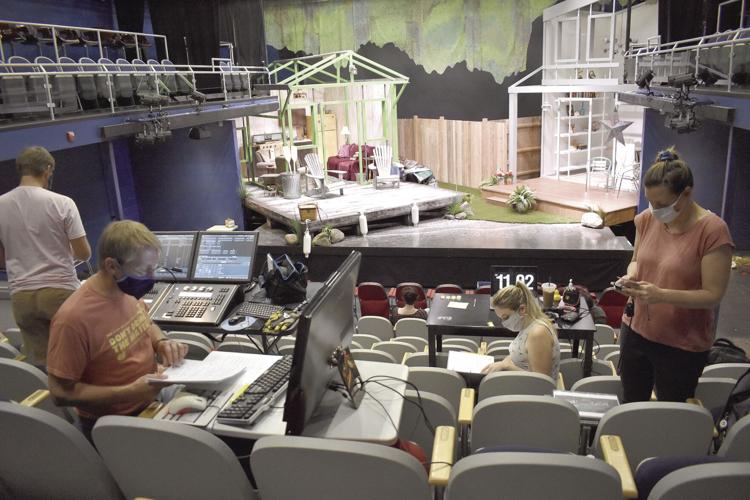
“No Wake,” which is set in Moultonborough, is currently being staged at the Winnipesaukee Playhouse, with dates through this weekend and another run of shows Oct. 7-11. Though there were two plays staged outdoors at the end of this summer, this play marks the first time that the playhouse is using its indoor theater since the governor issued his stay-at-home order in the spring.
The outdoor shows came at a steep cost for the nonprofit theater organization. The expanded stage and terraced seating they installed required a significant investment, and although patron and company services director Lesley Pankhurst said the artistic value was high for the two shows they staged outdoors, the social distancing they felt obliged to maintain between each group of patrons meant they couldn’t sell enough tickets to come close to recovering their outlay costs.
That wasn’t necessarily the point of the outdoor shows, Neil Pankhurst, the group's creative director, said in a previous interview about the outdoor shows. The goal, rather, was to bring live drama back to the Lakes Region, do it in a way that would make audience members feel safe, and to make improvements to the organization’s campus that will bear fruit for years to come.
The indoor show fits in much the same framework. Seats will be sold in only half of the rows, and at least two empty seats will be left between groups of audience members, all of whom will be expected to wear masks for the duration of the show.
With the seating arrangement, they won’t be able to sell more than half of the seats for any given show. Meanwhile, improvements to the theater’s air handling system, made to further limit the transmission of airborne diseases, will add an up-front cost of between $10,000 and $12,000 to the theater’s operation.
Thom Beaulieu, a board member of the theater, is handling the upgrade to the HVAC system. He said the organization looked at what some other theaters are doing and found that some are adding ultraviolet lights to their ventilation systems in order to kill any pathogens, including viruses, that might be circulating within the building. Others have used a powered ionizing filter, which will trap small particles before the air is pumped back into the auditorium, lobby or other indoor spaces. Winnipesaukee Playhouse, Beaulieu said, has chosen to do both.
Neil Pankhurst said “No Wake” has no chance of selling enough tickets to make the production profitable. Rather, success will be measured by whether audience members agree that they’ve created a safe environment for indoor theater. That is an important question, as the coronavirus pandemic is expected to continue into 2021.
Lake culture
Berman lives in Madison, Wisconsin, which is where she wrote and developed the play. But it was an experience she had in New Hampshire that sparked the story for her, she said.
Berman is a New Jersey girl who came to know Lake Winnipesaukee and the mix of people that spend time on the lake, as an adult.
Her husband’s great-great uncle built a cabin on Winnipesaukee more than 100 years ago, and she said she owes the concept for “No Wake” to one particular day she spent on the lake.
“I was just so struck by this culture of people who live in New Hampshire all of the time, and the people who come to New Hampshire for the summer. That dichotomy really interested me,” said Berman in a phone interview. “It really fascinated me, that need for each other. I was writing it just before the last election, thinking about these Clinton bumper stickers driving past Trump signs.”
In areas of larger population, she said, it’s possible to go about her day without mixing with people of other socioeconomic circumstances or political beliefs. Not so in central New Hampshire, where everyone shops at the same supermarket and relies on the same tradespeople to take care of their properties. Everyone eats at Hart’s Turkey Farm, she said.
“You rely on each other, you lean on each other. That all really fascinates me,” she said.
Sometimes, we yell at each other.
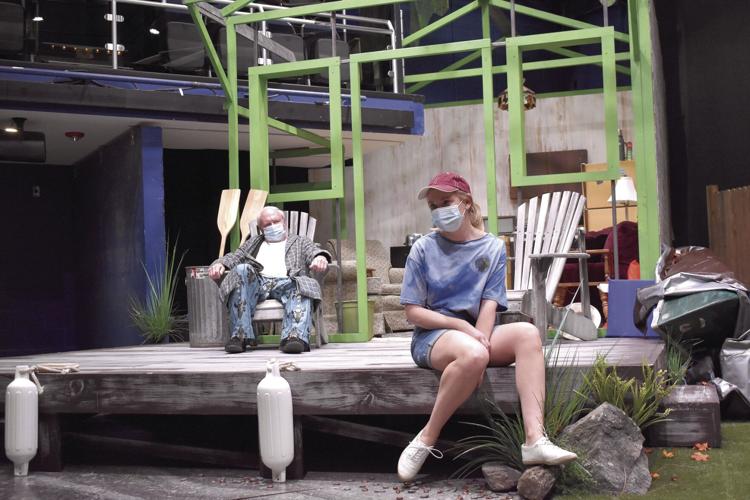
“There was one episode in particular that really inspired the play,” Berman said. She was relaxing at her in-laws’ camp when they heard a man yelling “No wake!” through a bullhorn. Berman hadn’t heard the phrase before, so she and her husband decided to launch kayaks to investigate. What they found was a vintage camp in a no-wake zone, with lots of loon-related decor, and seemingly the dominion of a single, older man.
“Oh my God, this is the set of a play,” Berman said was her immediate thought.
The resident of that camp, at least the one that Berman imagined, is one of the two characters in the play. The other is someone who is spending the summer at a neighboring camp. The characters are from different generations and economic classes, but they share something in common: they both have a need to connect with another human being.
“This is a play about loneliness and loss,” Berman said. Although the script was completed prior to the pandemic, she said those emotions – isolation and longing – are more broadly relatable than ever before. “I think that’s something that everyone will be able to identify with.”
In fact, it’s only because of the pandemic that the Winnipesaukee Playhouse chose “No Wake” for its indoor experiment. Berman contacted the theater last winter with her script on offer, but Neil Pankhurst initially told her that they would only do a stage reading, not a full production, because they had just produced “On Golden Pond” last year.
When it came time to choose a pandemic-friendly play, though, Pankhurst found that “No Wake” was a perfect fit. It had the appropriate emotional themes, requires only two actors, and fits with his original theme of the year of honoring women in theater.
Berman said she is thankful for Pankhurst’s change of mind.
“I am beside myself with excitement and gratitude. I am so thrilled,” Berman said. “I wanted to bring this play home, as it were… Winnipesaukee is like a third character, besides the two actors we see on the stage. To bring (the play) back to people who know Winnipesaukee, and love Winnipesaukee, like I do, is a gift.”


(0) comments
Welcome to the discussion.
Log In
Keep it Clean. Please avoid obscene, vulgar, lewd, racist or sexually-oriented language.
PLEASE TURN OFF YOUR CAPS LOCK.
Don't Threaten. Threats of harming another person will not be tolerated.
Be Truthful. Don't knowingly lie about anyone or anything.
Be Nice. No racism, sexism or any sort of -ism that is degrading to another person.
Be Proactive. Use the 'Report' link on each comment to let us know of abusive posts.
Share with Us. We'd love to hear eyewitness accounts, the history behind an article.