


Where were you on July 20, 1969, 50 years ago, the day Apollo 11’s Neil Armstrong and Buzz Aldrin walked on the moon? While I can’t remember the moon walk in any detail, I can vividly recall watching Alan Shepard, from Derry, being sent into space in Freedom Seven. My mother gathered us around our small, black and white television to experience this historic moment. What fascinated me was watching her expression as she focused intensely on the screen.
While I never harbored any thoughts of wanting to be an astronaut (I knew I wanted to be a writer) I have always been intrigued by the thought of space exploration. Last week PBS, as part of their American Experience series, featured “Chasing the Moon,” a three-episode film by Robert Stone that “reimages the race to the moon for a new generation.” It’s available to stream and is fascinating because it puts the race to the moon in historical context.
At the same time the focus has been on the anniversary of the first moon walk, I have been reading the uncorrected proofs of a book titled, "Handprints on Hubble" (MIT Press, Cambridge, Massachusetts, November 2019), written by my friend Kathryn D. Sullivan. Kathy flew on three shuttle missions and logged more than 530 hours and 8.6 million miles in orbit. She was on the shuttle that launched the Hubble telescope and with Bruce McCandless they were “the only two Hubble repair spacewalkers in the universe.” The book can be pre-ordered from Amazon. I couldn’t put it down.
I met Kathy years ago and had an opportunity to reunite her, over a dinner in New York, with the late Henry Cooper, who covered the space program for the New Yorker and published a book entitled: "Before Lift Off, the Making of a Space Shuttle Crew" (John Hopkins University Press, 1987). Henry had been given permission to embed himself into the astronauts' one-year training program prior to a shuttle mission. It was new territory for a writer and journalist and it was Kathy’s first flight. What an experience that dinner was, listening to the banter between the two as, years later, they recalled those halcyon days of the space program.
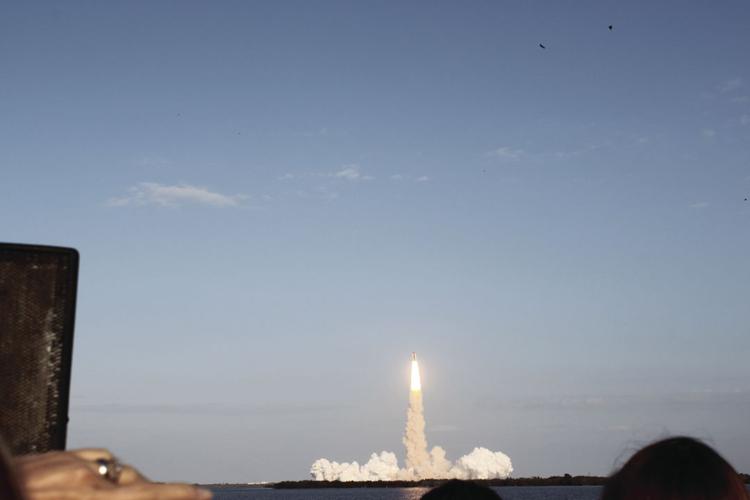
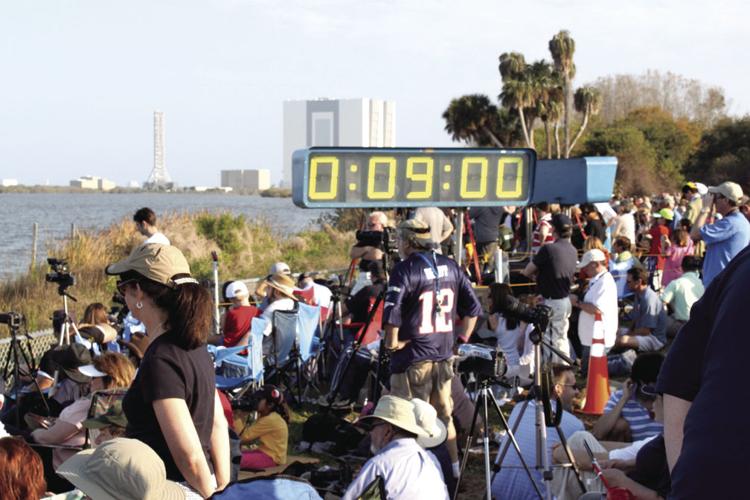
On February 23, 2011, the shuttle Discovery was blasted into space for the last time and this marked the end of the shuttle program. Diana Balmori, a close friend and colleague, had always wanted to attend a launch and Kathy made arrangements for us to have VIP tickets. We flew to Florida early one morning and drove to the space center. I remember getting there almost as vividly as the launch, because we were late, the single lane traffic was bumper to bumper and, as the driver, I had to make the decision to “risk” slipping out of the line to drive along the edge of the road so we could be on time. When you’re thinking about space and exploration, earthly risk seems negliable.
At the appropriate moment a loudspeaker begins the countdown. Ten, nine, eight, seven … until the final words, “Discovery crew cleared to go, enjoy the ride.” Kathy describes in her new book the actual sensation of being aboard the shuttle at this moment.
There have been many books written by astronauts and others involved in NASA and the space program, and yet the one that stands out is Michael Collin’s "Carrying the Fire" (Farrar, Straus and Giroux, New York, 1974). The book has just been re-released in a 50th Anniversary Edition with a Foreword by Charles A. Lindbergh. Mr. Collins describes the earth … “just outside my window, motionless, cradled in black velvet. That sight – the Earth, tiny, shiny, blue of sky and water, white of clouds, with only a brown trace of land – haunts me. … Surprise? If allowed one word to describe Earth, I would say fragile.”
Listen to the interviews, watch the movies, read the books and the one common thought that threads and connects them is the word "cooperation." The recognition that it is the teamwork of thousands of people working together that assures missions into space are achieved. If only governments could set goals, trust invention and work as seamlessly to care for our “fragile” planet.
Elizabeth Howard is an author and journalist. Her books include: Ned O’Gorman: A Glance Back, a book she edited (Easton Studio Press, 2015), A Day with Bonefish Joe (David R. Godine, 2015), Queen Anne’s Lace and Wild Blackberry Pie, (Thornwillow Press, 2011). She lives in New York City and has a home in Laconia. You can send her a note at: Elizabeth@laconiadailysun.com


(0) comments
Welcome to the discussion.
Log In
Keep it Clean. Please avoid obscene, vulgar, lewd, racist or sexually-oriented language.
PLEASE TURN OFF YOUR CAPS LOCK.
Don't Threaten. Threats of harming another person will not be tolerated.
Be Truthful. Don't knowingly lie about anyone or anything.
Be Nice. No racism, sexism or any sort of -ism that is degrading to another person.
Be Proactive. Use the 'Report' link on each comment to let us know of abusive posts.
Share with Us. We'd love to hear eyewitness accounts, the history behind an article.