


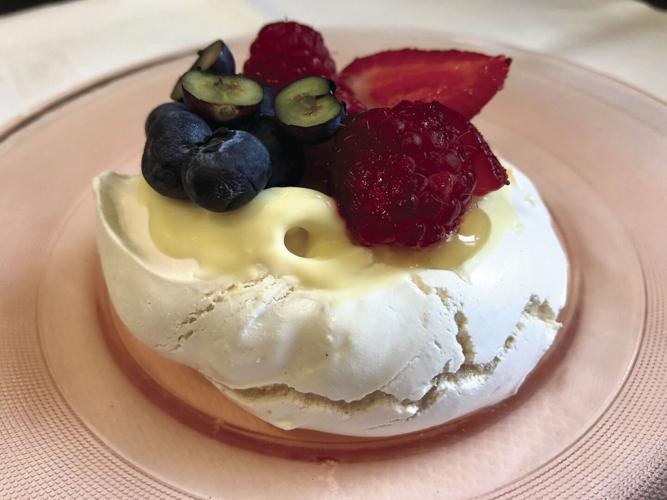
Light airy meringues are a great summer dessert alternative to the heavier biscuits and cakes. Creating the perfect meringues is easy once you understand a few facts.
Always start with cold eggs, because refrigeration keeps them fresh, compared to eggs that have been left out to warm at room temperature. It is true that warm eggs will whip faster, but not to their maximum volume or best structure. It's the same when using whole eggs, yolks or whites.
Perhaps on a trip to Europe you have noticed that they store eggs at room temperature, so why don’t we? American egg producers focus on preventing contamination from the outside, so they are required by the USDA to thoroughly wash the eggs before they go to market. They’re rinsed in hot water, dried and sprayed with a chlorine mist almost as soon as they’re laid.
Europeans take a different approach. In the United Kingdom, for example, producers instead vaccinate laying hens to prevent the transmission of salmonella. They then rely on a thin, naturally occurring coating called the cuticle, to prevent any contamination from the outside of the shell penetrating to the egg.
You can safely warm cold eggs by mixing with the sugar in a bowl over simmering water until they are warm. The other added benefit with this method, is that it also dissolves the sugar into a liquid causing less friction while whipping. You will also notice the meringue whips much faster. Normally to avoid this the sugar is added slowly while the whites are whipping allowing it to dissolve. If you add the sugar all at once it doesn't dissolve completely and instead forms a clear, semi-dissolved rope that drags in the egg whites, causing lower volume and a weaker structure.
Most recipes have you whip at high speed, but for the best structure and foam, start at high speed to get the volume, then reduce to a lower speed to which creates smaller bubbles for better structure and a smoother mixture.
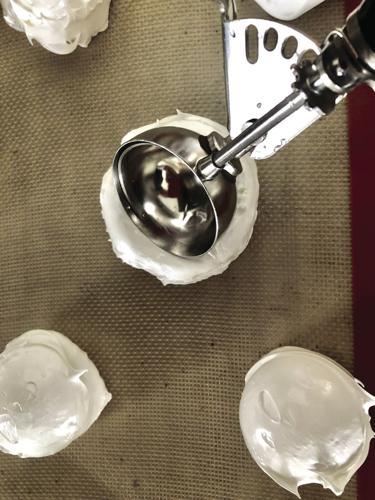
For scooping the nest I use a 3-ounce, spring-triggered ice cream scoop with about a 2 inch-wide opening. You can also use a large kitchen spoon to achieve similar results, the scoop is just easier.
If you are baking in a convection oven and using parchment paper, the fan will often lift the uncovered edges of the paper flipping it over on top of the meringues. To prevent this, place a dollop of meringue about the size of a nickel under each corner of the parchment, then press on the parchment to flatten it and fuse it to the cookie sheet.
You can also easily melt chocolate in a microwave. Just remember these tips!
Chop the chocolate into small pieces and spread in a bowl. Never heat more than 20 seconds without stopping and stirring the chocolate! It’s deceiving because it melts in the center of the chocolate first, so you may not think it has melted. Chocolate also burns very easily, which is another reason you need to stir it so you are distributing the heat in the melted chocolate. Never completely melt the chocolate in the microwave, only melt until 75% is melted. The remaining 25% helps to cool the chocolate and redistribute the cocoa butter. Just repeat the 20 second heating then stirring rule until the chocolate is melted to 75%. Dark, milk and white all melt differently, some take longer to melt.
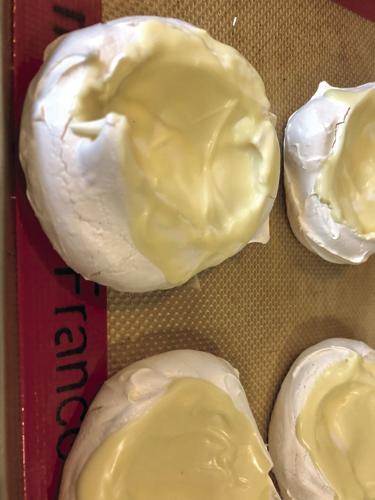
Brush the top of the wells with a thin layer of melted chocolate to add an interesting flavor and texture that will complement berries and prevent the meringues from becoming soft from curds or caramel you may want to add to enhance the fresh fruit. Cut some of the berries in half to make a more interesting presentation by exposing the colorful and succulent center. Or try adding a scoop of ice cream or sorbet topped with a complementing sauce and toasted nuts or coconut.
Meringue Nest
Yields 8 medium size meringue nests
2 extra large egg whites, cold
2/3 cup sugar
Line a cookie sheet with parchment paper or a baking pad.
Adjust oven rack to lower third level. Preheat the oven to 200°F, or 175°F if using a convection oven.
Create a double boiler by combining a medium size saucepan with a stainless steel bowl that will fit securely over the top. Place a wire whisk and 3 ounce ice cream scoop within reach.
Fill the sauce pan with about 1 inch of water and heat to a boil. Meanwhile add the whites and sugar to the bowl and whisk until smooth.
Once the water has boiled, reduce to a simmer and place the egg white mixture on top. Use the whisk to stir continuously, blending the whites and sugar. The stirring will also distribute the heat generated at the bottom of the bowl. After a few minutes the mixture will be warm, about 130-135°F, quickly transfer mixture to the bowl of an electric stand mixer.
Attach the whip and beat at high speed for 2 minutes, until the mixture doubles in volume. Reduce to medium speed and continue whipping for another 3 minutes or until firm peaks form with a satin sheen.
Scoop 8 meringues equally spaced onto the lined cookie sheet. Center the back of the scoop over the scooped meringue and gently press down 2/3 deep, then turn the scoop to form the indentation. Do this to each mound of meringue.
Place on the adjusted rack and bake for 30 minutes. Then rotate from the pan from front to back for even baking. Continue baking for another 30 minutes, or until firm to the touch and the shells are easily removed using a thin metal spatula. Remove the pan from the oven and cool on a rack.
Once cooled, store meringues in an airtight container in a cool dark area. You can layer them with sheets of parchment paper.
Melting Chocolate
4 ounces chocolate, chopped
Spread the chocolate in a shallow stainless steel bowl working its way up the sides so it forms a well.
Fill a small saucepan with 1/3 of water and bring to a simmer. Turn off the heat and place the bowl of chocolate on top. Let stand until about a half the chocolate has melted. Stir the chocolate with a large stainless steel spoon or rubber spatula to cover the remaining unmelted chocolate. Let stand for a few more minutes or until 80% melted. Stir until all the chocolate is melted. Move the bowl from the heat and to a counter. Continue stirring for another minute until the chocolate is without streaks, streaks are an indication of isolated cocoa butter in the chocolate. Using it at this stage will cause white streaking when it hardens.
Use the back of a spoon to coat the well of the meringues with a thin layer of melted chocolate. Set aside to harden.


(0) comments
Welcome to the discussion.
Log In
Keep it Clean. Please avoid obscene, vulgar, lewd, racist or sexually-oriented language.
PLEASE TURN OFF YOUR CAPS LOCK.
Don't Threaten. Threats of harming another person will not be tolerated.
Be Truthful. Don't knowingly lie about anyone or anything.
Be Nice. No racism, sexism or any sort of -ism that is degrading to another person.
Be Proactive. Use the 'Report' link on each comment to let us know of abusive posts.
Share with Us. We'd love to hear eyewitness accounts, the history behind an article.