


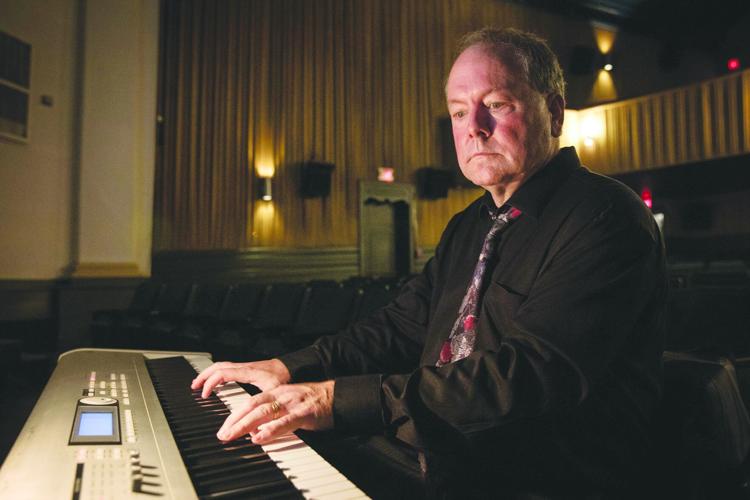
PLYMOUTH — Jeff Rapsis said he was “a weird child” because, when he was growing up, his interests were unusual. Rapsis was raised in Nashua and introduced to something that jump-started a lifetime interest: silent movies and the music accompanying them.
“When I was in junior high school in the 1970s, my music teacher was a film collector. He played some of those movies in a study hall. The other kids weren’t very interested, but I was fascinated,” Rapsis said.
The silent movies starring Charlie Chaplin held particular interest for Rapsis. Chaplin was a masterful pioneer movie comedian. Rapsis was fascinated and soon went to the local library to learn more about silent movies and the stars of the old days.
“I found out I could mail order to receive a silent movie from a collection, and I started there,” he said.
Rapsis studied music in high school and began making his own films; he still has his early attempts.
“I don’t come from a musical family,” he said. “However, my mother got some LPs of the music of Bach and other classics, which got me serious about music. I wanted to be a composer because I always had music in my head.”
When Rapsis realized there was very little demand for movie composers, he majored in English in college and became a newspaper reporter. But he never forgot the charm of the silent movies he loved as a kid, and he did not give up on music.
Rapsis played keyboards in pit bands and did a musical score for a film called “Dangerous Cross Winds” and realized he greatly enjoyed the creative work.
His love of silent movies returned when Rapsis learned there was an open night at the Palace Theatre in Manchester.
“I mentioned to the executive director of the theatre that maybe they could fill the spot with a silent movie. It was during the Halloween season, and we decided to show ‘Phantom of the Opera.’ I accompanied the movie with a digital keyboard and just winged the music,” Rapsis said. “It was wonderful and a lot of fun.”
Realizing he could improvise the music to accompany a silent movie with good results, he was off and running. Although silent movies have been around since the early part of the 1900s, with the advent of talking films interest in the silents faded away. Over the years there has been little call for the old-time, classic form of entertainment.
“Back in the silent movie days, every film was like a magic carpet ride,” Rapsis said. “A movie could take the audience to a place they were unlikely to ever see otherwise, such as a desert or a trip back in time. These things were just not available in a typical home at the time. Movies, also, at the time, were a shared experience.”
Silent films feature no soundtrack, no dialogue, and no explanations in spoken words, but with the occasional text slide for context.
“The stories were about fear, love, joy, and other emotions. Today, we watch a movie at home, sometimes alone, and it is much less of a group experience,” Rapsis said. “At the Flying Monkey, we show the silent movies as they were meant to be shown, in their unique form.”
Rapsis shows movies and performs musical accompaniment all over the state and beyond. From a large movie theatre to a modest setting, such as a yearly silent movie showing at the “Blazing Star Grange” in Danbury, curious people come to see a silent film for the unique experience. Rapsis said people of all ages attend the Danbury showing.
Using a digital synthesizer, Rapsis can create every type of music according to what fits the scene in each movie. For example, a cowboy western silent movie might open with an exciting chase, guns blazing. Rapsis would pull out all the stops and create fast-paced, thrilling music. If the following scene was romantic, he could fit the music at a more emotional level.
The most popular movies Rapsis shows are comedies featuring once popular stars like Buster Keaton.
“I screen about 100 shows a year, and I have done 400 shows total in every setting from a high school cafeteria to a nursing home to a full stage,” Rapsis said. At most places, he plays and shows silent movies, and he suggests which films to show; presenters rely on his knowledge.
Few people have much experience with old silent movies and the stars who played in them, but Rapsis is as familiar with the names of Chaplin, Keaton, Mary Pickford, and many others as one would be with today’s stars. He hesitates to name his favorite silent movie star because they were all good in their own way. He mentioned Mary Pickford, once known as “America’s Sweetheart,” represented hope to a world sometimes at war, sometimes struggling with financial woes and other situations.
“She played remarkable characters, often downtrodden women who had to fight their way out of a bad life. People loved her movies because they were good stories,” Rapsis said.
In the future, Rapsis hopes to continue presenting silent movies and providing the music for each film. He is also busy as the executive director of the Aviation Museum of New Hampshire, located in Londonderry.
“I want to expose new audiences to silent movies,” he said. “I also want to spend more time writing music. I really want to use the music I have had in my head all these years. For me, working with silent movies is a dream come true.”
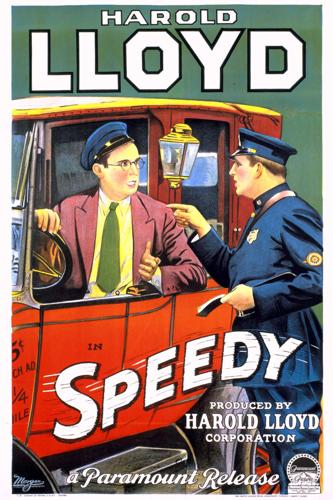
A showing of the 1928 silent film “Speedy” with comedian Harold Lloyd will be shown on Thursday, May 22, at the Flying Monkey Movie House and Performance Theatre on Main Street in Plymouth. The show begins at 7 p.m. Visit flyingmonkeynh.com for more information.
For more from Rapsis, visit silentfilmlivemusic.blogspot.com.


(0) comments
Welcome to the discussion.
Log In
Keep it Clean. Please avoid obscene, vulgar, lewd, racist or sexually-oriented language.
PLEASE TURN OFF YOUR CAPS LOCK.
Don't Threaten. Threats of harming another person will not be tolerated.
Be Truthful. Don't knowingly lie about anyone or anything.
Be Nice. No racism, sexism or any sort of -ism that is degrading to another person.
Be Proactive. Use the 'Report' link on each comment to let us know of abusive posts.
Share with Us. We'd love to hear eyewitness accounts, the history behind an article.