


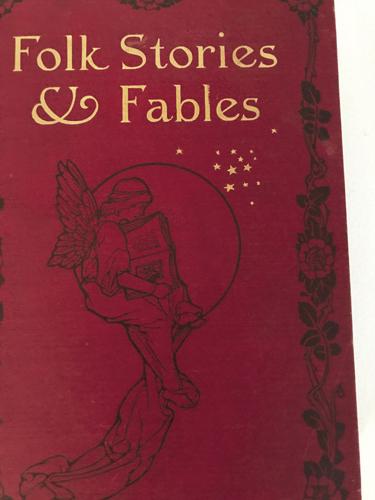
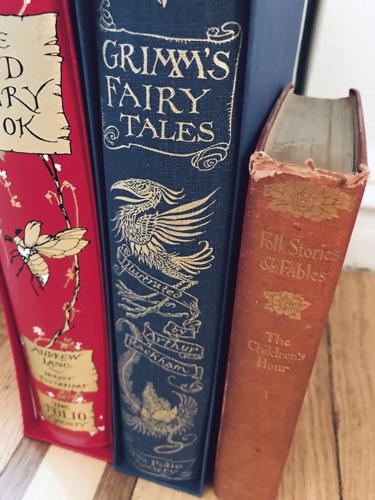
One of the books on my shelf is a worn and faded copy of Folk Stories & Fables, selected and arranged by Eva March Tappan and published by Houghton, Mifflin and Company in 1907. The book belongs to my mother and in her beautifully written script her name appears on one of the endpapers inside the cover, a clear indication she used the book for readings.
This week as we settled back into our routine after spending a festive and glorious holiday season it occurred to me that “Cinderella: Or, The Glass Slipper” could be used as a metaphor for New Year’s Eve, and I used this as an excuse to reread the enchanting story.
The holiday season is the ball, when everything seems to sparkle, homes become wonderlands with lighted trees and people gather clothed in “a red velvet dress, with point-lace trimmings’ or “a brocaded train and a circlet of diamonds.” Diets are abandoned for Buche de Noel, and cookies laden with sugar and chocolate. Disputes are set aside, colleagues work harmoniously, and families gather in a spirit of love.
Then the ball drops at exactly twelve o’clock midnight on December 31. The carriage becomes a pumpkin, the dapple-gray horse becomes a mouse, the coachman is transformed into a rat and the six footmen become lizards. The second morning in January there is the feeling the magic is gone. There is the exhaustion from removing and storing the holiday decorations, distress as the bills begin to pile up on the desk, the morning alarm seems particularly obnoxious and the zipper on your favorite pair of jeans is a little tight.
The diet begins and then a cookie or two creeps in. With all good intentions we go to the gym the morning after New Year’s and then the next morning it’s just too difficult to get out of bed. Life falls back into a routine. There are days in January when we feel like Cinderella the morning after the ball. It’s back to sweeping the hearth.
“Cinderella” can be traced back to the Greeks. It was a French writer, Charles Perrault, who added the pumpkin, the fairy-godmother and the glass slipper into the story in 1697. His story was titled “Cendrillon” and it became one of the most popular fairy tales.
When Cinderella eventually becomes a princess, after suffering at the hands of her evil stepmother and step-sisters, she “was as good as she was beautiful, and wished everyone about her to be happy, allowing her sisters to lodge in the palace, and gave them in marriage, that same day, to two lords belonging to the court.” Cinderella brought grace and kindness into the kingdom.
Don’t worry about eating too much chocolate (it actually has health benefits), walk upstairs instead of taking lifts and you’ll add lots of exercise to your daily routine, sleep a little longer (most Americans don’t get enough sleep). Most importantly, try to spread goodness into the world.
The ball has dropped. Now beauty is found in the winter sun, watching the birds fly through the frozen air and the warmth of true friendship.
Elizabeth Howard is an author and journalist. Her books include Ned O’Gorman: A Glance Back, a book she edited (Easton Studio Press, 2015), A Day with Bonefish Joe (David R.Godine, 2015), Queen Anne’s Lace and Wild Blackberry Pie, (Thornwillow Press, 2011). She lives in New York City.


(0) comments
Welcome to the discussion.
Log In
Keep it Clean. Please avoid obscene, vulgar, lewd, racist or sexually-oriented language.
PLEASE TURN OFF YOUR CAPS LOCK.
Don't Threaten. Threats of harming another person will not be tolerated.
Be Truthful. Don't knowingly lie about anyone or anything.
Be Nice. No racism, sexism or any sort of -ism that is degrading to another person.
Be Proactive. Use the 'Report' link on each comment to let us know of abusive posts.
Share with Us. We'd love to hear eyewitness accounts, the history behind an article.