


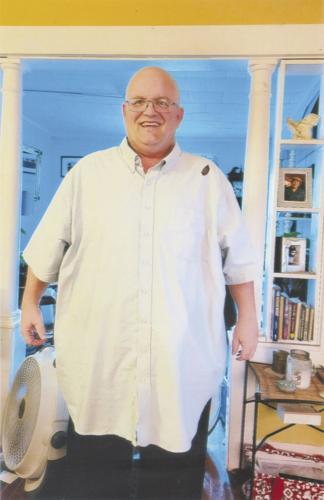

PLYMOUTH — Local resident Ike Barton had always been a big guy, but a year ago, he reached his heaviest weight of 370 pounds. His health was deteriorating, and during a routine checkup, his primary care physician revealed that Barton was on the verge of becoming an insulin-dependent diabetic.
Fearful of needles and desperate for a change, Barton asked about his options. His doctor presented two choices: return to a dietitian or weight loss surgery. Determined to change the direction he was heading, Barton decided to pursue both at the Weight Loss Center at Speare Memorial Hospital.
Weight loss or bariatric surgery is scientifically recognized as a life-saving measure — the most effective and long-lasting treatment for people with an excess weight problem. A new study found that eligible people who have weight loss surgery are significantly less likely to die from heart disease, diabetes or cancer than those who don’t.
“I was able to prolong it as long as possible, but now I was at my highest weight,” says Barton. Maxed out on medication, particularly Metformin, for over a decade, he knew he had to take action. He made an appointment with the Weight Loss Center at Speare, where Dr. Robert Chastanet, a fellowship-trained Speare surgeon specializing in weight loss surgery, determined that Barton was an ideal candidate for weight loss surgery due to his high BMI and history of gastroesophageal reflux disease.
Over the next six months, Barton embarked on a transformative journey. He worked with Speare dietitian Janette Gaumer, consulted a psychologist to ensure his readiness for surgery, and joined Speare's weight loss support group, where he found inspiration and a wealth of practical advice. Under the Weight Loss Center’s guidance, Barton underwent a profound shift in his relationship with food.
“They literally changed how I look at food, even how I look at water,” he said. “I no longer live to eat; I eat to live.”
Barton learned to make healthier choices and adopted a new perspective on eating that focuses on food as a means to live a healthier life.
Instead of eating when bored, Barton established a structured eating routine and learned to savor each meal. He says the process wasn't a burden or a chore like previous diets; it became a lifestyle change.
It was decided that gastric bypass was the ideal surgery for Barton. Gastric bypass is considered the gold standard for significant, long-term weight loss in people with clinically excessive weight. It changes how much can be eaten, how digestion occurs and how food is absorbed. These changes let the body use excess fat for energy, resulting in weight loss. Gastric bypass can also lead to hormonal changes that lessen the appetite, which assists in keeping off weight.
“I was a little apprehensive,” said Barton. “But because of my GERD, I’ve had endoscopies and colonoscopies since turning 45, so my fear of becoming an insulin-dependent diabetic far outweighed my fear of surgery.”
The surgery, performed on Barton's 53rd birthday, marked a turning point in his life. “I don’t hurt anymore. I figure that I have given myself another 15 to 20 more years.”
Ten months post-surgery, Barton's weight has dropped to 246 pounds, representing an impressive one-third reduction in his body weight. His clothes hang differently — his 5x shirt size is now 1x, his belt has reduced from 60 inch to 42 inch and even his shoe size has shrunk because he no longer carries the excess weight that flattened his arches and widened his feet.
Beyond the physical changes, Barton's energy levels have skyrocketed, allowing him to reclaim an active, fulfilling life. And he no longer needs to take his blood pressure, GERD or diabetes medication.
“I am forever thankful for the Weight Loss Center at Speare. They have reopened my way of thinking about life,” said Barton. “The support and knowledge they offer is phenomenal. It’s top-notch beyond belief.”
The next Weight Loss Center at Speare info session is Thursday, Sept. 21. Learn more at SpeareHospital.com/weightloss.






(0) comments
Welcome to the discussion.
Log In
Keep it Clean. Please avoid obscene, vulgar, lewd, racist or sexually-oriented language.
PLEASE TURN OFF YOUR CAPS LOCK.
Don't Threaten. Threats of harming another person will not be tolerated.
Be Truthful. Don't knowingly lie about anyone or anything.
Be Nice. No racism, sexism or any sort of -ism that is degrading to another person.
Be Proactive. Use the 'Report' link on each comment to let us know of abusive posts.
Share with Us. We'd love to hear eyewitness accounts, the history behind an article.