


Memorial Day weekend marks the unofficial start of summer on Lake Winnipesaukee. Docks are in, boats are launching, grills are heating up, and there's that familiar buzz of people settling in for the season. It’s the time of year when the lake starts to wake up again, but it’s also a time to be mindful of early-season conditions like high water levels and cold-water temps.
As of Thursday, May 22, at 10 a.m., the lake level was 504.63 feet, about 3.7 inches above the full lake level of 504.32 feet. When the lake runs high like it is now even small wakes can cause erosion, damage docks, and impact shoreline properties. Erosion doesn’t just wash away the soil, it carries sediment and nutrients into the water, which can decrease water clarity and contribute to plant growth and cyanobacteria blooms. Over the past few weeks, I’ve been taking calls and responding to questions on social media about why a “no wake order” hasn’t been issued or considered. It’s a good question, and to help clarify, it’s worth explaining how these decisions are made and what the current process looks like.
In 2024, the state passed HB1360, which gives the Commissioner of the Department of Safety the authority to establish temporary no wake zones for up to 10 days during emergencies caused by weather or environmental conditions. There is no set lake level that automatically triggers a no wake order. Instead, decisions are based on multiple factors including rainfall, inflow and outflow rates, downstream impacts, weather forecasts, and input from the Department of Environmental Services.
For historical context, a no wake restriction was last issued on Winnipesaukee in July 1998, when the lake level was at 505.53 feet. In May 2006, a wake restriction was not implemented when the lake was at 505.45 feet, nor in July 2023, when the lake was at 504.98 feet. In both cases, Marine Patrol released a statement urging boaters to operate at headway speed to reduce shoreline impacts.
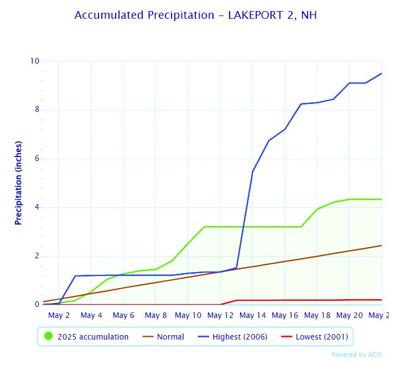
This May has been much wetter than usual, with over four inches of rain already recorded this month, almost two inches above normal for this time of year. On Thursday, the Dam Bureau reported an outflow of 1,550 cubic feet per second. It’s important to remember that Winni is an interconnected system. Releasing too much water too quickly from Lakeport Dam can cause problems downstream, especially in areas like Silver Lake in Belmont, where high water levels can severely impact property owners.
In addition to high water concerns, boaters should be aware that lake temperatures remain dangerously cold. As of this week, Lake Winnipesaukee is around 50 degrees. Earlier this month, NH Marine Patrol issued a seasonal warning about the dangers of cold-water immersion, which remain high throughout the spring and early summer in New Hampshire. Even on sunny days, water temperatures in lakes and rivers often stay below 60°F well into June. Falling into cold water can lead to cold shock, hypothermia, and drowning in just minutes, even for strong swimmers. It can impair muscle function and make it difficult to stay afloat or put on a life jacket. Marine Patrol urges boaters to stay safe by always wearing a life jacket, checking water temperatures before heading out, dressing for the water (not the air) and carrying a waterproof communication device.
As the lake wakes up and the summer season begins, let’s make sure we’re starting it off right, by staying aware of current conditions and being mindful of the water. Whether it’s keeping your wake low near shorelines or making sure you’re prepared for cold water, a little extra caution this time of year helps protect not just the lake, but the people and places we all care about. Here’s to a safe, respectful, and memorable start to summer on Winni.
•••
Bree Rossiter is the conservation program manager for the Lake Winnipesaukee Alliance. She leads the water quality and cyanobacteria monitoring efforts, coordinates the LakeSmart program to promote lake-friendly practices among property owners, and supports community education and outreach initiatives. Bree can be reached at brossiter@winnipesaukee.org. The Lake Winnipesaukee Alliance is the only nonprofit dedicated to protecting the water quality and natural resources of Lake Winnipesaukee and its watershed. To learn more visit winnipesaukee.org.


(0) comments
Welcome to the discussion.
Log In
Keep it Clean. Please avoid obscene, vulgar, lewd, racist or sexually-oriented language.
PLEASE TURN OFF YOUR CAPS LOCK.
Don't Threaten. Threats of harming another person will not be tolerated.
Be Truthful. Don't knowingly lie about anyone or anything.
Be Nice. No racism, sexism or any sort of -ism that is degrading to another person.
Be Proactive. Use the 'Report' link on each comment to let us know of abusive posts.
Share with Us. We'd love to hear eyewitness accounts, the history behind an article.