




(Photo by Vitaly Gariev via Unsplash)
What is the world’s “trust tipping point” for artificial intelligence? While most people (66%) are comfortable using AI in their personal and professional lives, there is still a line they draw for how far they’re willing to go.
A new global study of 11,000 respondents from around the world explored how AI is becoming part of more aspects of people’s lives and aimed to uncover how that impacts their overall trust, current usage and future forecasting.
Results revealed the average person knowingly uses AI an average of six times during a typical week (5.6), with those in India averaging about twice per day (14.2 times per week) and those in Indonesia falling closer to 11 times per week (10.5).
Still, respondents estimate that they unintentionally interact with AI another four times per week (4.3) and suspect they encounter it another four times (4.3).
When interacting with a brand, most of those polled (56%) say it’s most important to know whenever AI is being used, more than double the amount who prefer the fastest, most accurate result, regardless of whether AI is disclosed (26%).
Undisclosed AI sets off alarm bells, as two in five (39%) are more cautious about what personal information they share, while two in five would avoid using that brand in the future or leave the website immediately (both 20%).
Americans (23%) and Australians (24%) are most likely to ditch the website immediately if they suspect they’re interacting with undisclosed AI.
The survey was conducted by Talker Research on behalf of Ping Identity and investigated the things that consumers feel the most — and least — comfortable outsourcing to agentic AI, as well as how much money they’re willing to trust it with.
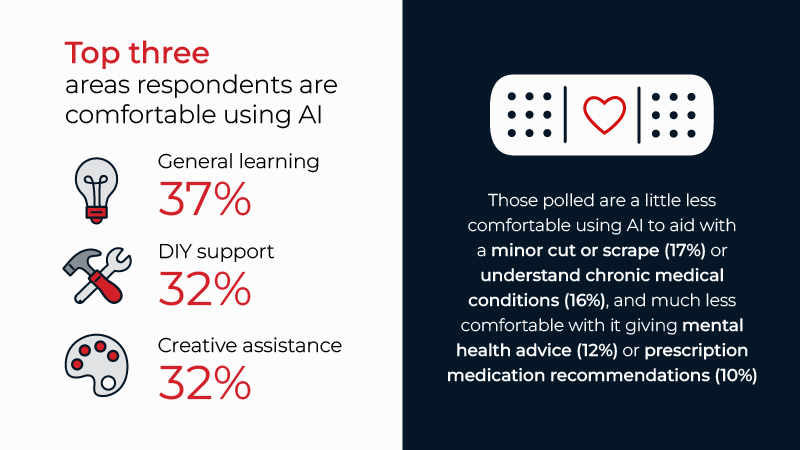
According to the results, general learning, such as researching a hobby or summarizing a book (37%), DIY support (32%) and creative assistance such as drafting an email or creating an image for fun (32%) ranked as the top areas in which respondents are comfortable using AI support to act on their behalf.
Many of those polled are also comfortable using AI for work support when it comes to summarizing meetings or writing reports (24%) or even job seeking, such as optimizing their resume or practicing for an interview (24%).
Others would specifically allow AI to review a cover letter (24%), plan meals or dietary needs (23%), research a new area to move (22%), give skincare recommendations (18%) and even review an offer letter (18%).
(Talker Research)


While almost one in five would trust AI to aid with a minor cut or scrape (17%) or even to understand chronic medical conditions (16%), that number decreases when it comes to more nuanced areas such as giving mental health advice (12%) or prescription medication recommendations (10%).
Hypothetically, respondents would be willing to trust an AI agent with an average of $200 to make a routine purchase on their behalf, without requiring their final approval.
Still, only 31% of those polled are likely to actually trust AI to independently make decisions on their behalf, such as scheduling appointments, selecting products or exploring rentals. On the flip side, 70% of those in India are likely to trust AI to make decisions, the highest of any country surveyed.
“According to the results, only 12% of those polled are ‘very aware’ of what agentic AI is,” said Darryl Jones, Vice President, Consumer Segment Strategy at Ping Identity. “And another 70% are concerned an AI agent could misrepresent their personality or values to others, signaling a disconnect between what this technology can do and where consumers feel comfortable using it. People should know when AI is making decisions for them, what they’ve given it permission to do and when they have the final say.”
In general, most of those polled trust AI to some degree (57%) and for 43%, that trust has increased from just one year ago.
But as trust increases, so do the standards users hold it to. Results revealed that respondents believe the same top three ethical standards should apply to both human and technology sources; personal data used in the interaction must remain strictly confidential, the source should be able to explain how they reached a specific conclusion or recommendation and the source must provide proof that they are who they claim to be.
Taking things a step further, users find it more helpful when AI presents the facts without taking any stance (38%) than when it confirms their existing thoughts or findings (21%) or even when it provides a different perspective or plays “devil’s advocate” (20%), much like traditional sources.
Regardless of their trust levels, 40% have caught AI providing made-up or false information, or "hallucinating" at least once over the years. But who’s to blame? Results revealed that respondents are more likely to blame the company that built the AI for a mistake than they are to blame the user who prompted it (29% vs 15%).
Still, respondents are more likely to see these hallucinations as an unintentional mistake than an intentional deception (44% vs 23%).
“It’s easy to blame a human source for errors; to err is to be human. But those feelings become more complex when there’s not another person on the other end of the conversation,” said Jones. “Results found that respondents mostly think of AI as a ‘search engine’ (48%) or a place to find information, underscoring the importance of accuracy. People should check sources, verify important information and be careful about acting on an AI recommendation without knowing where the information came from. Knowing what you can trust is just as important as getting an answer quickly.”
Research methodology:
Talker Research surveyed 11,000 global respondents (2,000 United States, 2,000 United Kingdom, 1,000 France, 1,000 Germany, 1,000 Singapore, 1,000 Australia, 500 India, 500 Indonesia, 500 Netherlands, 500 Sweden, 500 Spain, 500 Italy) who have access to the internet; the survey was commissioned by Ping Identity and administered and conducted online by Talker Research between June 17 and June 25, 2026. A link to the questionnaire can be found here.
To view the complete methodology as part of AAPOR’s Transparency Initiative, please visit the Talker Research Process and Methodology page.


(0) comments
Welcome to the discussion.
Log In
Keep it Clean. Please avoid obscene, vulgar, lewd, racist or sexually-oriented language.
PLEASE TURN OFF YOUR CAPS LOCK.
Don't Threaten. Threats of harming another person will not be tolerated.
Be Truthful. Don't knowingly lie about anyone or anything.
Be Nice. No racism, sexism or any sort of -ism that is degrading to another person.
Be Proactive. Use the 'Report' link on each comment to let us know of abusive posts.
Share with Us. We'd love to hear eyewitness accounts, the history behind an article.