


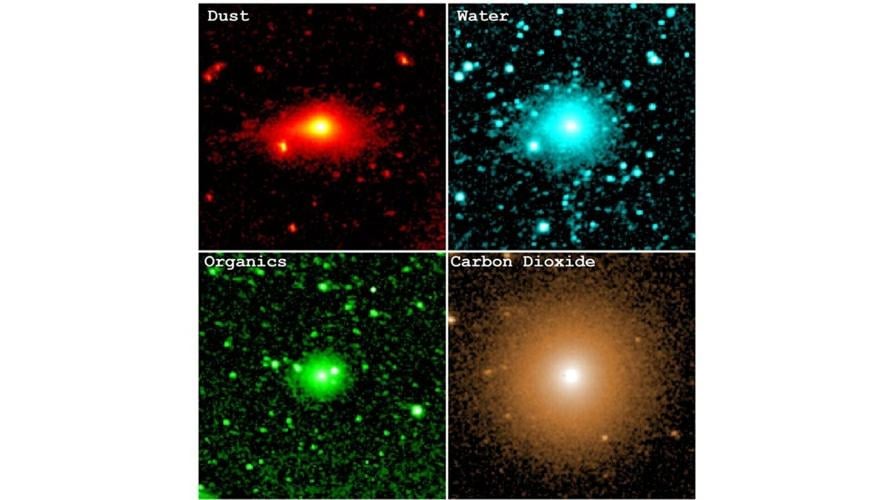
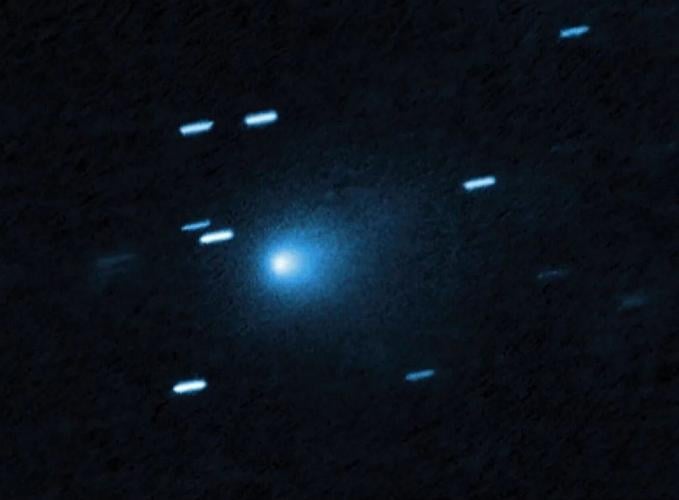

These December 2025 observations by NASA's SPHEREx show the infrared light emitted by the dust, water, organic molecules, and carbon dioxide contained within comet 3I/ATLAS's coma during the mission's recent campaign. (NASA/JPL-Caltech via SWNS)
By Dean Murray
The mysterious space rock that passed through our solar system grew significantly brighter as it left, according to scientists.
Researchers say Comet 3I/ATLAS, suggested to be a hostile alien spaceship by one Harvard astrophysicist, saw a "dramatic increase in brightness" two months after the icy body had passed its closest distance to the Sun.
The interstellar visitor, only the third such object to be discovered passing through our solar system, had ignited controversial theories upon its discovery.

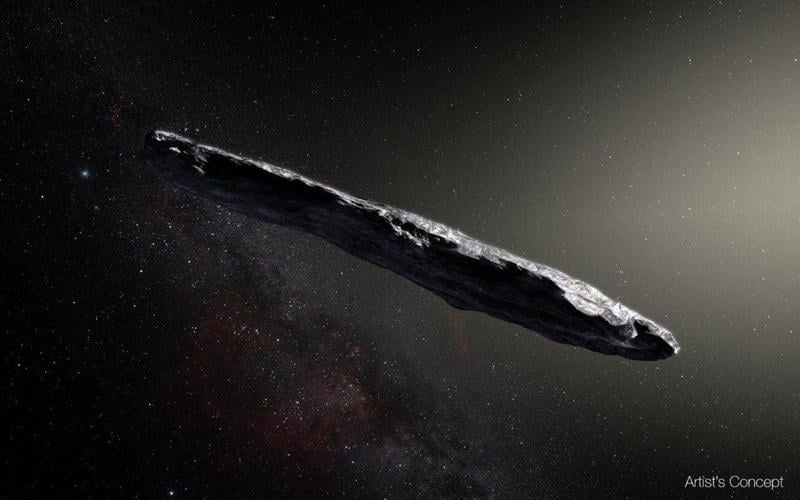
Artist's impression shows the first interstellar object discovered in the Solar System, 'Oumuamua'. (NASA via SWNS)
Harvard astrophysicist Avi Loeb theorized it could be an artificial alien probe on a reconnaissance mission, due to its unusual glow, trajectory aligning with planetary orbits, and non-natural path.
A scientific paper co-authored by Loeb had warned the object could be a hostile spacecraft for which humanity should be prepared.


It read: “The consequences, should the hypothesis turn out to be correct, could potentially be dire for humanity, and would possibly require defensive measures to be undertaken (though these might prove futile).”

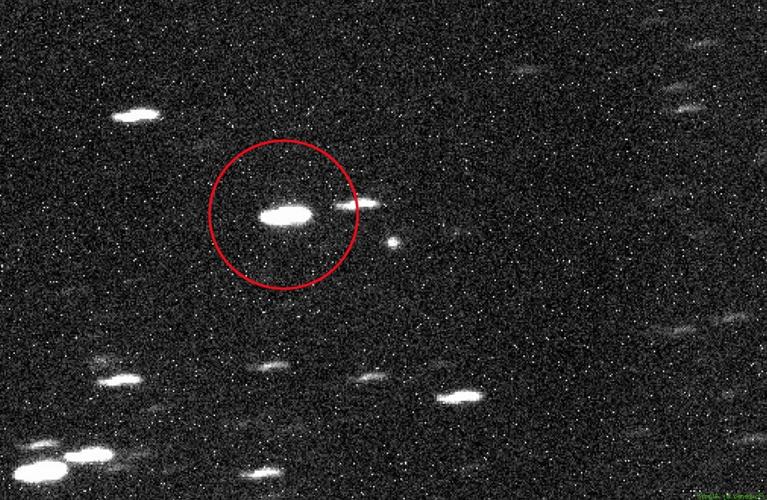
The Deep Random Survey telescope managed to capture images of interstellar object 3I/Atlas (previously known as A11pl3Z) in July 2025. (K Ly / Deep Random Survey via SWNS)
NASA’s SPHEREx space telescope mission viewed 3I/ATLAS in December 2025, when researchers believed the brightening occurred due to a phenomenon associated with comets as they vent water, carbon dioxide, and carbon monoxide into space.
Study lead Carey Lisse, of Johns Hopkins Applied Physics Laboratory, said: "Comet 3I/ATLAS was full-on erupting into space in December 2025, after its close flyby of the Sun, causing it to significantly brighten.
"Even water ice was quickly sublimating into gas in interplanetary space. And since comets consist of about one-third bulk water ice, it was releasing an abundance of new, carbon-rich material that had remained locked in ice deep below the surface.

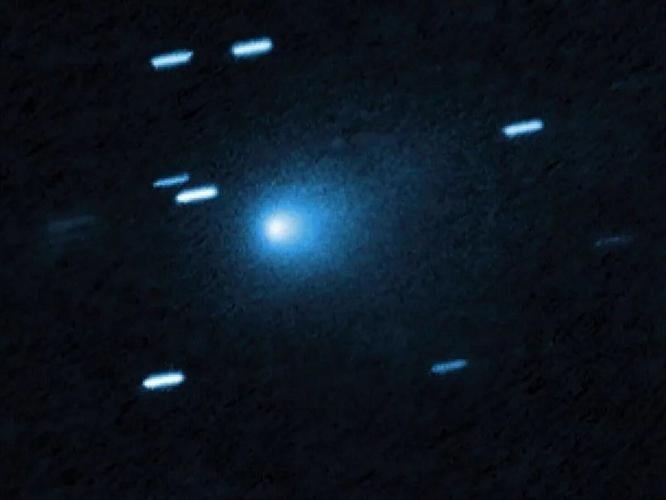
NASA image of Comet 3I/ATLAS. (NASA via SWNS)
"We are now seeing the usual range of early solar system materials, including organic molecules, soot, and rock dust, that are typically emitted by a comet."
Yoonsoo Bach, deputy study lead from the Korea Astronomy and Space Science Institute, added: "Our unique space telescope is gathering unprecedented data from across the universe. But in this case, our galaxy delivered a piece of a faraway star system to us only a few months after launch, and SPHEREx was ready to observe it. Science is sometimes like that: you’re in the right place at the right time."


(0) comments
Welcome to the discussion.
Log In
Keep it Clean. Please avoid obscene, vulgar, lewd, racist or sexually-oriented language.
PLEASE TURN OFF YOUR CAPS LOCK.
Don't Threaten. Threats of harming another person will not be tolerated.
Be Truthful. Don't knowingly lie about anyone or anything.
Be Nice. No racism, sexism or any sort of -ism that is degrading to another person.
Be Proactive. Use the 'Report' link on each comment to let us know of abusive posts.
Share with Us. We'd love to hear eyewitness accounts, the history behind an article.