




What 600,000 AI sessions reveal about the content that wins AI traffic
What content do we actually need to come up in AI search?
It’s a question businesses ask every day. As more customers turn to ChatGPT, Gemini, and other AI platforms to research products, services, and providers, marketers know AI search matters. The challenge is knowing which content investments are most likely to improve visibility and ultimately bring customers to your website.
To answer that question, WebFX analyzed nearly 600,000 AI sessions across 2,500 URLs spanning businesses in 15-plus industries between May 2025 and May 2026.
These findings provide a practical blueprint for the content businesses should prioritize to earn more visibility, website traffic, and customers from AI search.
What types of content earn the most AI traffic?
The data revealed several clear winners.
Homepages generated the largest share of AI traffic by a wide margin (31.3%), followed by product pages (16.8%), service pages (11.4%), blog articles (11.3%), and FAQ/resource pages (7.2%).
These “big five” page types accounted for more than two-thirds of all AI traffic in the dataset.
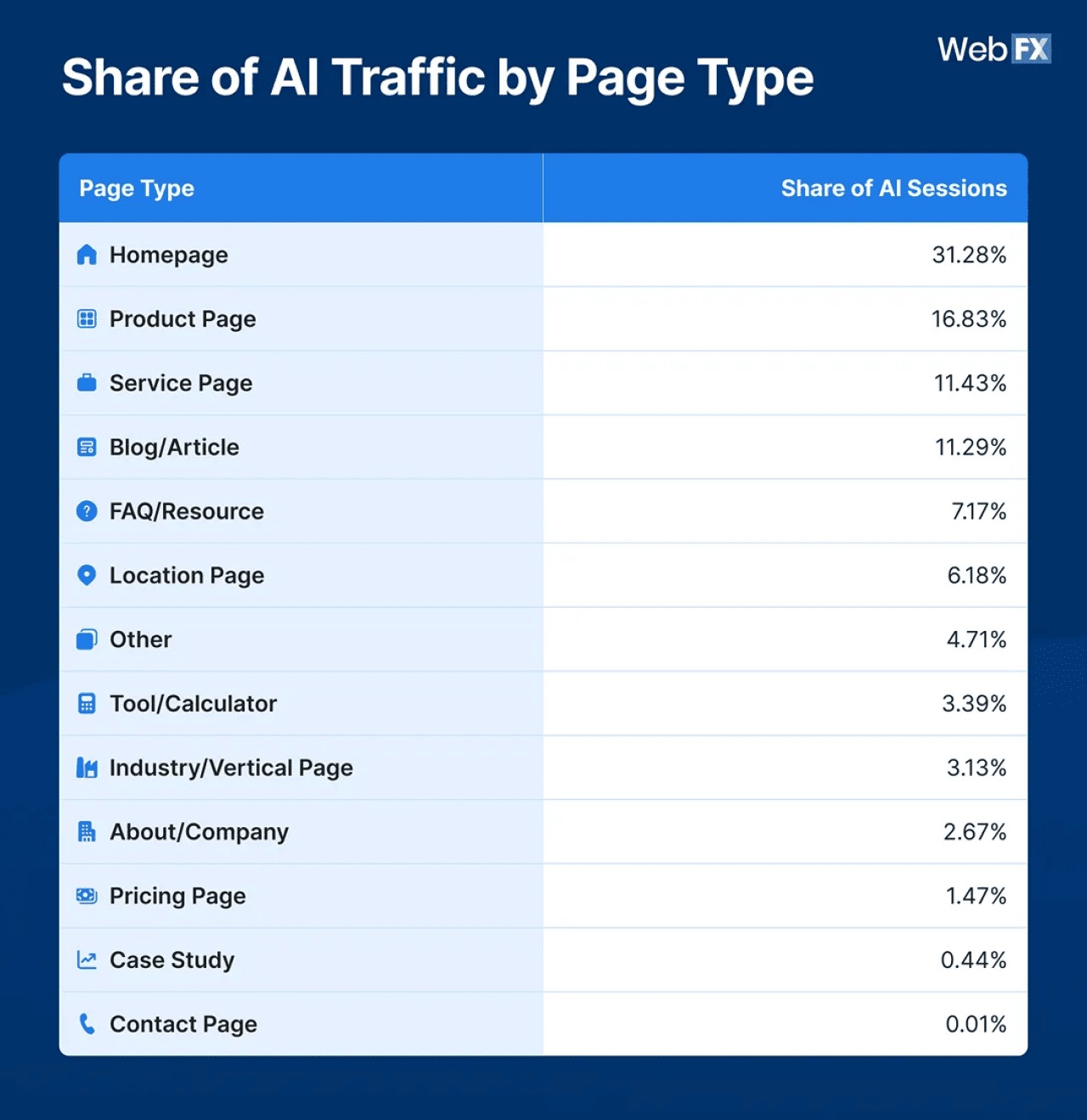
Looking across the distribution, three findings stood out.
Key finding 1: Homepages drove nearly one-third of all AI traffic
Homepages generated 31% of all AI sessions, more than any other page type in the analysis.
This reflects how people increasingly use AI. Instead of navigating through multiple search results, users often ask AI to recommend businesses, products, or providers. Once AI identifies a strong match, the homepage naturally becomes the starting point for learning more.
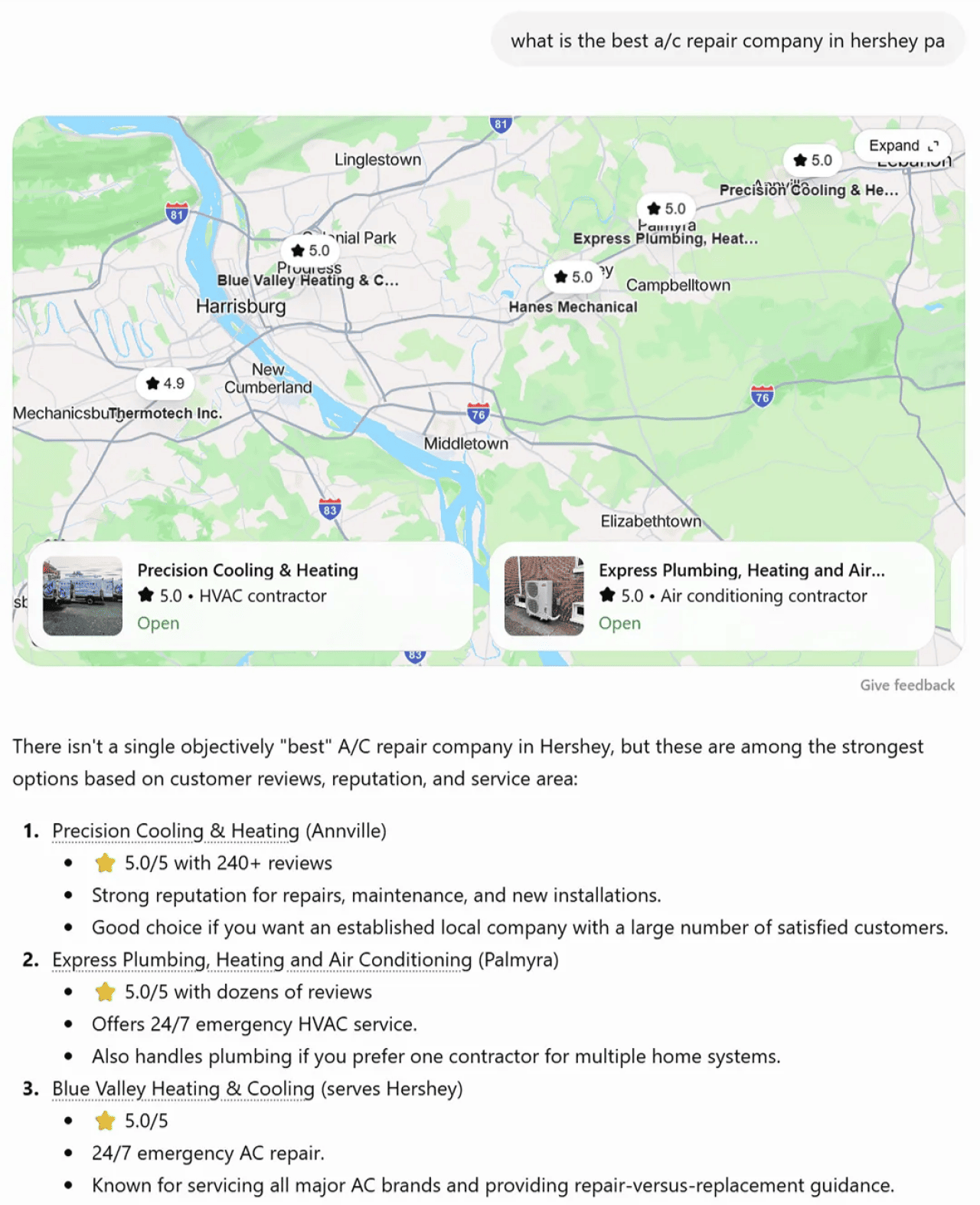
For example, when researchers asked ChatGPT for the best AC repair company in Hershey, PA, every recommendation pointed directly to a company’s homepage, where visitors could explore services, reviews, and decide whether to take the next step.
Key finding 2: Product, service, and resource pages are AI traffic magnets
After homepages, product pages (16.8%), service pages (11.4%), blog articles (11.3%), and FAQ/resource pages (7.2%) generated the largest share of AI traffic.
Although these pages serve different purposes, they all help users move forward. Some answer detailed questions. Others compare solutions or explain services. Many help users evaluate whether a business is the right fit. AI platforms consistently referred users to pages that supported those next steps.
Key finding 3: AI rewards comprehensive websites
Homepages drove the largest share of AI traffic in the study, but they weren’t the whole story. Product pages, service pages, blog articles, FAQs, industry pages, and tools all earned meaningful AI referrals.
The highest-performing websites weren’t relying on one standout page. They built a portfolio of content that answered different questions and supported different stages of the customer journey, giving AI multiple opportunities to recommend their business.
Business takeaway: Build a content ecosystem that establishes authority in your niche
Every page contributes a signal about your business:
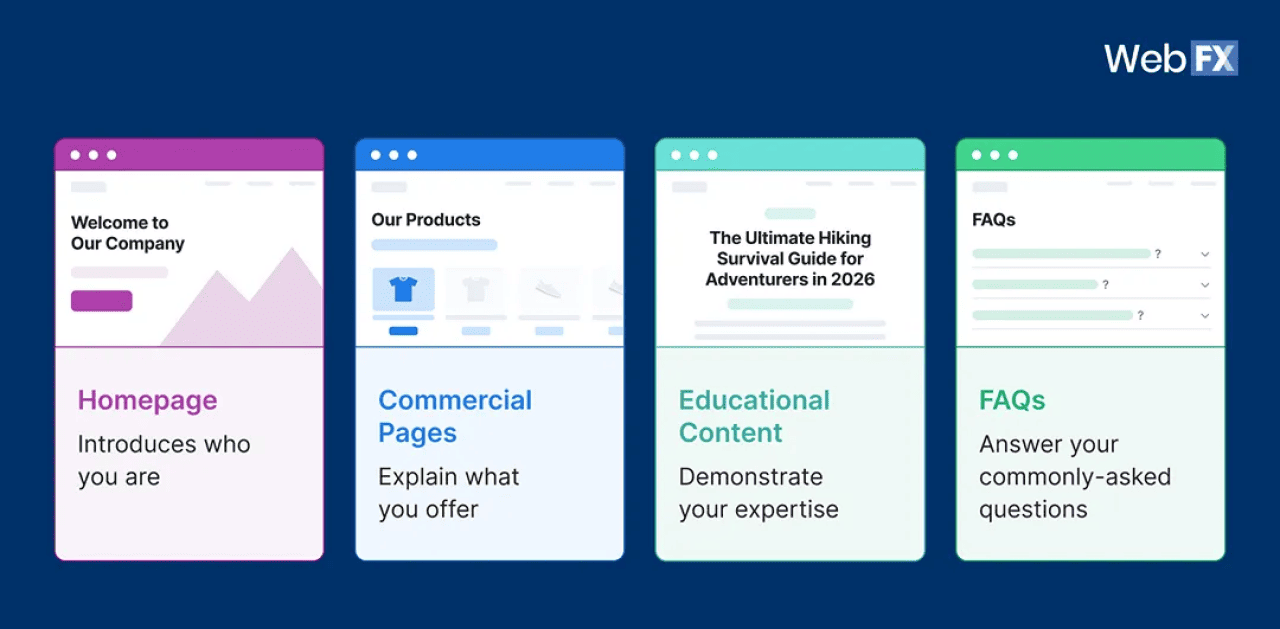
- A homepage introduces who you are
- Commercial pages explain what you offer
- FAQs answer common questions
- Educational content demonstrates expertise
Together, they create a digital fingerprint that helps AI understand where your business has authority and when it’s the right recommendation for a customer’s next question or next step.
Why AI traffic is more bottom-of-funnel than you think
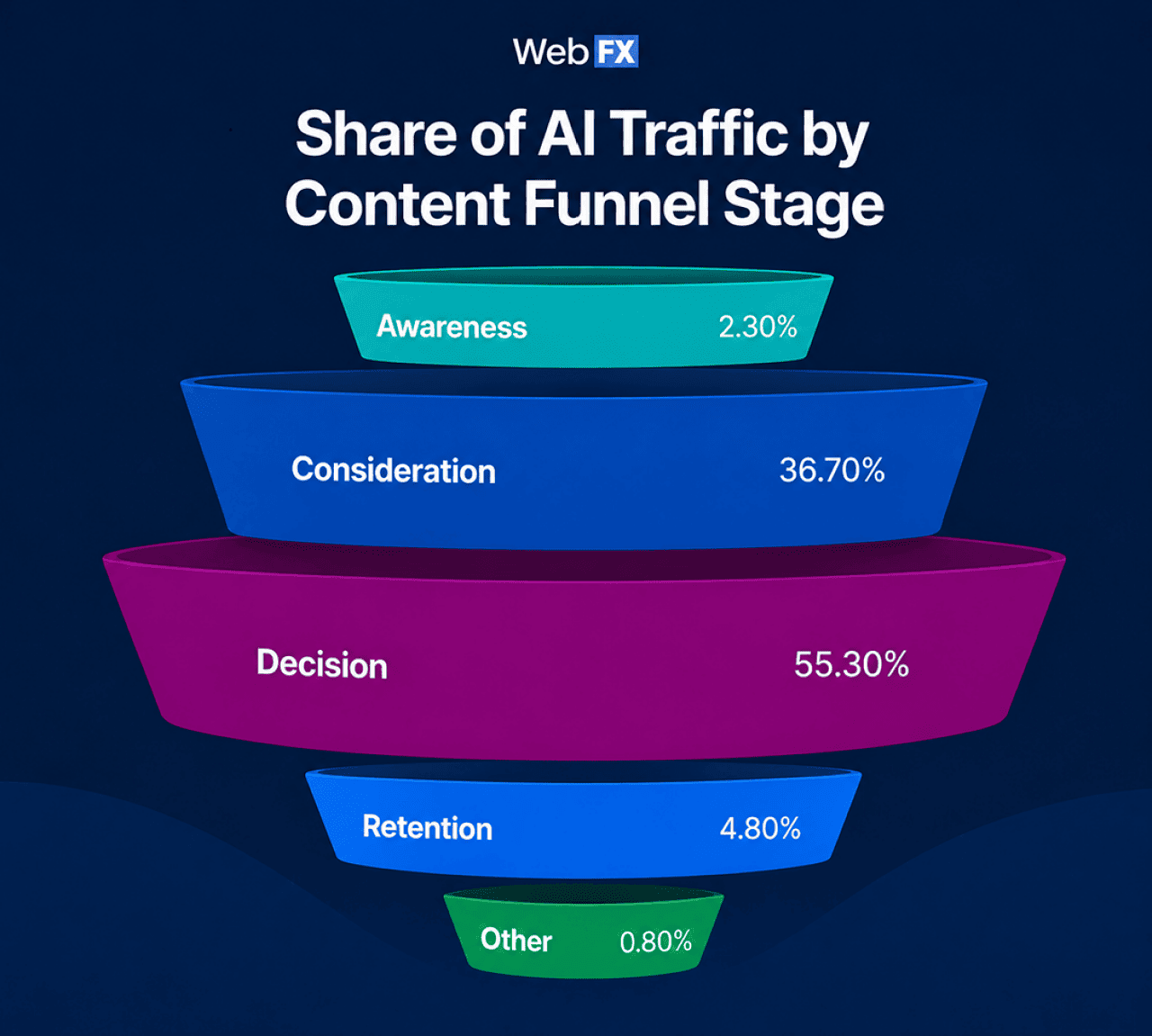
More than 9 in 10 AI sessions landed on consideration or decision-stage content, while awareness pages accounted for just 2.3% of AI traffic.
That finding aligns with another WebFX study showing AI traffic converts 1.2 times higher than traditional organic search. Together, the data suggests AI is increasingly connecting businesses with customers who have already moved beyond initial research and are actively comparing options, evaluating providers, and preparing to make a decision.
Key finding 1: AI users are evaluating, not just learning
Decision-stage content accounted for 55.3% of all AI traffic, while consideration pages generated another 36.7%.
Combined, 92% of AI traffic landed on content designed to help users compare providers, evaluate solutions, or make purchasing decisions.
That paints a very different picture than many marketers and business owners might have.
Key finding 2: AI is shortening the research process
Traditional search often encourages users to research one question at a time. AI changes that experience.
Instead of bouncing between multiple websites, users can ask AI to compare providers, summarize reviews, explain tradeoffs, and narrow their options before ever clicking a link. By the time they visit your website, they’re often looking for validation rather than an introduction.
That helps explain why service and product pages, FAQs, and comparison content consistently appear among the strongest AI performers.
Key finding 3: Transactional content drives the majority of AI traffic
The content intent data tells a similar story.
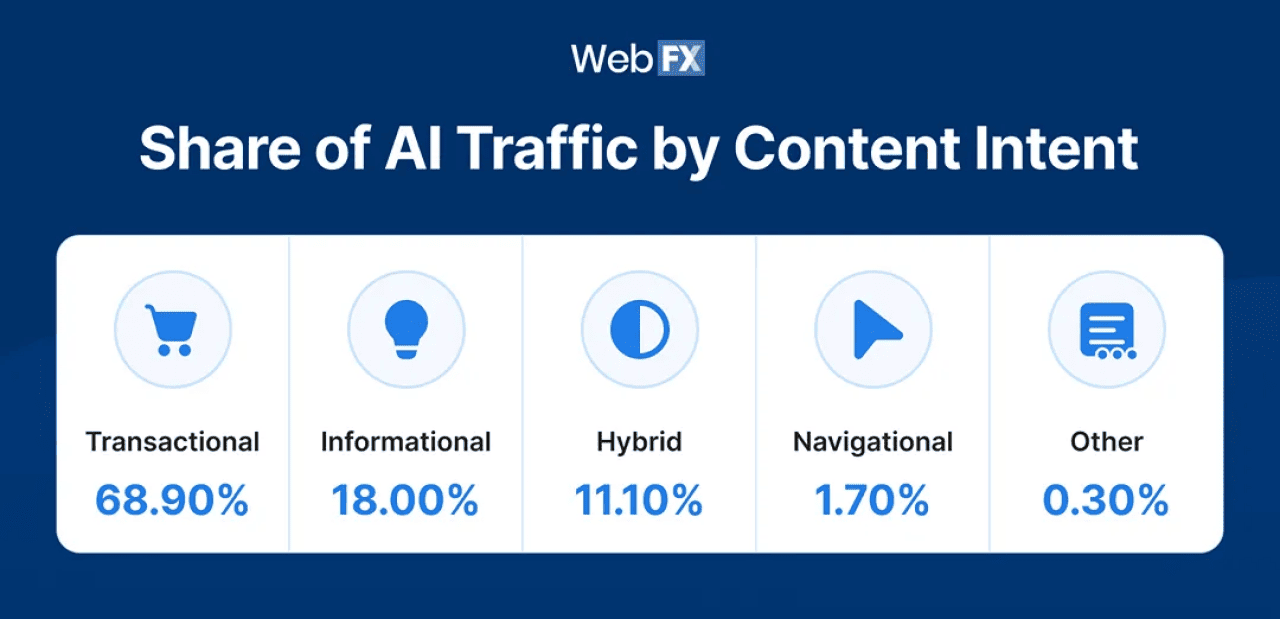
Nearly 7 in 10 AI sessions landed on transactional content, while informational pages accounted for just 18% of AI traffic. Both the funnel stage and commercial intent data point in the same direction: The majority of AI traffic reached pages supporting evaluation and decision-making.
Business takeaway: Prioritize content that helps customers make decisions
For years, many organizations invested heavily in top-of-funnel educational content to grow organic visibility. That foundation remains important. Educational resources build authority, earn citations, and help AI understand your expertise.
The WebFX research suggests the biggest opportunity for AI traffic often comes later in the customer journey. Businesses that invest in strong service pages, comparison content, pricing resources, FAQs, and other decision-stage assets are better positioned to capture users after AI has already helped narrow their options.
As AI becomes a larger part of the buying process, some of the highest-value content on your website may be the content that helps customers confidently take the next step.
What content performs best in AI vs. organic search?
For decades, content strategy has largely been shaped by one question: What content performs best in Google Search?
As AI search becomes a growing source of discovery, a new question is emerging: Will the same content continue to perform as customers shift from search engines to AI assistants? The answer has important implications for where businesses invest their time, budget, and content strategy over the next several years.
The answer? Both yes and no. Many of the same page types perform well across both channels, but AI platforms don’t distribute traffic the same way Google does. Comparing the two reveals where AI is creating new opportunities and where traditional search continues to have the upper hand.
Key finding 1: AI creates the biggest opportunities for product, blog, and resource content
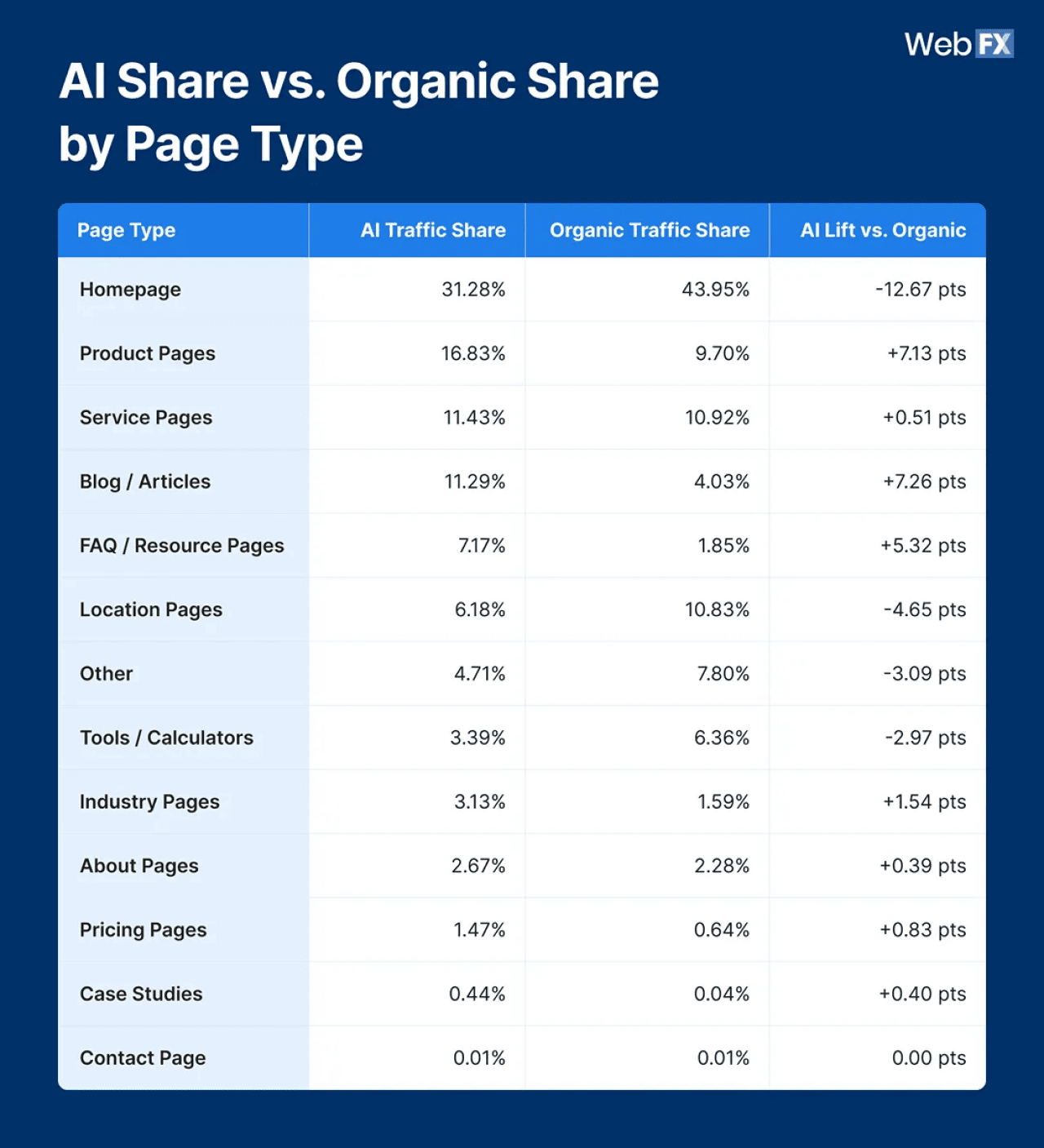
The largest AI lift came from blog articles (+7.3 percentage points), product pages (+7.1 points), and FAQ/resource pages (+5.3 points).
These pages all serve a similar purpose. They help users compare options, answer detailed questions, and continue evaluating solutions after AI has narrowed the field. For businesses looking to grow AI traffic, they are some of the clearest opportunities in the dataset.
Key finding 2: Google still leads branded and local discovery
While homepages generated the largest share of AI traffic overall, they accounted for an even larger share of organic traffic (44% vs. 31.3%). The same pattern appeared with location pages (-4.7 AI lift) and tools/calculators (-3 AI lift).
That suggests traditional search continues to play a larger role in branded, navigational, and local discovery, while AI increasingly connects users with deeper content that supports evaluation and decision-making.
Key finding 3: Service pages consistently perform across both channels
One result stood out for a different reason.
Service pages generated nearly identical shares of AI and organic traffic (11.4% vs. 10.9%), resulting in an AI lift of just +0.5 percentage points.
That’s encouraging because it suggests investments in high-quality service pages continue to pay dividends regardless of how customers discover your business.
Business takeaway: Invest where AI lift is highest without losing sight of your strongest SEO assets
Comparing AI and organic search reveals that homepages, service pages, and product pages consistently perform well across both channels, making them some of the strongest long-term investments.
Blog articles, FAQ/resource pages, and industry pages generated the highest AI lift, signaling opportunities to grow AI traffic beyond traditional SEO.


At the same time, location pages and tools continue to be important drivers of organic search visibility and remain worth protecting.
Knowing where to invest is only part of the equation. The next question is what makes those pages successful enough for AI to recommend them in the first place?
Content playbook for winning AI traffic
The research provides insights into the pages earning AI traffic, where users enter the buying journey, how AI search differs from traditional organic search, and where businesses have the biggest opportunities to invest.
Those findings naturally lead to one final question: What does content that consistently earns AI traffic have in common?
Looking across the 2,500 URLs generating the highest levels of AI referral traffic, five trends emerged. No single tactic guarantees AI visibility, but together they provide a practical playbook for creating content that AI systems are more likely to recommend and customers are more likely to visit.
1. Start with a trusted homepage
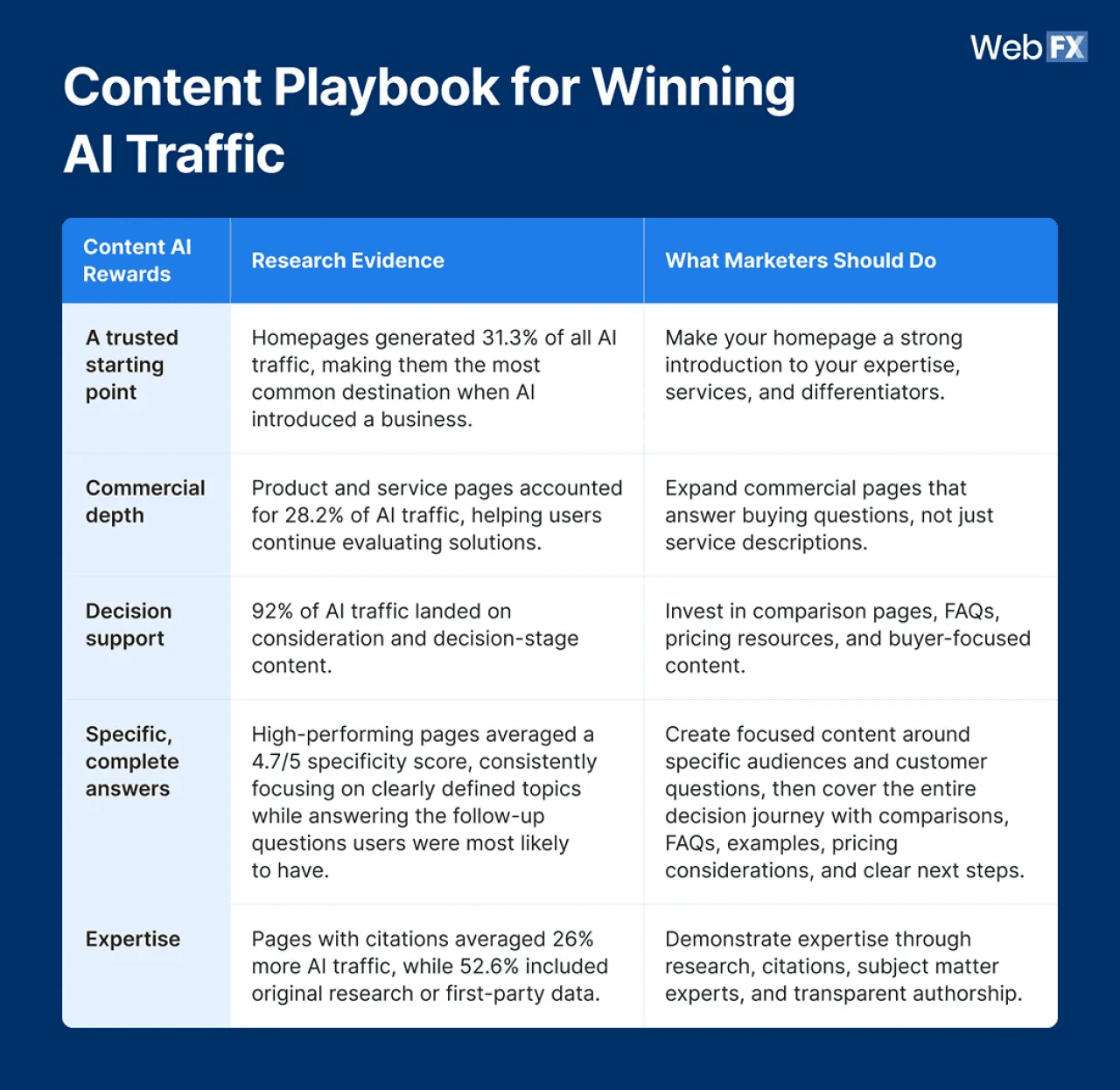
Homepages generated 31.3% of all AI traffic, making them the single largest destination in the dataset.
That reinforces the important role homepages play in AI search. Before recommending a product, service, or resource, AI often introduces users to the business itself.
A clear, trustworthy homepage gives users a place to validate that recommendation and continue exploring. Make sure your homepage clearly communicates:
- Who you are
- Who you serve
- What makes your business different
- Why people trust your business (think reviews, awards, certifications, and other trust signals)
2. Build commercial depth
Product and service pages accounted for 28.2% of AI traffic, helping users move from discovery to evaluation.
Rather than stopping at a homepage, AI frequently recommends commercial pages that answer buying questions, explain services, and help customers compare solutions.
Expand your service and product pages beyond basic descriptions by addressing pricing, implementation, comparisons, FAQs, and the questions prospects ask before contacting sales.
3. Help customers make decisions
The report found that 92% of AI traffic landed on consideration and decision-stage content.
That indicates AI is often introducing users after much of their early research is complete. The strongest-performing pages reduced uncertainty and helped customers confidently take the next step.
Content types that help support the decision-marketing process include:
- Comparison pages
- Buyer’s guides
- Pricing resources
- FAQs
- Industry-tailored content
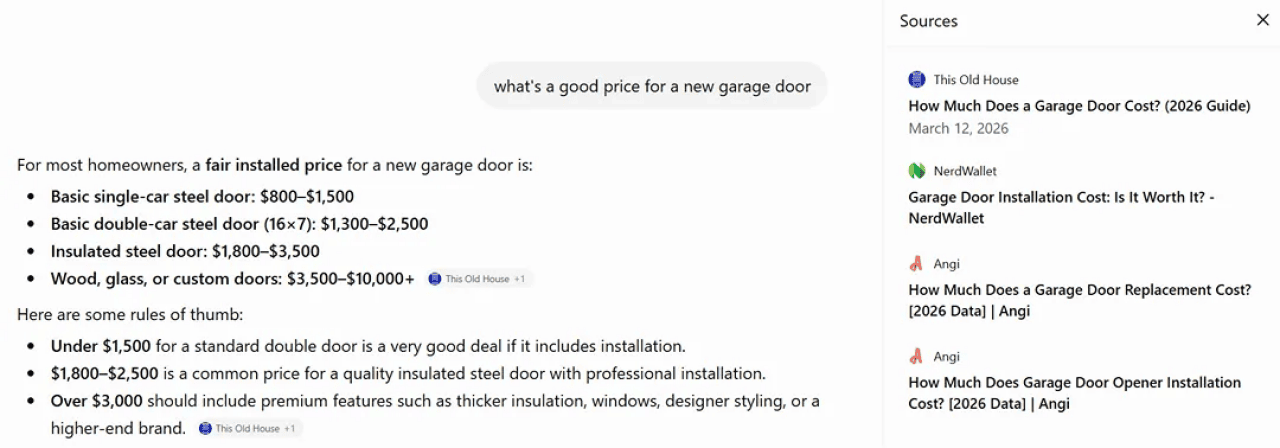
For example, a quick search in ChatGPT for “what’s a good price for a new garage door” yields content geared toward helping searchers evaluate pricing and what’s worth the investment.
4. Answer specific questions completely
Pages most likely to be cited by AI-generated answers averaged a 4.76 out of 5 specificity score, which measures how specific a page’s content is based on the presence of concrete details such as facts, named entities, dates, statistics, pricing, and product names. Those same pages averaged a 4.15 out of 5 completeness score, which measures how thoroughly a page answers its primary topic and addresses related questions and context. The pages most likely to be cited by AI-generated answers outperformed other pages on both measures.
The strongest-performing pages focused on clearly defined:
- Audiences
- Industries
- Services
- Customer questions
These pages also backed up their content with:
- Specific facts
- Named entities
- Statistics
- Product names
- Pricing details
- Real examples
They also anticipated the next question a user might ask, addressed common objections, and expanded beyond the initial answer with comparisons, FAQs, implementation guidance, and other supporting information that helped users continue making decisions without returning to AI or Google.
Businesses looking to increase AI visibility should create focused content around specific customer needs, then build those pages into comprehensive resources that:
- Answer related questions
- Explain tradeoffs
- Provide examples
- Support the entire decision-making journey
5. Demonstrate authority and expertise
Trust signals consistently appeared across the strongest-performing pages in the study.
More than two-thirds included expert credentials, 52.6% featured original research or first-party data, and pages with citations averaged 26% more AI traffic than those without.
Rather than relying on a single trust signal, the highest-performing pages built confidence from multiple angles. You can do the same with your content by:
- Publishing original research
- Incorporating subject matter experts
- Supporting claims with credible citations
- Identifying authors
All these steps help reinforce expertise.
Business takeaway: Become the source AI wants to recommend
Looking across nearly 600,000 AI sessions, the strongest-performing pages all shared the same goal: Helping users confidently take the next step.
That’s ultimately what AI search is trying to do.
Businesses don’t need a completely different content strategy for AI.
They need content that’s trustworthy, specific, comprehensive, and genuinely useful throughout the customer journey. Those are the pages AI consistently recommended throughout the study, and they’re the pages most likely to earn visibility, traffic, and customers as AI search continues to evolve.
Do different AI platforms recommend different content?
Most discussions about AI search treat it as a single channel. In reality, businesses are competing for visibility across multiple AI assistants, each with its own user experience and recommendation patterns.
Looking across the data, one platform currently stands apart: ChatGPT accounts for 97.5% of AI referral traffic in the dataset.
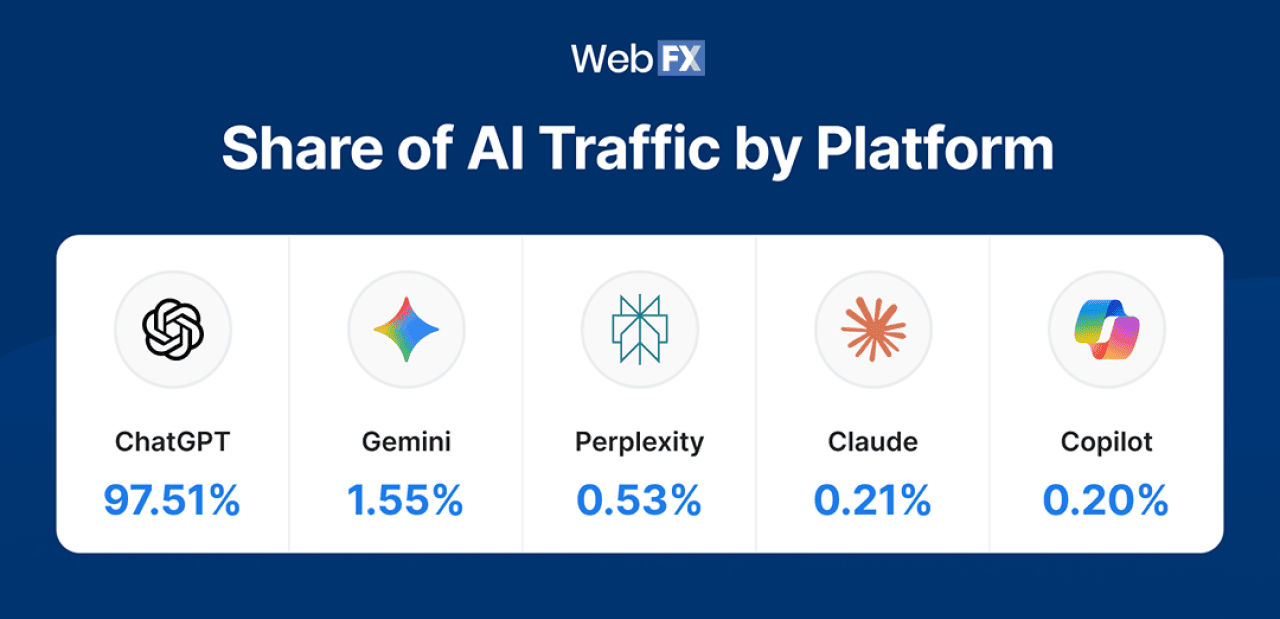
That doesn’t mean Gemini, Perplexity, Claude, or Copilot aren’t important.
AI search is evolving rapidly, and today’s platform mix will almost certainly change over time. But it does mean the broader trends throughout this report largely reflect how users interact with ChatGPT today.
Although traffic volumes remain much smaller outside ChatGPT, the study included a platform-level breakdown to provide additional context on where those referrals are landing.
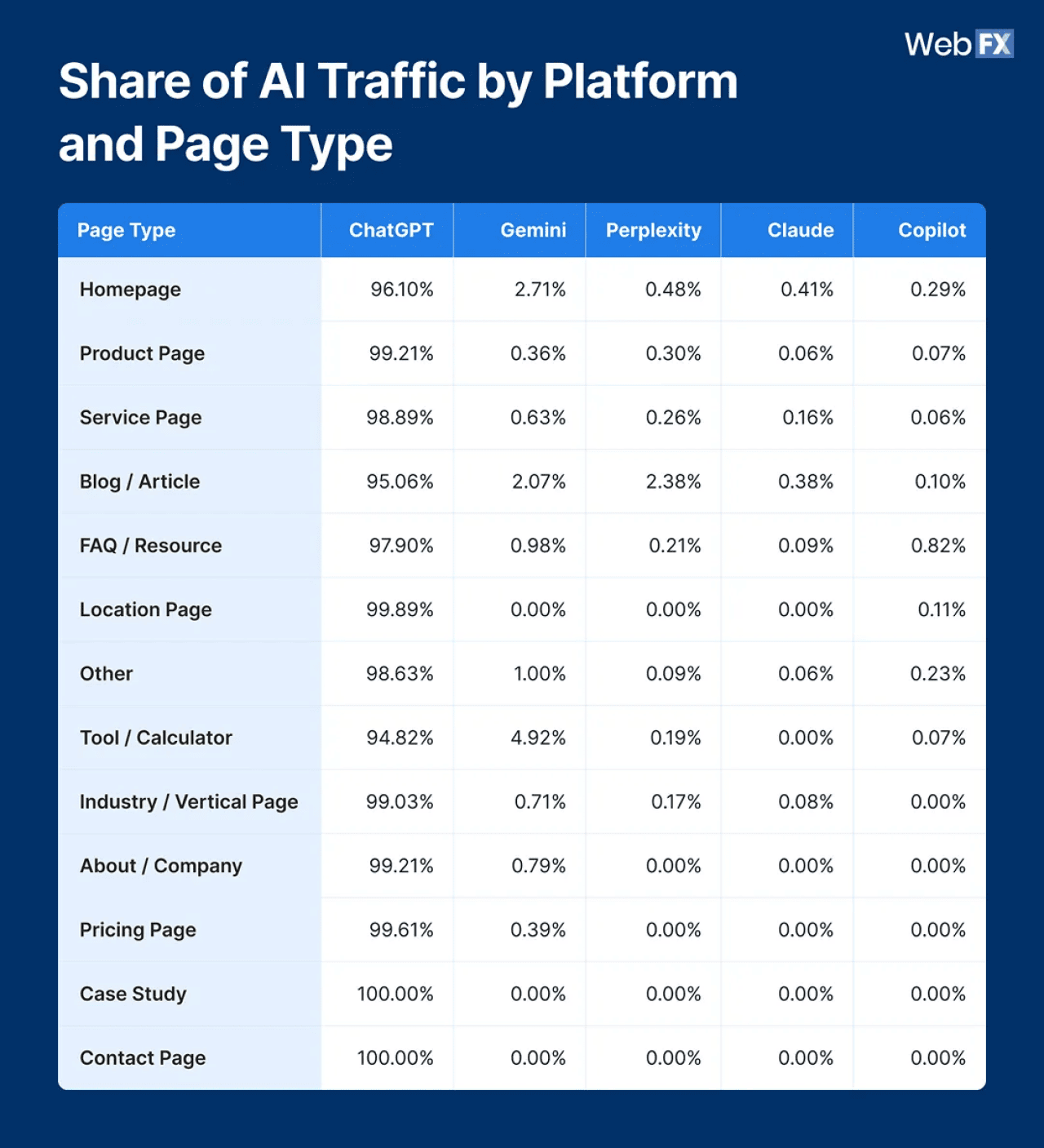
The differences are subtle, but a few early patterns emerge:
- ChatGPT sends traffic across a broad mix of page types.
- Perplexity directs a relatively larger share of traffic to blog content.
- Gemini appears to over-index on tool and calculator pages as well as homepages.
Given the relatively small volume of traffic outside ChatGPT, it’s too early to draw broad conclusions about platform-specific optimization strategies. As adoption grows, however, these referral patterns will be worth monitoring.
Business takeaway: Prioritize the content, not the platform
Rather than building separate content strategies for individual AI assistants, focus on creating high-quality content that serves users well regardless of where the recommendation originates.
As the AI search landscape evolves, businesses should build strong homepages, commercial pages, educational resources, and decision-support content.
Insights to action: What this study means for your AI content strategy
AI search is becoming an increasingly important part of how customers discover and evaluate businesses. Looking across nearly 600,000 AI sessions, one theme appeared repeatedly. The pages earning AI traffic made it easy for both customers and AI systems to:
- Understand who the business served
- What made the business credible
- Why the business deserved a recommendation
That gives businesses a practical direction for the years ahead.
Investing in trusted homepages, stronger commercial pages, deeper educational resources, and first-party expertise creates more opportunities to earn visibility across both AI and traditional search.
Those investments improve the customer experience while strengthening the signals AI systems rely on when deciding what to recommend.
Methodology
This study measures AI referral traffic, not AI citations. WebFX analyzed visits sent from AI platforms rather than how frequently brands appeared in AI-generated responses. The dataset focuses on high-performing AI pages. Findings reflect characteristics commonly shared by the pages generating the most AI traffic, rather than the average webpage.
This story was produced by WebFX and reviewed and distributed by Stacker.


(0) comments
Welcome to the discussion.
Log In
Keep it Clean. Please avoid obscene, vulgar, lewd, racist or sexually-oriented language.
PLEASE TURN OFF YOUR CAPS LOCK.
Don't Threaten. Threats of harming another person will not be tolerated.
Be Truthful. Don't knowingly lie about anyone or anything.
Be Nice. No racism, sexism or any sort of -ism that is degrading to another person.
Be Proactive. Use the 'Report' link on each comment to let us know of abusive posts.
Share with Us. We'd love to hear eyewitness accounts, the history behind an article.