


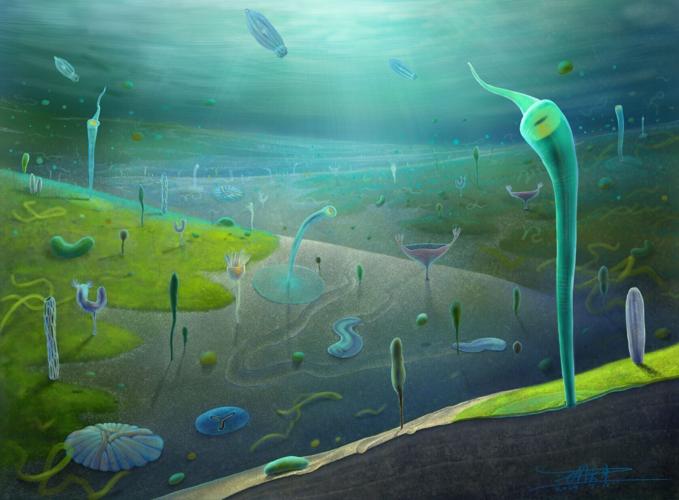

Reconstruction of Jiangchuan biota (~554-539 million years ago). (Xiaodong Wang via SWNS)
By Stephen Beech
The discovery of a fossil "treasure trove" has pushed back the origins of animals at least four million years.
The "exciting" find in China includes the remains of a creature that "looks like the sand worm from Dune."
It has transformed understanding of how complex animal life emerged on Earth, say scientists.
A study, published in the journal Science, reveals that many key animal groups had already evolved before the start of the Cambrian Period.
The research team explained that one of the most transformative events in Earth's history was the rapid diversification of animal life, resulting in a dramatic rise in complexity and diversity from simpler life forms.
Up to now, that was thought to have happened at the start of the Cambrian Period — in an event known as the "Cambrian explosion" — beginning around 535 million years ago.
But the new study, led by scientists from Oxford University and Yunnan University in China, shifts that timeframe back by at least four million years, to the end of the Ediacaran period.
Lead author Dr. Gaorong Li said: "Our discovery closes a major gap in the earliest phases of animal diversification.

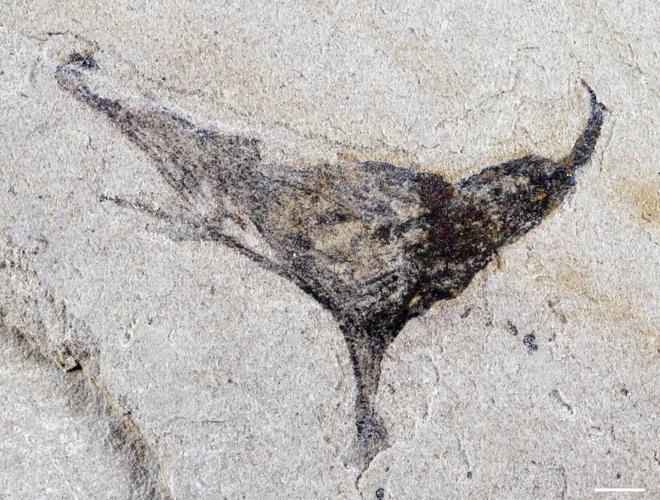
The Haootia-like fossil (an early cnidarian the phylum that includes jellyfish, sea anemones and corals) from the Jiangchuan Biota (~554-539 million years old). (Gaorong Li via SWNS)
"For the first time, we demonstrate that many complex animals, normally only found in the Cambrian, were present in the Ediacaran period, meaning that they evolved much earlier than previously demonstrated by fossil evidence."
The discovery was made at a site in Yunnan Province, China, where more than 700 fossil specimens were recovered, aged between 554 and 539 million years old.
The fossil site revealed a diverse community of Ediacaran organisms — both new, undescribed animal forms and groups known from the Cambrian period.
Researchers identified fossils thought to be the oldest known relatives of deuterostomes — the broader group that today includes vertebrates such as humans and fish.
The new fossils push the fossil record of deuterostomes back into the Ediacaran Period for the first time.
Among the fossil specimens were ancestors of modern starfish and their closest relatives, the acorn worms or Ambulacraria.

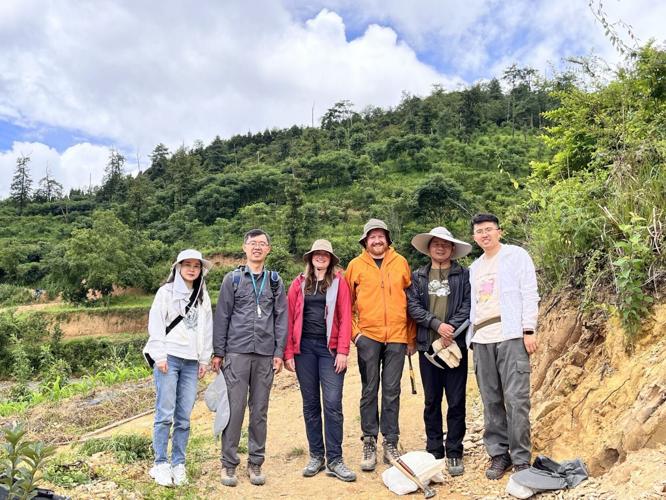
Part of the research team from the University of Oxford and Yunnan University during June 2024 fieldwork in the section of Jiangchuan Biota. From left to right, Dr. Wenwen Wen, Professor Peiyun Cong, Dr. Frances Dunn, Associate Professor Luke Parry, Associate Professor Fan Wei and Dr. Gaorong Li. (Gaorong Li via SWNS)
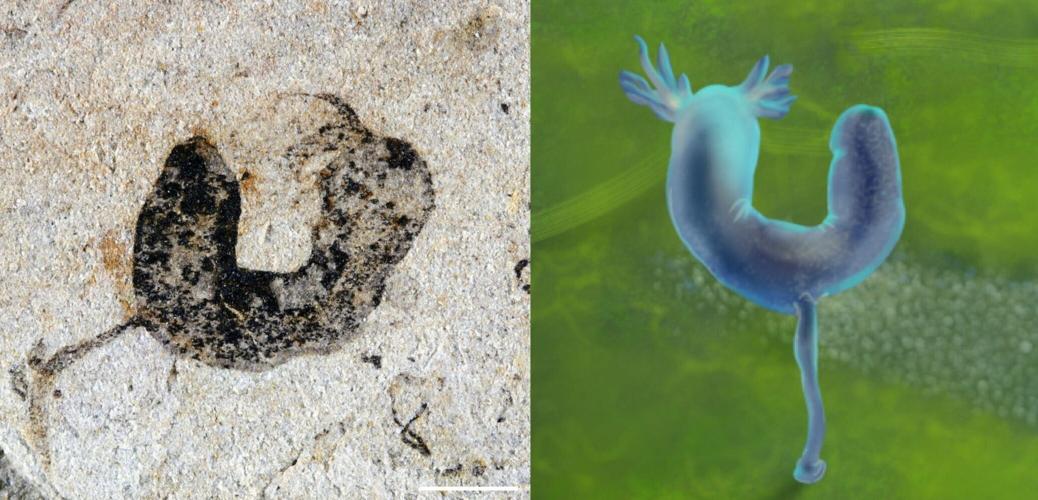
Those fossils have a U-shaped body and were attached to the seafloor with a stalk, with a pair of tentacles on their head used to catch food.
Co-author Dr. Frankie Dunn, of Oxford University's Museum of Natural History, said: "The presence of these ambulacrarians in the Ediacaran period is really exciting.


"We have already found fossils which are distant relatives of starfish and sea cucumbers and are looking for more.
"The discovery of ambulacrarian fossils in the Jiangchuan biota also means that the chordates — animals with a backbone — must also have existed at this time."
She said other ancestral groups among the fossils included worm-like bilaterian animals, some with complex feeding adaptations, alongside rare fossils interpreted as early comb jellies.
Many specimens showed novel combinations of anatomical features — such as tentacles, stalks, attachment discs, and feeding structures that can be turned inside out — that do not match any known Ediacaran or Cambrian species.
Dr. Dunn added: "For instance, one specimen looks a lot like the sand worm from Dune."
Study co-author Associate Professor Luke Parry, of Oxford University, said: "This discovery is extremely exciting because it reveals a transitional community: the weird world of the Ediacaran giving way to the Cambrian, the following time period where the animals are much easier to place in groups that are alive today.
"When we first saw these specimens, it was clear that this was something totally unique and unexpected."
The research team say the new findings also help to resolve a long-standing puzzle in evolutionary biology.
While molecular studies and trace fossils suggested that animal lineages diversified a long time before the Cambrian explosion, up to now fossils of many of those groups of complex animals have been missing from the Ediacaran period.

A deuterostome cambroernid fossil from the Jiangchuan Biota (~554-539 million years old) and artist's reconstruction. (Gaorong Li and Xiaodong Wang via SWNS)
Unlike most Ediacaran fossil sites, which preserve organisms mainly as impressions on sandstone surfaces, the Jiangchuan Biota fossils are preserved as carbonaceous films, a mode of preservation more typical of well-known Cambrian sites such as the Burgess Shale in Canada.
The exceptional preservation reveals anatomical details such as feeding structures, guts and locomotory organs.
Co-author Associate Professor Ross Anderson, also of Oxford's Museum of Natural History, said: "Our results indicate that the apparent absence of these complex animal groups from other Ediacaran sites may reflect differences in preservation rather than true biological absence.
"Carbonaceous compressions like those at Jiangchuan are rare in rocks of this age, meaning that similar communities may simply not have been preserved elsewhere."
The new fossils were discovered by a research group from Yunnan University, led by Professor Peiyun Cong and Associate Professor Fan Wei.
They have spent nearly a decade looking for diverse Ediacaran animal fossils.
The rocks from Eastern Yunnan were already known to contain fossils, but previously had yielded only remains of algae and not animals.
Fan said: "After years of fieldwork, we finally found several sites with the right conditions where animal fossils are preserved together with the abundant algae."
Feng Tang, from the Chinese Academy of Geological Science, added: "The new fossils provide the most compelling evidence for the presence of diverse bilaterian animals at the end of the Ediacaran, evidence people have searched for across decades."




(0) comments
Welcome to the discussion.
Log In
Keep it Clean. Please avoid obscene, vulgar, lewd, racist or sexually-oriented language.
PLEASE TURN OFF YOUR CAPS LOCK.
Don't Threaten. Threats of harming another person will not be tolerated.
Be Truthful. Don't knowingly lie about anyone or anything.
Be Nice. No racism, sexism or any sort of -ism that is degrading to another person.
Be Proactive. Use the 'Report' link on each comment to let us know of abusive posts.
Share with Us. We'd love to hear eyewitness accounts, the history behind an article.