



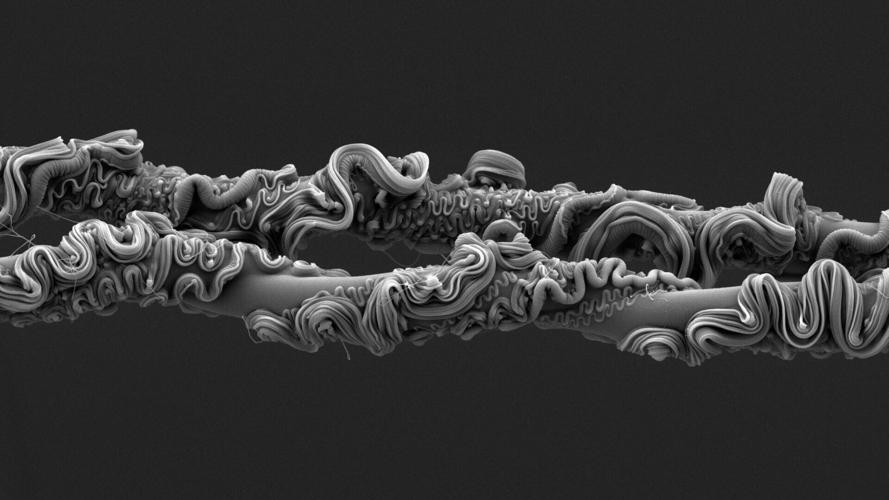



"Mesmerizing spider threads," by Dr. Martin Ramirez was chosen as the overall winner. (Dr. Martin Ramirez via SWNS)
By Dean Murray
A microscope image of two exceptional threads of silk from the Australian net-caster spider has been announced as the winner of the Royal Society Publishing Photography Competition 2025.
The competition, run in association with the Royal Photographic Society (RPS), celebrates incredible images that shed new light on hidden scientific phenomena around us.
This year’s overall winner, titled Mesmerizing spider threads, is by Dr. Martin Ramirez, a research scientist for CONICET (National Scientific and Technical Research Council – Argentina) at the Argentinian Museum of Natural Sciences, where he works on systematics, evolutionary morphology and biogeography of spiders.

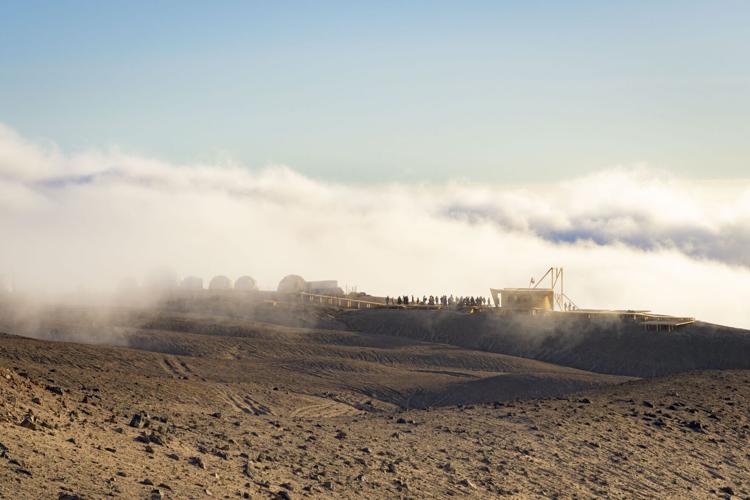
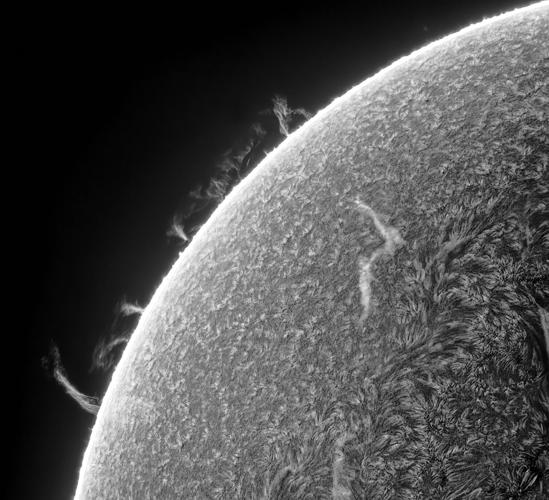
"Dancing on the Edge of Fire" by Imran Sultan was the Astronomy category winner. (Imran Sultan via SWNS)
The image, taken with a scanning electron microscope (SEM), shows a 0.05-millimetre-long close-up of silk from the Australian net-casting spider (Asianopis subrufa).
These spiders are ambush predators, holding their web between their forelegs and throwing it out to capture passing insects. This requires the silk to have unique properties, which is what attracted Dr Ramirez and his collaborator Dr Jonas Wolff, from Greifswald University, to study them.
“Just from observing the behaviour, we knew something spectacular was going to be there,” Dr Ramirez said. “The web is incredibly stretchy; no normal silk can extend in that way to then return to its original form.”

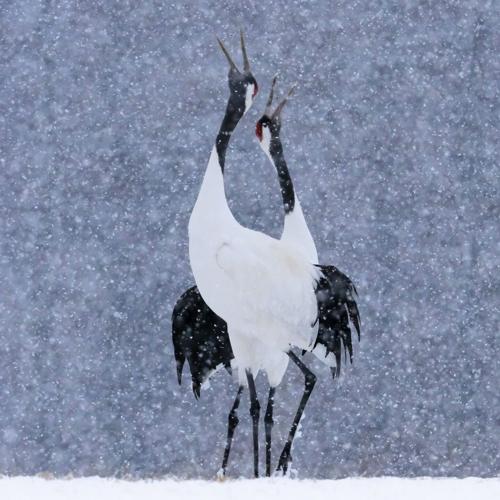
"Prairie Chicken Jump Off" by Peter Hudson was the Behavior category winner. (Peter Hudson via SWNS)


In Germany, the pair were studying the tension of the web using specialised machines and light microscopes. “We were doing tiny dissections, fibre by fibre, in a really artisanal way, to measure the stretchiness in particular,” Dr Ramirez said.
But the winning image was captured when the samples were brought back to Buenos Aires and examined under an electron microscope, which uses a beam of electrons instead of light to capture images in incredible resolution. “What the image reveals is this very complicated spinning of the net-caster spiders, and the winding fibres that allow for its unique strength and stretchiness.”

"Scanning glaciers in the Antarctic winter" by Michael Meredith was the Earth sciences & climatology category winner. (Michael Meredith via SWNS)
This is Dr Ramirez’s first time entering the Royal Society Publishing Photography Competition, after following it for a number of years.
“I knew my image was nice, but it is very surprising to be competing with these awesome photographers.”
Hugh Turvey, Science Committee Chair at the Royal Photographic Society and a member of the judging panel, said:
"The judges were unanimous in their selection of this winning photograph. We evaluate entries on two key criteria: aesthetic appeal and the ability to convey a compelling scientific phenomenon. This bold, graphic SEM of inconceivable rope-like structures — with their remarkable twists and complex undulations — evokes a sense of wonder, perfectly demonstrating the intersection of artistic form and scientific function."

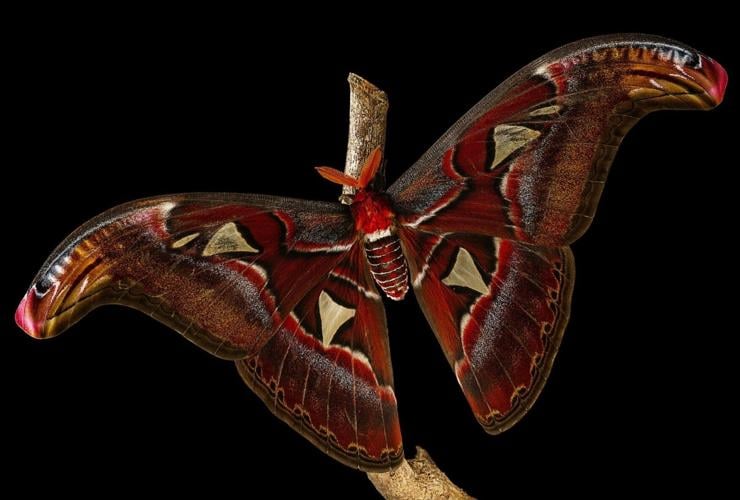
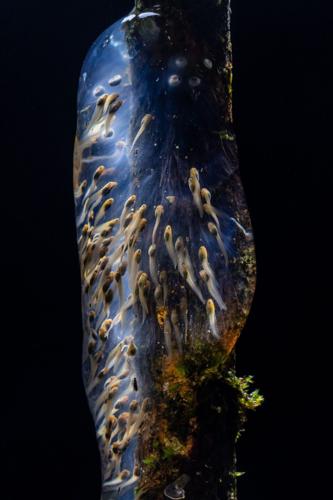
"Amphibian galaxy" by Filippo Carugati was the Ecology and environmental science category winner. (Filippo Carugati via SWNS)
The competition invites entries across five scientific categories:
- Astronomy
- Behavior
- Earth science and climatology
- Ecology and environmental science
- Microimaging


(0) comments
Welcome to the discussion.
Log In
Keep it Clean. Please avoid obscene, vulgar, lewd, racist or sexually-oriented language.
PLEASE TURN OFF YOUR CAPS LOCK.
Don't Threaten. Threats of harming another person will not be tolerated.
Be Truthful. Don't knowingly lie about anyone or anything.
Be Nice. No racism, sexism or any sort of -ism that is degrading to another person.
Be Proactive. Use the 'Report' link on each comment to let us know of abusive posts.
Share with Us. We'd love to hear eyewitness accounts, the history behind an article.