




(Flints Auctions via SWNS)
By Ed Chatterton
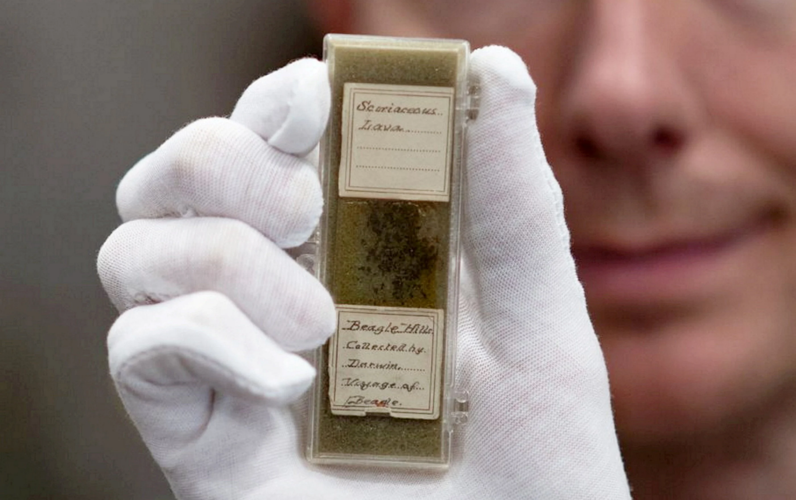
One of Charles Darwin’s microscope slides from his groundbreaking geological research is set for auction after being discovered in a cardboard box - almost 200 years on.
The tiny piece of history, which was bought as part of a job lot from a local auction, is believed to be the only slide from Darwin's research to ever publicly go under the hammer.
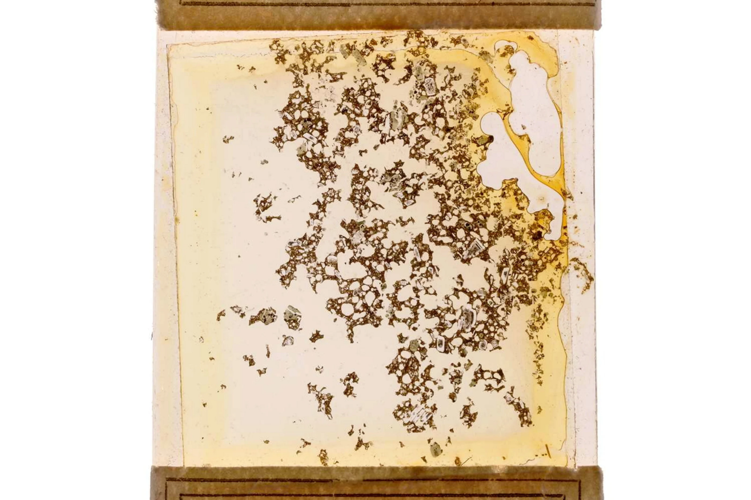
The specimen containing Scoriaceous Lava collected during Darwin’s legendary voyage aboard H.M.S. Beagle (1831–1836) will be sold at Flints Auction in Newbury, Berks., with a starting price of £500.
Experts say the item had been given such a modest estimate due to nothing similar ever coming to auction and expect it could fetch much more on Dec. 3.

(Flints Auctions via SWNS)
The vendor stumbled across the treasure among 250 other slides featuring insects, petrology and diatoms.
But tucked away in with the specimens was the extraordinary relic from one of the greatest minds in history.
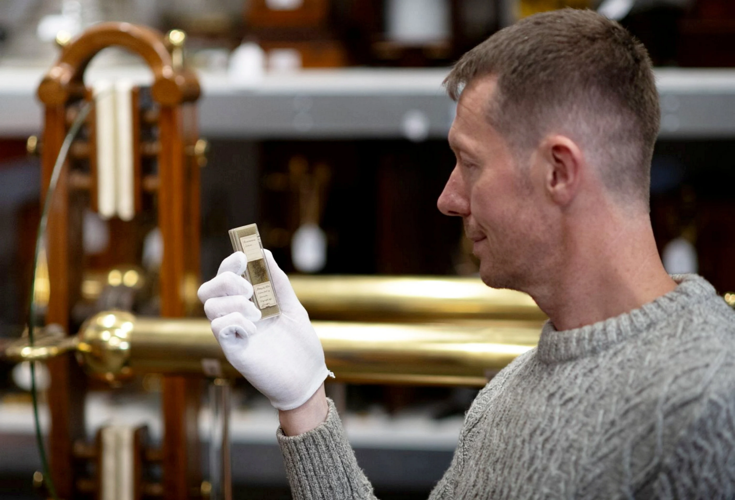
Matt Nunn, specialist at Flints Auctions said: “This is the first time I have ever seen anything related to Darwin and his scientific research outside of a museum or institution.


"To have a specimen that actually relates to him is really quite phenomenal.
"This piece of history will have a broad appeal and I anticipate interest from museums as well as collectors of Charles Darwin ephemera and those who are fascinated by scientific instruments.”
Scoriaceous Lava is a rare material and its discovery by Darwin was key to the understanding of the geology of the volcanic islands and it represents some of the earliest scientific observations of the rock types in the Atlantic and Pacific.

(Flints Auctions via SWNS)
Darwin’s most complete treatment of scoriaceous and vesicular volcanic rocks appears in his Geological Observations on the Volcanic Islands (1844), a work derived directly from his field notes during the voyage.
The rock type itself, scoria, is now recognized as a widespread product of explosive basaltic volcanism
The lightweight fragments accumulate around the vent to form steep conical hills known as cinder cones, and Darwin encountered numerous examples.
The auction listing adds: "A microscope slide purportedly collected during the Beagle voyage therefore carries exceptional historical and scientific interest.
"Not only does it represent a physical specimen from Darwin’s fieldwork, but it also embodies the observational foundations of modern volcanology.
"Such artifacts remain invaluable for understanding the empirical methods through which Darwin developed his broader geological and evolutionary thinking."


(0) comments
Welcome to the discussion.
Log In
Keep it Clean. Please avoid obscene, vulgar, lewd, racist or sexually-oriented language.
PLEASE TURN OFF YOUR CAPS LOCK.
Don't Threaten. Threats of harming another person will not be tolerated.
Be Truthful. Don't knowingly lie about anyone or anything.
Be Nice. No racism, sexism or any sort of -ism that is degrading to another person.
Be Proactive. Use the 'Report' link on each comment to let us know of abusive posts.
Share with Us. We'd love to hear eyewitness accounts, the history behind an article.