


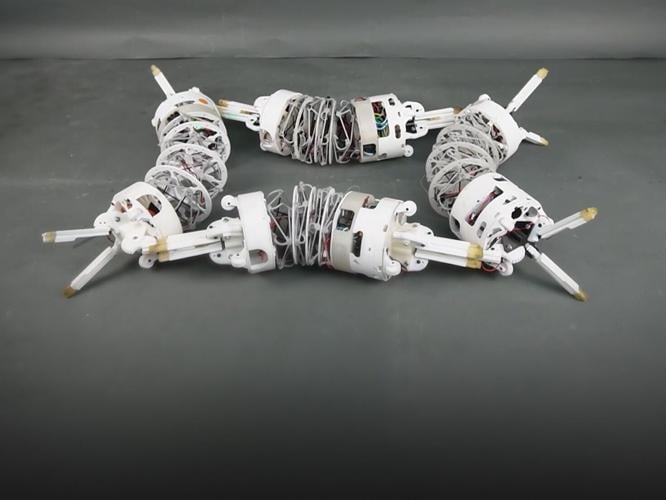
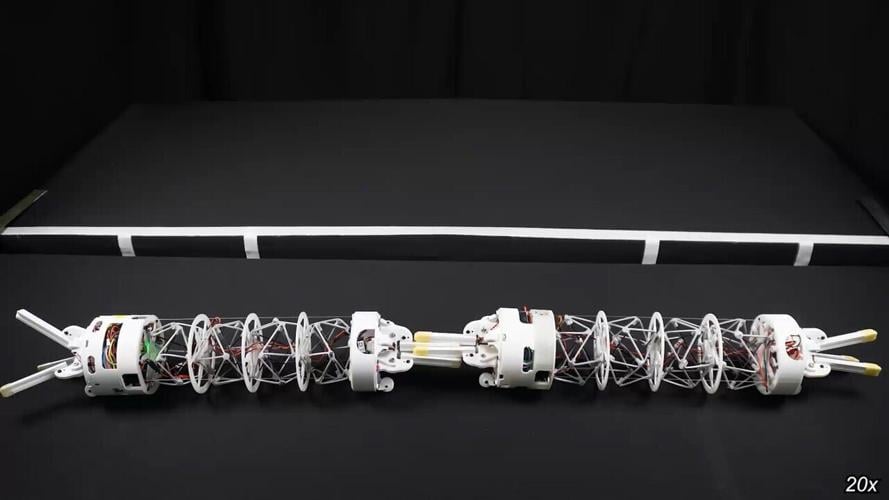
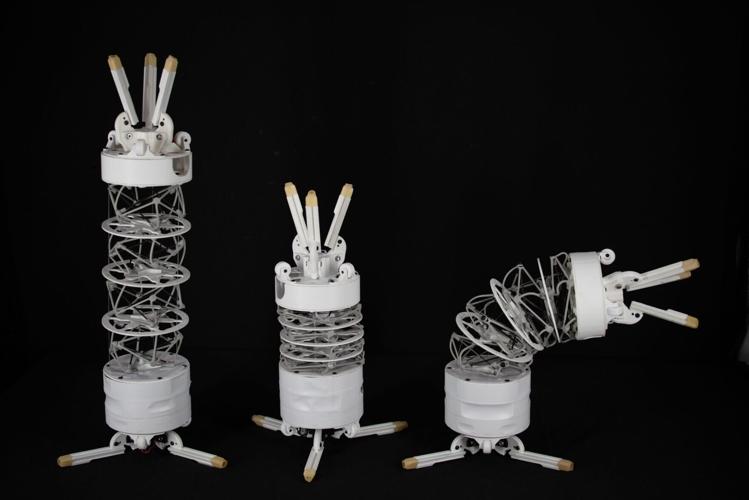
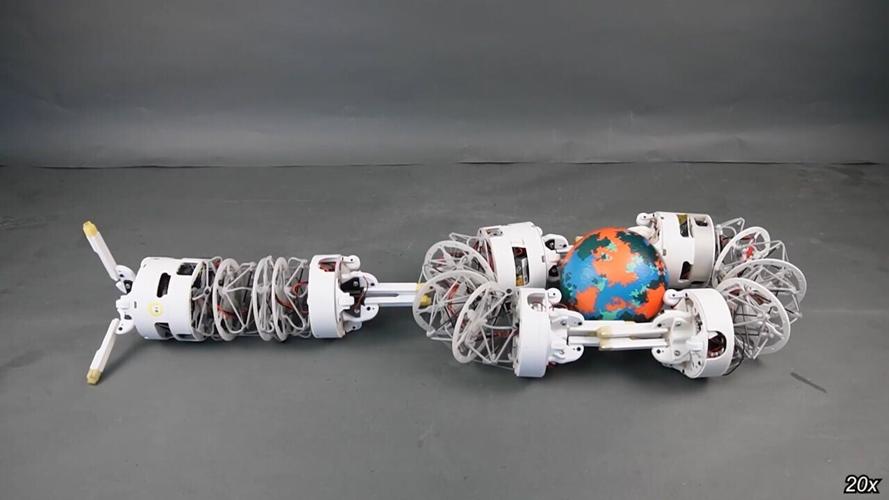

Researchers at Colorado State University have developed a flexible robot that functions like an elephant’s trunk to grip objects, with a goal of one day sending teams of these machines to aid in space exploration or to help with any number of other complex tasks. (Colorado State University Walter Scott, Jr. College of Engineer via SWNS)
By Stephen Beech
A new generation of shape-shifting robots — inspired by elephant trunks — can bend, grab and even team up.
They have been designed to easily grip objects — with a goal of one day sending teams of them to aid in space exploration.
They were developed by American scientists to address limitations in current robotic systems, which are more commonly built from rigid blocks that limit the shapes they can form.
The new robots were made instead with a design approach called “tensegrity” — in which stiff rods are held in place by a web of tensioned cables rather than being rigidly locked together.
That makes them flexible and lets them bend, collapse and change shape as needed, according to a study published in the journal Nature Machine Intelligence.

(Colorado State University Walter Scott, Jr. College of Engineer via SWNS)
Like tentacles, they have no traditional joints yet feature a pair of gripping claws at both ends of their tube-like bodies that can attach to partner robots for teaming or to manipulate items.
The robots were developed by associate professor Jianguo Zhao and his team in the Department of Mechanical Engineering at Colorado State University (CSU).
Zhao described the robots as “generalists” that could one day help in tasks ranging from search and rescue operations to supporting humans in a manufacturing setting.
He said: “Often the physical structure of robots is fixed, but our approach allows these flexible systems to adapt their shape to their environment and to the potentially changing needs of their mission by collapsing, stretching or grasping.

(Colorado State University Walter Scott, Jr. College of Engineer via SWNS)
“They are also modular, meaning each robot works like a building block: it can operate on its own or connect with others to form bigger, more capable shapes.”
Zhao says that the dual claw-attachment design avoided the need for magnets, which can sometimes fail as connection points.
He said the combination of claw attachments and body structure open many possibilities for their eventual use.


Zhao added: “They can bend around to lift and carry different sized objects with their body or to navigate difficult terrain like a snake would.
“The claw-attachment also reduces the chance of misalignments during connections — making it easier for them to team up and form loops, chains and branches of different sizes to accomplish their tasks.

(Colorado State University Walter Scott, Jr. College of Engineer via SWNS)
“They are very adaptable to the situation and goals.”
Study co-first author Mahmud Hasan Saikot took over the robot initially designed by team member Sydney Spiegel, the paper’s other co-first author.
CSU doctoral student Saikot said the team went through several design ideas before landing on the current version of the robotic arms.
He says one of the challenges was finding motors that were small enough to support the various types of movements, but were also powerful and reliable over longer periods of time.
Saikot said the team spent a lot of time testing configurations and taking the robots into the field to see how they handled crossing natural landscapes in addition to work in the lab.
He says the next step in the project will be developing the ability for the systems to work with humans and on their own.

(Colorado State University Walter Scott, Jr. College of Engineer via SWNS)
The team also hopes to make them operate at faster speeds.
Saikot said: “Right now, these systems need to be piloted by a human.
“However, we have already demonstrated that two robots can find each other and connect on their own.”
He added: “In the future, we can envision mostly autonomous teams of tens or even hundreds of them — attached through the claws — traveling to a location and then deploying for a specific purpose.
“With that in mind, we want to continue improving their ability to work together with minimal human supervision.”


(0) comments
Welcome to the discussion.
Log In
Keep it Clean. Please avoid obscene, vulgar, lewd, racist or sexually-oriented language.
PLEASE TURN OFF YOUR CAPS LOCK.
Don't Threaten. Threats of harming another person will not be tolerated.
Be Truthful. Don't knowingly lie about anyone or anything.
Be Nice. No racism, sexism or any sort of -ism that is degrading to another person.
Be Proactive. Use the 'Report' link on each comment to let us know of abusive posts.
Share with Us. We'd love to hear eyewitness accounts, the history behind an article.