


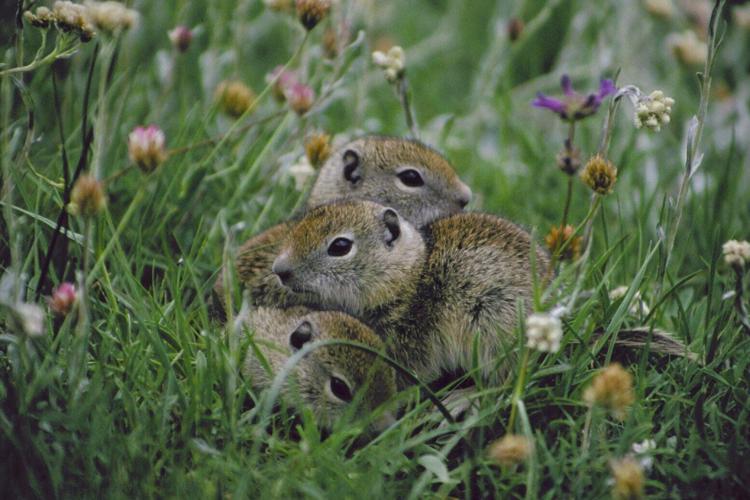
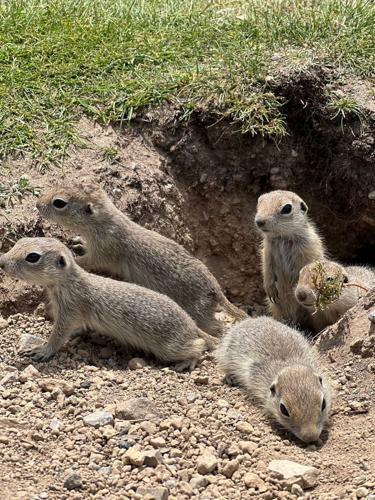

Three juvenile Belding's ground squirrels emerged aboveground for the first time, at about 25 days of age. Their chances of surviving to the following year depend on many factors, including foraging ability, anti-predator behaviors and social interactions. (Jill Mateo via SWNS)
By Stephen Beech
Large extended families help female squirrels survive hibernation, reveals a new study.
Researchers found that the number of living female relatives “significantly boosted” an adult female’s chances of survival, something that has never been shown before in the animal kingdom.
Bigger body size and a short snowy season also improve survival rates, according to the study.
The findings showed that adult female Belding’s ground squirrels are more likely to survive year to year if they live near more adult female kin.
But neither males nor young females get the same boost from nearby family, according to the findings published in the journal PLOS One.
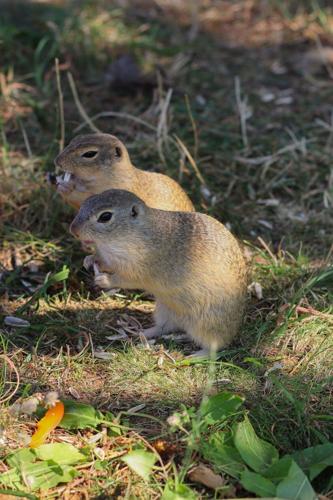
Belding’s ground squirrels are hibernating rodents that live in the mountains of California, Nevada and Oregon in the United States.

(Photo by Goszton via Pexels)
While young males leave home to find new territories, study lead author Jill Mateo says females stay put and live in communal family groups.
Mateo, from the University of Chicago, said: “The female kin alert each other to danger and protect each other’s offspring from infanticide.”
To identify factors that improve the odds of survival in Belding’s ground squirrels, Mateo and her colleagues analyzed two decades of mark-recapture data, where researchers tagged squirrels and checked the subsequent year to see if they survived.
They looked specifically at the impact of age, sex, weight, number of offspring, the number of nearby family members and certain hormones.
The research team also took into account annual snowfall.
The analysis showed that, as expected, heavier individuals were more likely to survive hibernation.

(Photo by Seda TunadaÄı via Pexels)


Females had higher survival rates than males, with juvenile males experiencing the highest mortality.
For adult females, the odds of surviving increased with the number of other adult female family members living nearby.
The researchers say that may be because they can share the burden of defending their territory and spend more time foraging.
But young females didn’t experience the same benefits from nearby female relatives, likely because they faced stiffer competition for food and burrows.
The researchers also showed that a short snowy season allowed the squirrels to emerge earlier from hibernation, which increased the survival of juvenile animals and helped adult females to have more offspring.
Mateo said the results show that an animal’s social structure, physiological state and response to the climate all interact to shape their survival — depending on their sex and life stage.
The findings also highlight the importance of having larger kin groups for female Belding’s ground squirrels — a unique finding among mammals — where strong social bonds enhance longevity, especially for females.

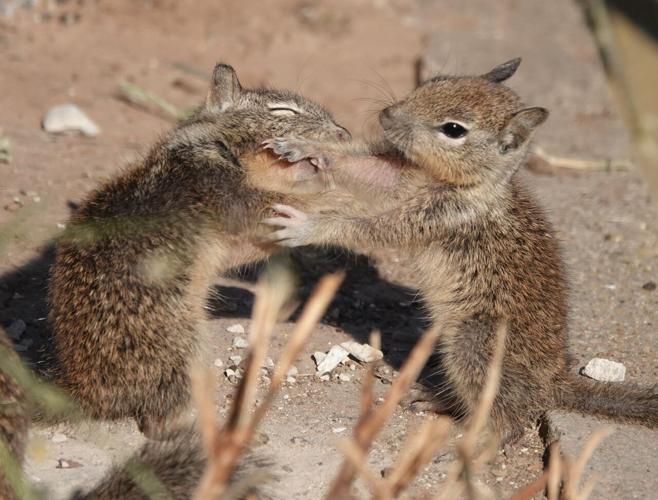
(Photo by Richard Block via Pexels)
Mateo says that understanding such interactions will be increasingly important in the future, as snowfall declines across much of the Belding’s ground squirrels’ range due to climate change.
She said: “We analyzed which variables predicted year-to-year survival in a group-living species which hibernates most of the year.
“We found that the number of living female relatives, beyond their mere presence, significantly boosted an adult female’s chances of survival, something that has never been shown before.
“We also expected snow fall to improve survival through insulative properties, but instead lower snow fall was associated with surviving to the following year, likely through phenological effects on summer activity patterns.”
Mateo added: “After collecting 25 years of demographic data on Belding’s ground squirrels at our eastern Sierra field site, I was eager to discover what influenced survival.
“Why, for example, our oldest female and male both lived nine years, but most adults live only two to three years.
“Of course, it is a complex interaction of physiological, social and ecological effects, but the previously unknown importance of kin count now begs the question of which mechanisms drive that effect.”


(0) comments
Welcome to the discussion.
Log In
Keep it Clean. Please avoid obscene, vulgar, lewd, racist or sexually-oriented language.
PLEASE TURN OFF YOUR CAPS LOCK.
Don't Threaten. Threats of harming another person will not be tolerated.
Be Truthful. Don't knowingly lie about anyone or anything.
Be Nice. No racism, sexism or any sort of -ism that is degrading to another person.
Be Proactive. Use the 'Report' link on each comment to let us know of abusive posts.
Share with Us. We'd love to hear eyewitness accounts, the history behind an article.