





Cloud cover seen from the ground. (Colorado State University / Walter Scott, Jr. College of Engineering via SWNS)
By Stephen Beech
Tiny particles bubbling up from melting Arctic sea ice play a key role in cloud formation, suggests new research.
The discovery may explain why Arctic clouds behave differently — and lead to improved forecasting of future climate change, say American scientists.
Their findings highlight how the airborne "ice-nucleating particles" from biological sources — such as bacteria — provide a platform for the creation of clouds.
Because cloud cover plays an important role in the balance between incoming solar energy and outgoing heat, as well as precipitation, the researchers say the particles may be key to developing a better understanding of climate change in the Arctic.
Ice-nucleating particles can come in the form of things such as mineral dust, microbes or sea spray.
As they make their way into the atmosphere, the research team explained that they act as templates for water vapor to freeze on to support cloud formation.
The new study, published in the journal Geophysical Research Letters, highlights ponds of melted water that sit on top of sea ice as a key source of these particles.

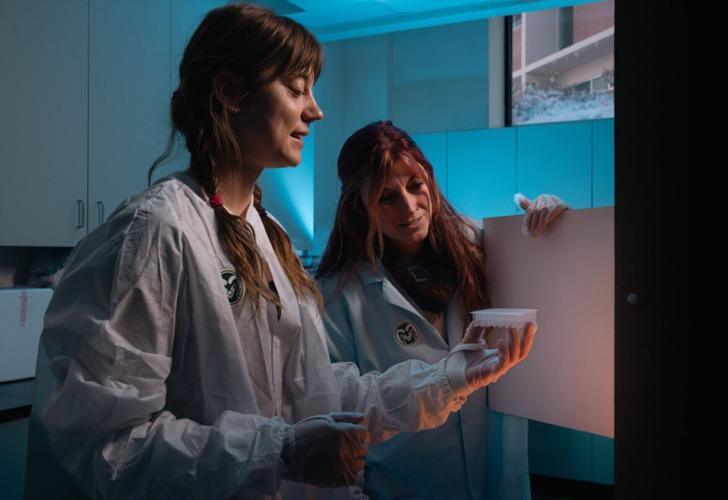
Camille Mavis (left) and Jessie Creamean review samples from the project. (Colorado State University / Walter Scott, Jr. College of Engineering via SWNS)
The ponds are made of melted snow, but can also include a mix of seawater that has seeped in as well as released soil sediment or melted ice from the pack of ice below that hosts small organisms.
By taking sea-ice core samples and measuring aerosol emissions around the pools, the research team was able to show that ice-nucleating particle concentrations were higher there than in seawater.
They believe that probably means there are specific biological processes at play in the pools, contributing to their formation.
Researchers from Colorado State University (CSU) led the work with samples collected during the Multidisciplinary Drifting Observatory for the Study of Arctic Climate (MOSAiC) expedition.
The project is aiming to develop a better understanding of declines in Arctic sea ice and how they are linked to climate change.
The 2019-2020 MOSAiC expedition offered a chance to gather data on the particles in a region that is already feeling the effects of climate change in the form of glacial melt, permafrost thaw and sea-ice decline.
So far, only a few specific particles are known to be a part of the cloud formation process.


Camille Mavis reviews samples used in the study. (Colorado State University / Walter Scott, Jr. College of Engineering via SWNS)
And their path into the atmosphere has rarely been studied in the northernmost, extreme high Arctic, partially because it is difficult to gather samples in that environment.
Study lead author Camille Mavis explained that the Arctic environment lent itself to studying the particles because it is a "simpler" system with fewer animals and variables than others around the globe.
She says the Arctic is warming four times faster than the rest of the globe, meaning more ponds may form in the future, or small changes in their composition could "significantly" alter the entire system.
Mavis, a CSU doctoral student, said: "Clouds are complex, and there is still a lot of uncertainty associated with how aerosol interactions affect cloud radiative effects overall.
"Developing an understanding of the role these particles play will help with weather modeling and a host of other benefits in the future.
"Our current models don't do a good job of mimicking these clouds right now, especially in polar regions."
Study senior author Jessie Creamean traveled with the MOSAiC Expedition to collect the samples.
CSU research scientist Creamean said: "The clouds in the Arctic are different than you would find in the Pacific or Atlantic.

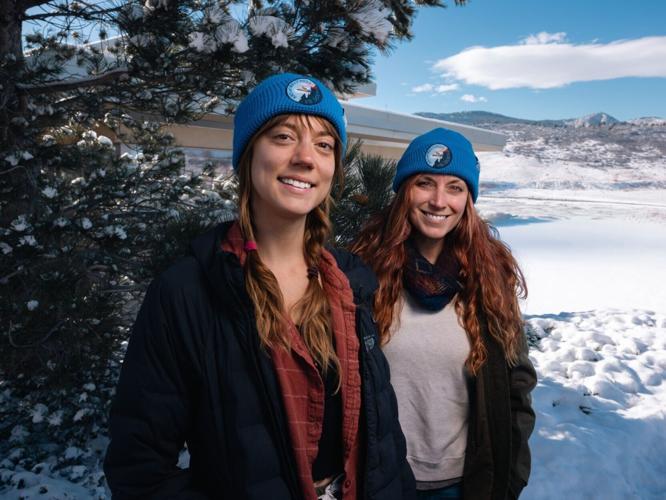
Camille Mavis (left) and Jessie Creamean. (Colorado State University / Walter Scott, Jr. College of Engineering via SWNS)
"They behave differently despite having some of the same general materials and processes.
"That is part of the reason we want to understand how they are formed there, because each region is unique in this small but important process.
"Our work shows the complex interactions and composition of these ponds and how they contribute to that process."
Study co-author Sonia Kreidenweis, also of CSU, says the team will now investigate the makeup of the particles and how conditions and processes contribute to their release.
She said: "The particles studied can trigger ice formation at relatively warm temperatures and appear to be more closely associated with time spent over ice rather than the open ocean."
Kreidenweis added: "More research is needed to understand how they are released from meltwater, and how big a role they play in the radiation budget as Arctic melt seasons grow longer and larger."


(0) comments
Welcome to the discussion.
Log In
Keep it Clean. Please avoid obscene, vulgar, lewd, racist or sexually-oriented language.
PLEASE TURN OFF YOUR CAPS LOCK.
Don't Threaten. Threats of harming another person will not be tolerated.
Be Truthful. Don't knowingly lie about anyone or anything.
Be Nice. No racism, sexism or any sort of -ism that is degrading to another person.
Be Proactive. Use the 'Report' link on each comment to let us know of abusive posts.
Share with Us. We'd love to hear eyewitness accounts, the history behind an article.