


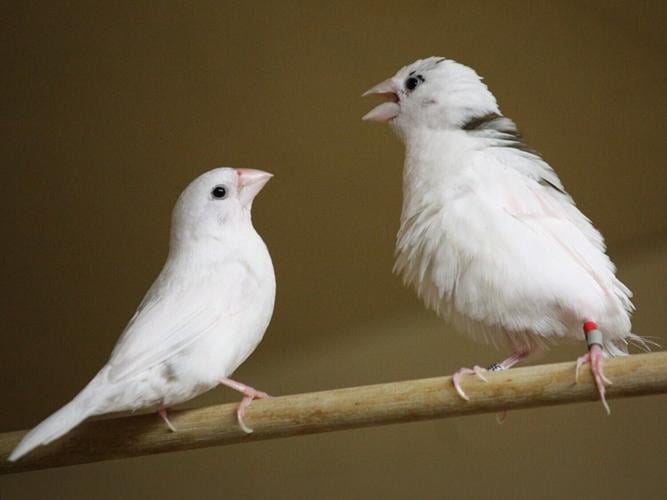






(Photo by Erik Karits via Pexels)
By Stephen Beech
Birdsong shows patterns similar to human language, according to a new study.
Researchers have uncovered a previously undetected structure in the songs of Bengalese finches that has the same statistical patterns found in human languages.
They say the birds — famous for their complex, learned songs — organize their singing using the same mathematical formula found in human speech.
The international research team found that the trait has developed over time which makes complex communication easier to learn and pass from one generation to the next.
Their findings, published in the journal Science Advances, build on the team's previous discovery that humpback whales also rely on the similar systematic structure.
Language has long been considered a uniquely human trait, with features that mark it out as distinct from the communication of all other species.

In this teaching situation, the father, right, shows his sons, left, how to sing. (Kazou Okanoya via SWNS)
However, the researchers say their latest findings suggest that some of language's most fundamental building blocks may not be uniquely human after all, but a universal feature of learned communication.
The study suggests that like human language the communication processes for songbirds and humpback whales are an evolutionary solution with them being transmitted culturally, meaning that they learn their communication systems from each other.
The research team — including scientists from the University of Edinburgh — used methods inspired by how babies discover words in speech, and applied them to song data collected from Bengalese finches in Japan.
They observed the finch songs contained statistically coherent sequences of notes — the avian equivalent of "words" — and the sequences followed the same patterns observed in human language where a few words are used very frequently and others are used more rarely, known as a Zipfian distribution.
Data was collected across the various stage of development of the birds and the patterns were already present during the birds' earliest attempts at singing, suggesting they emerge naturally as part of the learning process.
The researchers found that young songbirds listen to the sounds around them to unconsciously learn the statistical patterns of the sounds and organize their songs — similar to how babies figure out where one word ends and the next begins by recognizing which sounds frequently occur together.
The statistical process is thought to make language easier to learn, helping infants identify recurring "chunks" of speech within the continuous stream of sounds they hear every day.

(Photo by Monstera Production via Pexels)


Leaders of the study, together with Ellen Garland from the University of St. Andrews, recently found similar statistical patterns in the songs of humpback whales.
The team says the new findings suggest that some of the fundamental building blocks that make language learnable can emerge wherever communication is learned and passed from one generation to the next — even in the songs of small birds.
Study co-leader Simon Kirby, of the University of Edinburgh, said: "We have become used to the idea that language is unique in the natural world.
"But by using insights from how babies learn language we've been able to take a closer look at birdsong, and have discovered a surprising commonality between these species separated by more than 300 million years of evolution.
"Both humans and songbirds pass on their communication through culture, and this is what creates the patterns that language and birdsong share.
"We humans are the only species with language, but we share the planet with several others who also have culturally evolving communication, and this may make us more similar to one another than we previously thought."
Scientists have long known that songbirds learn their songs by listening to adult birds, much as children learn language from people around them.
The study goes a step further by showing that the songs themselves are organized according to the same statistical principles that help human babies learn spoken language.

Anil Kumar
Together with recent discoveries in humpback whales, the researchers say their findings suggest that evolution may repeatedly arrive at the same solution whenever complex communication must be learned and transmitted across generations.
Inbal Arnon, of the Hebrew University of Jerusalem, said: "People often think language is what makes humans unique.
"Our findings suggest that some of the fundamental properties that make language what it is can emerge wherever communication is learned and passed from one generation to the next — and that this happens across evolutionarily distant species: humans, Bengalese Finches, humpback whales.
"This does not mean that human language is not special in other ways, but it gets us closer to understanding what it shares, and does not, with other communication systems in nature.
"For me, it is really exciting to see how ideas from child language learning can reveal new insights about language evolution and animal communication"
Kazuo Okanoya of Teikyo University, Japan, added: "I have studied Bengalese finch song for many years and thought I knew it rather well.
"It was therefore a pleasant surprise to discover, through this international collaboration, that it shares yet another property with whale song and human language: frequently used chunks of syllables tend to be shorter, while less frequently used chunks tend to be longer — a pattern known as Zipf's law."


(0) comments
Welcome to the discussion.
Log In
Keep it Clean. Please avoid obscene, vulgar, lewd, racist or sexually-oriented language.
PLEASE TURN OFF YOUR CAPS LOCK.
Don't Threaten. Threats of harming another person will not be tolerated.
Be Truthful. Don't knowingly lie about anyone or anything.
Be Nice. No racism, sexism or any sort of -ism that is degrading to another person.
Be Proactive. Use the 'Report' link on each comment to let us know of abusive posts.
Share with Us. We'd love to hear eyewitness accounts, the history behind an article.