



Report: In June, nearly 50% of press releases were written with AI
Individuals are using AI to write LinkedIn posts for them at a rate outpacing almost any other AI writing use case. But how common is generative AI in other kinds of public relations writing? In particular, what does AI uptake look like among business communications, like press releases?
To answer this question, Pangram looked at the AI contribution rate in corporate press releases on the largest press release distributor in the U.S., PR Newswire. Companies pay the service to syndicate internally written public relations material like earnings reports, product launches, and announcements, which PR Newswire pushes to newsrooms and financial terminals. It is one of the main syndication networks for companies obligated to make Securities and Exchange Commission disclosures, and handles releases from companies such as Pfizer, Toyota, and Walt Disney World.
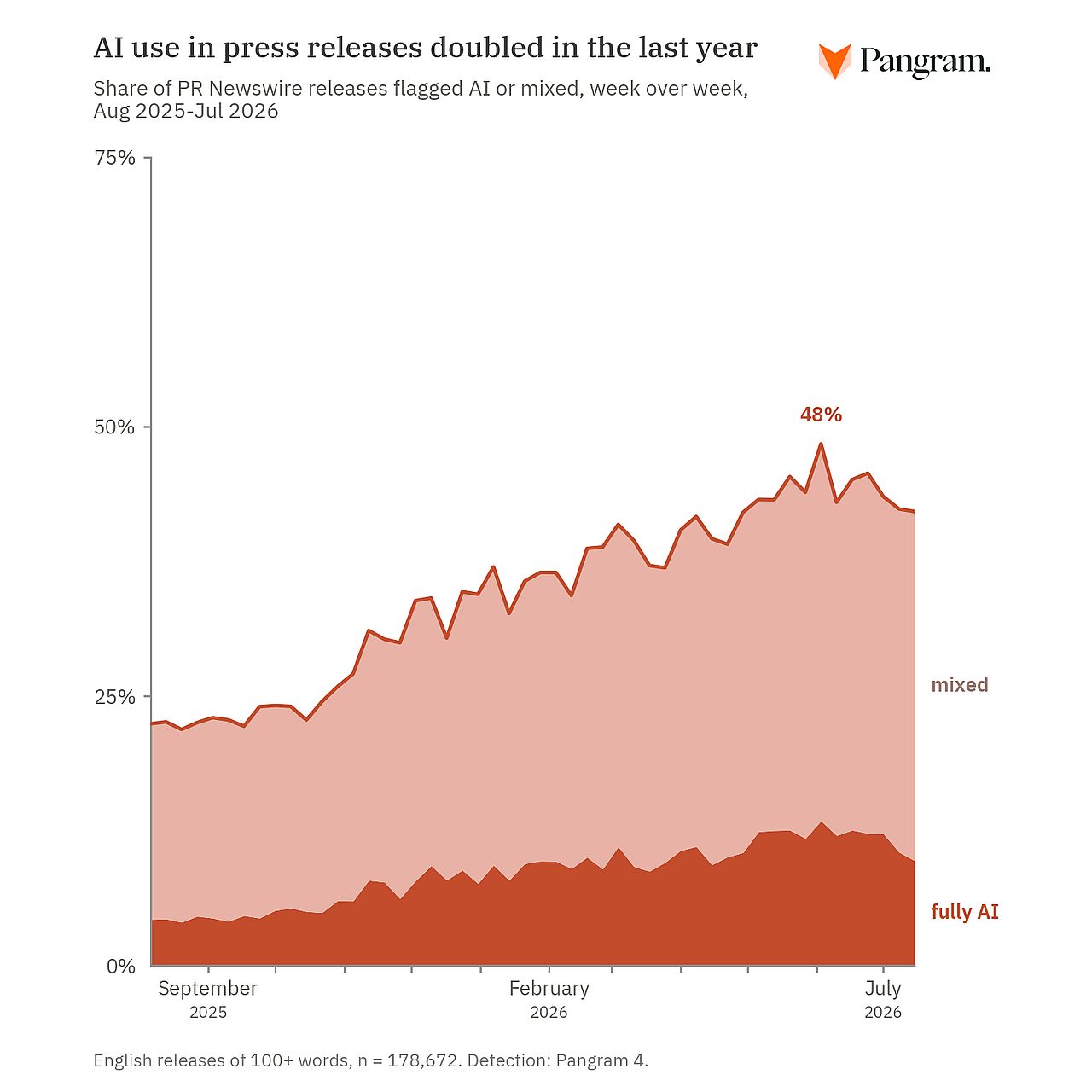
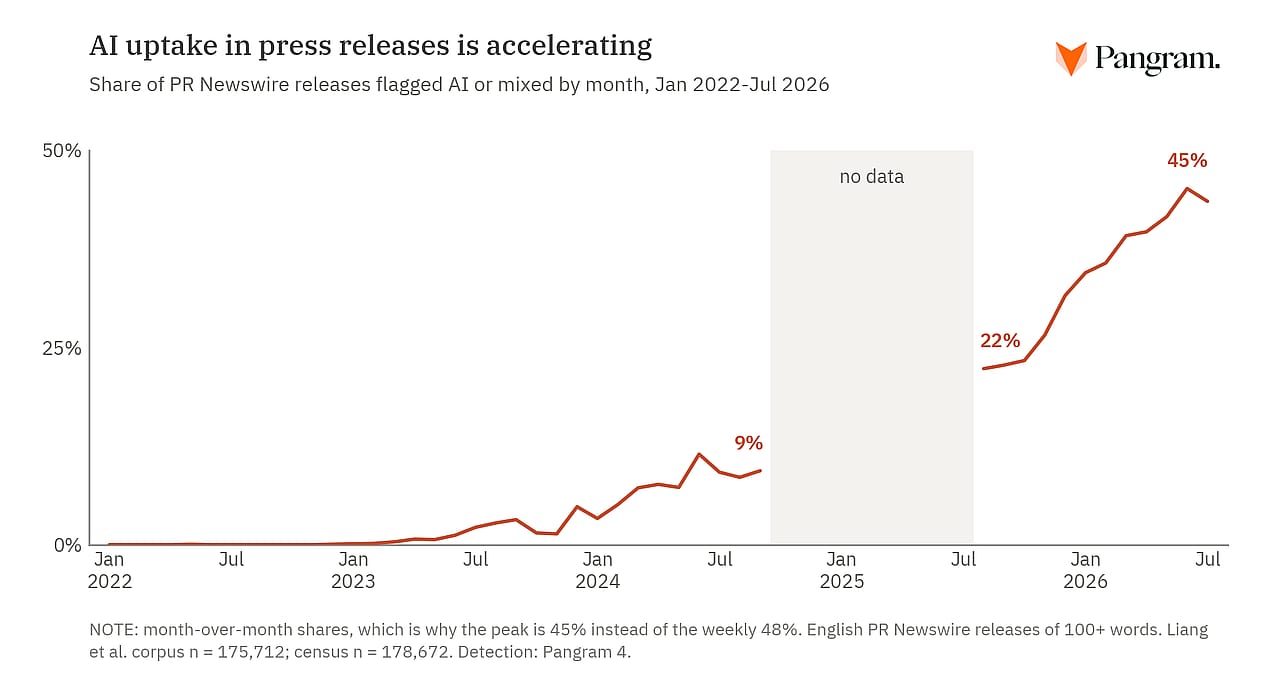
Pangram scanned 178,672 English press releases published on PR Newswire, and found that 34% of them contained AI-generated text in the last 12 months. Moreover, weekly AI share doubled in the last year, from 22% to 48% in June 2026. Of the 61,523 releases that flagged for AI content, 25% flagged as fully AI-generated (15,205), and 75% flagged as mixed (46,318).
Key findings:
- In June 2026, 48% of press releases on PR Newswire contained AI-generated text
- AI prevalence in PR Newswire releases has doubled in the last year, and the rate of adoption is increasing
- Advertising had the highest share of fully AI-generated press releases at 41%, as well as the highest overall AI content share, at 64%
AI share has doubled in the last year
The share of press releases syndicated on PR Newswire containing AI-generated text has doubled in the last year, from 22% in Aug 2025 to a peak of 48% in June 2026.
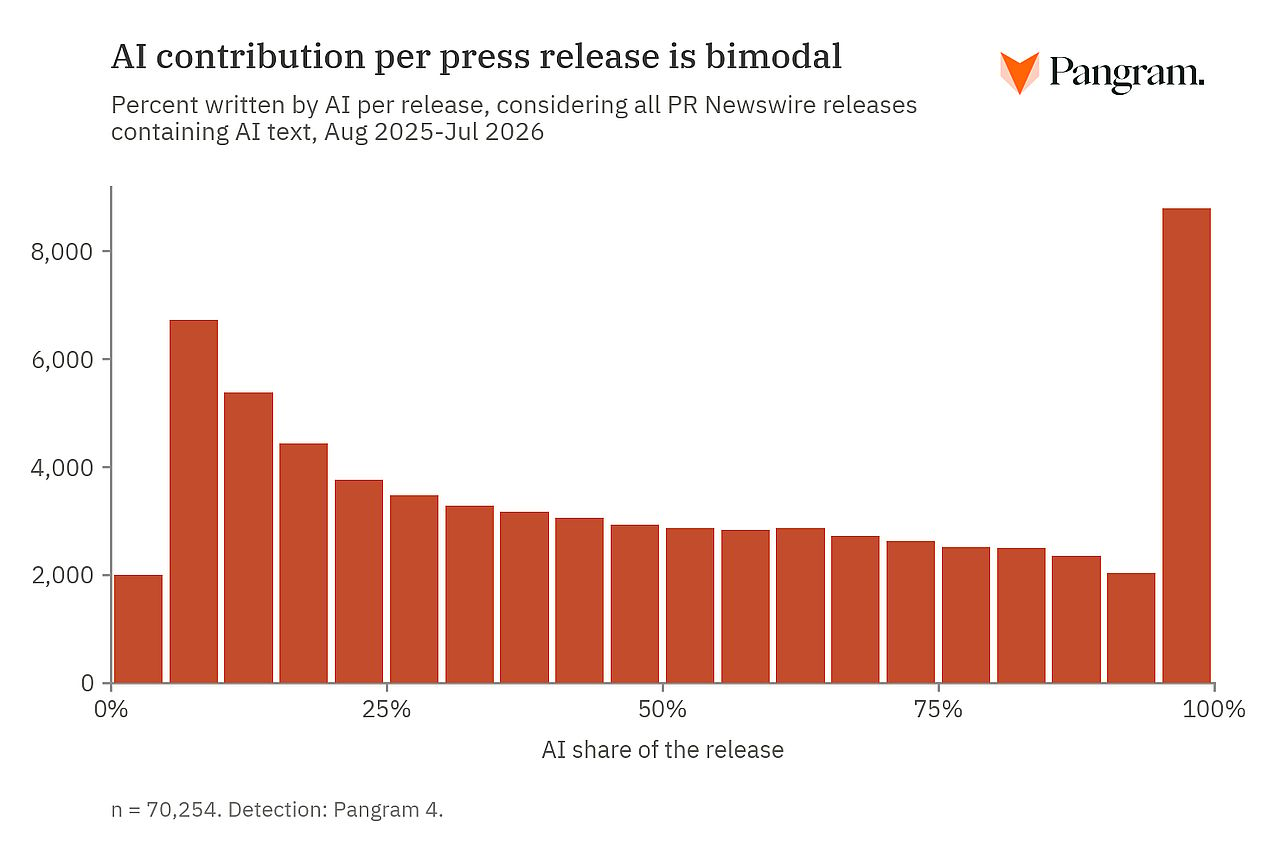
AI contribution per press release was substantial on average: The median press release flagged for AI content was 52% AI-authored. Of all documents that were flagged for containing AI-generated text, 25% were fully AI-generated; the remaining 75% of flagged documents contained mixed human and AI text. Across all flagged documents, the AI contribution rate was bimodal, showing either very light contribution or full AI generation.
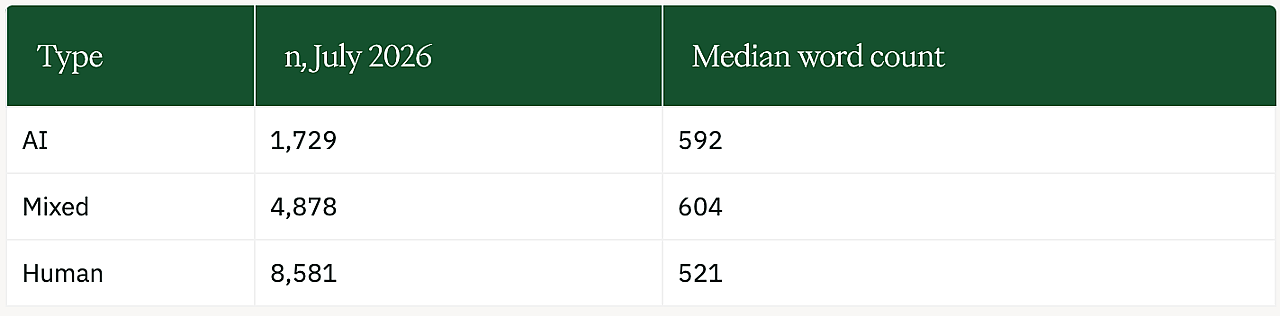
AI authorship also seems to be driving a modest word count increase in press releases. The median word count increased about 15% in PR Newswire releases in the last twelve months, from 488 to 562 words. Mixed and fully AI press releases are becoming longer than fully human authored ones: In July 2026, the median human press release was 521 words compared to a weighted average of 601 words for documents that contained AI-authored text.
Which industries are publishing AI-generated press releases?
AI share in press releases varied by industry. Finance, energy, and biotechnology all had the lowest rate of AI-generated text, and in particular had sub 5% rates of fully AI-authored press releases. Advertising had the highest share of fully AI-generated press releases at 41%, as well as the highest overall AI content share, at 64%.
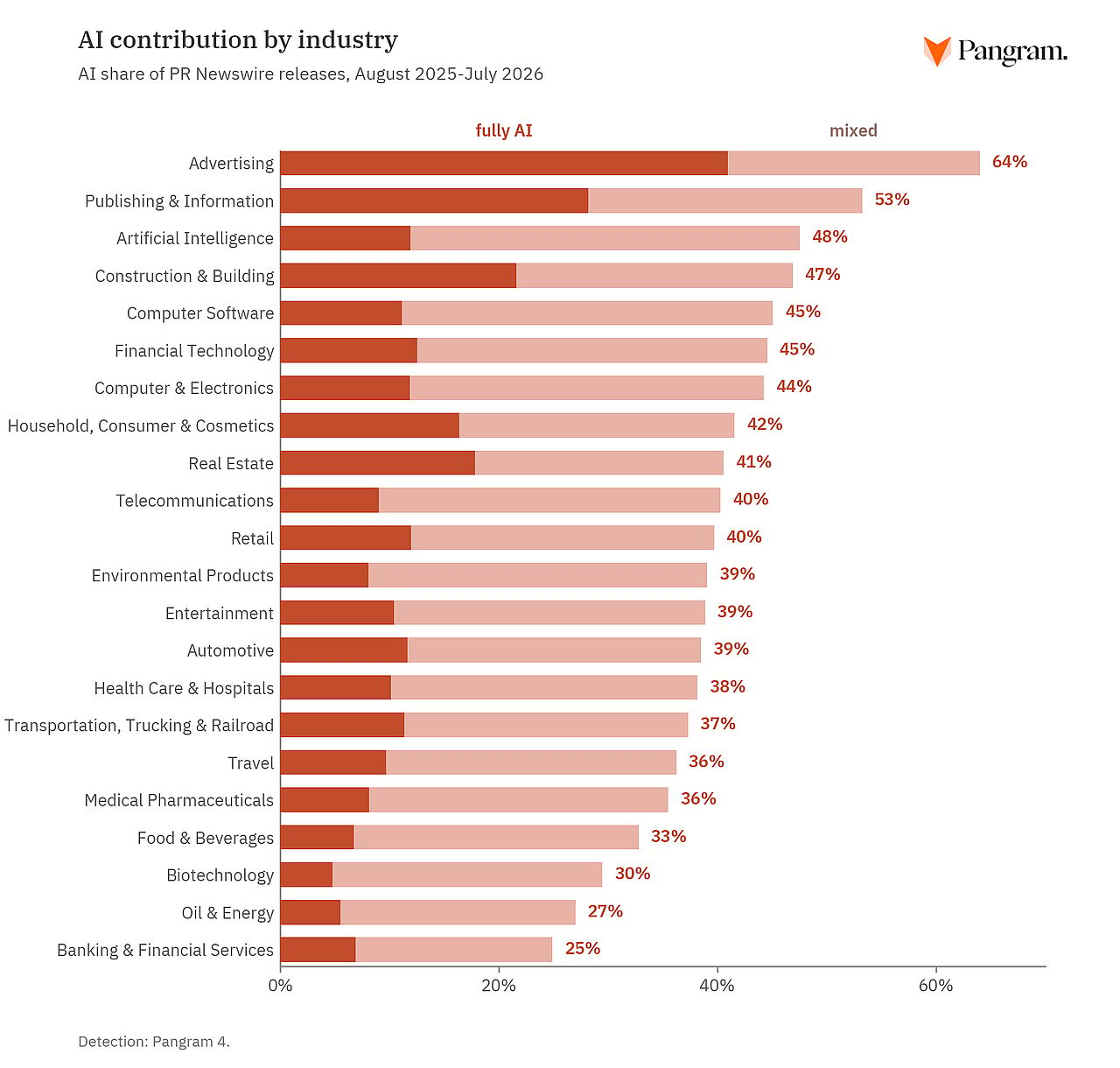
Some of advertising's high AI share is down to the prevalence of authority laundering content marketing agencies, which release a high volume of editorial-style marketing articles on behalf of local businesses. One such issuer, HelloNation, was responsible for 2,265 press releases in the dataset. Among those releases, 2,198 were fully AI (97%), 66 were mixed, and only one was flagged as human-written.


In general, sectors dominated by small businesses and startups had much higher AI share than those occupied by larger, more established institutions. For example, financial technology releases (n=1526) — populated by small, single-person startups and crypto ventures — had an AI contribution rate of 44%, with 12% fully AI-generated. On the other hand, banking and financial services (n=8,817), dominated by traditional banks and funds, had an AI contribution rate of 25%, with only 7% of press releases flagging as fully AI-generated.
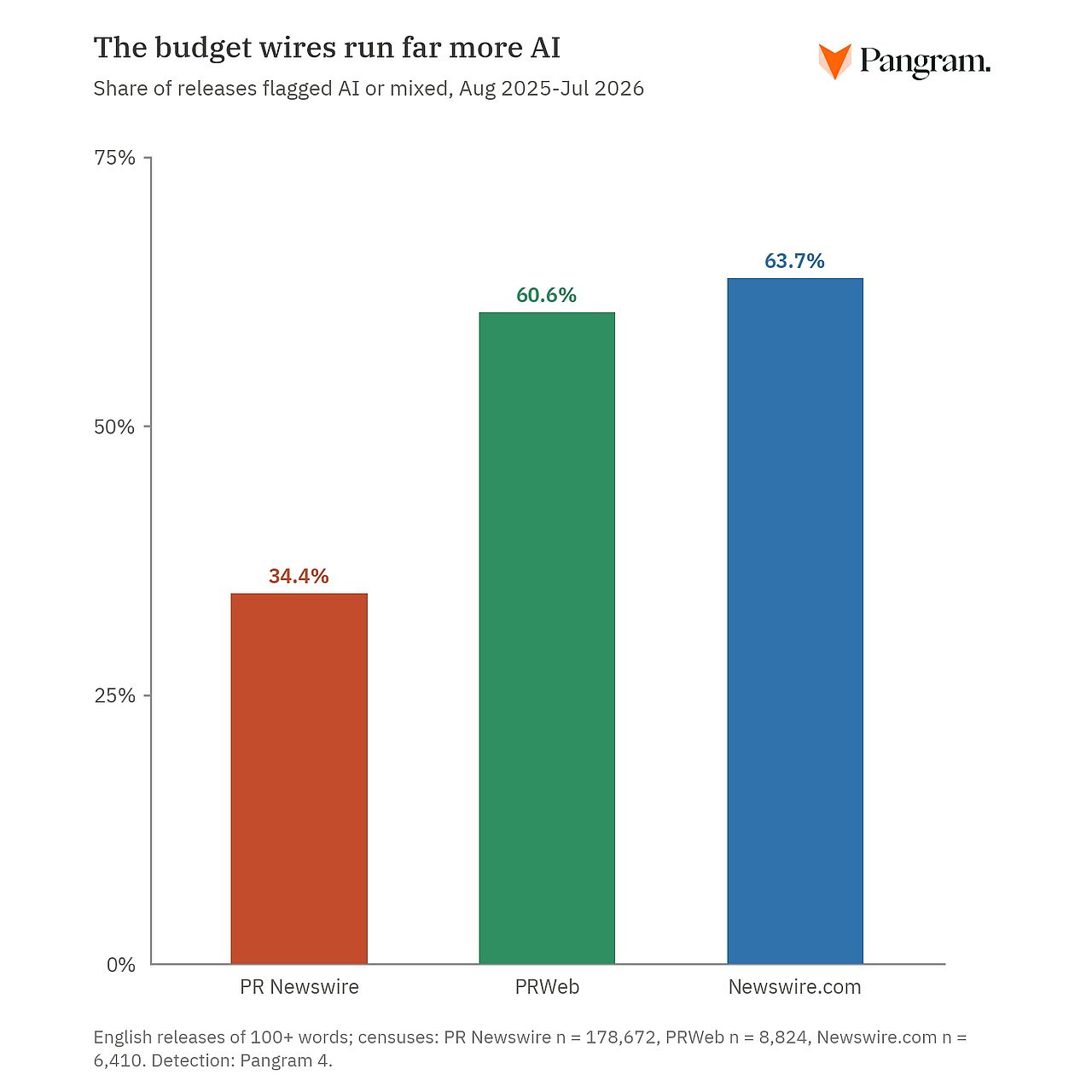
This was also true for newswires that market to small businesses. We scanned the last 12 months of releases from two budget wires: PRWeb, which is a self-serve distributor, and Newswire.com, which caters to small and midsized businesses. Both had close to double the AI contribution rate of PR Newswire.
Previous studies overestimate
A previous study of AI use in corporate communications by Liang et al., "The Widespread Adoption of Large Language Model-Assisted Writing Across Society", used word frequency analysis to estimate AI prevalence at a population level. For the present study, Pangram rescanned their corpus of PR Newswire releases. By stitching the results for the two datasets together, we can see that AI uptake in press releases is accelerating. According to Pangram 4, AI contribution rate took two years to reach 9% in August 2024, doubled to 22% by July 2025, and doubled again to 44% in July 2026.
Contrary to Liang et al.'s results, the analysis indicates that AI uptake was actually quite gradual in the months following ChatGPT's November 2022 launch. Pangram found that it took nearly a year for press releases to break a 5% AI contribution rate.
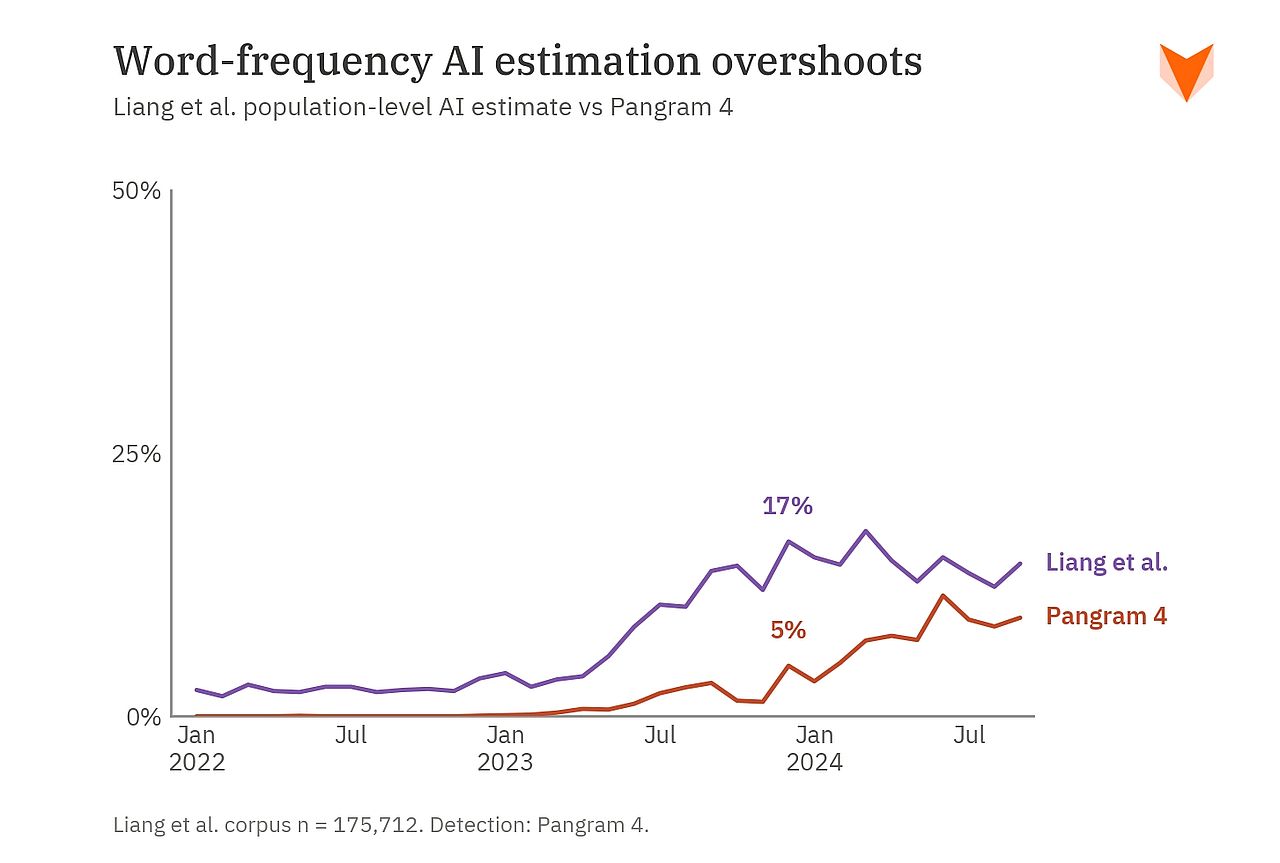
The Liang et al. releases also double as a benchmark set for Pangram 4: for releases that predate ChatGPT, Pangram 4 achieves one false positive among 21,625 releases, or 0.0046% false positive rate.
Methodology
Pangram used four datasets for this analysis. The primary dataset was a census of 178,672 English PR Newswire releases longer than 100 words, published between Aug. 16, 2025, and July 31, 2026. To extend the analysis, Pangram scanned 175,712 releases from the Liang et al. PR Newswire corpus from January 2022 to September 2024, which they released publicly here. To compare those results with budget wires, Pangram analyzed 8,824 PRWeb releases published between Aug. 21, 2025, and July 31, 2026, and 6,410 Newswire.com releases published between Aug. 1, 2025, and July 31, 2026. You can find the full dataset of AI press release statistics here.
Industries were determined by their tags on PR Newswire, and tags with more than 1,400 entries were considered. In two cases, one tag was entirely contained within a larger one: “medical pharmaceuticals” and “pharmaceuticals” were treated as a single industry, while “financial technology” and “finance” were kept separate because their populations differed significantly.
What is the problem with AI writing press releases?
None of the wires scanned require any sort of AI disclosure. In fact, just as with LinkedIn, PR Newswire actually sells an AI writing tool, and states outright that it "does not publicly tag press releases to indicate they were created using AI."
Large language models may be well-suited to producing a large volume of polished, grammatical, good-enough text at a very low cost. The flaws of AI-written text — that it can be impersonal, formulaic, or lack information density — are also common critiques of human-authored professional writing. That means those flaws may be easily overlooked here, although AI writing still contributes to burdensome, low-effort communications, otherwise known as workslop.
AI use in press releases does likely degrade their quality regardless. People find AI writing less trustworthy, and fatigue around common LLM-isms like "quietly" and "delve" continues to grow. Moreover, AI can also introduce errors into copy, which could have legal ramifications for press releases designed to fulfill SEC obligations.
Perhaps the most significant negative effect of using AI for professional writing comes down to volume. Because large language models allow massive amounts of low-information text to be produced at scale, we are entering a world where anyone can publish a press release, memo, or report essentially at the cost of distribution, and the length and frequency of these texts will increase accordingly. Similar AI-driven volume increases are happening in areas like adjudicating pro se lawsuits and processing literary manuscripts. It seems likely that, left unchecked, these AI outputs will degrade the signal of many channels of professional and corporate communication, affecting smaller players, like genuine local businesses, the most.
This story was produced by Pangram Labs and reviewed and distributed by Stacker.


(0) comments
Welcome to the discussion.
Log In
Keep it Clean. Please avoid obscene, vulgar, lewd, racist or sexually-oriented language.
PLEASE TURN OFF YOUR CAPS LOCK.
Don't Threaten. Threats of harming another person will not be tolerated.
Be Truthful. Don't knowingly lie about anyone or anything.
Be Nice. No racism, sexism or any sort of -ism that is degrading to another person.
Be Proactive. Use the 'Report' link on each comment to let us know of abusive posts.
Share with Us. We'd love to hear eyewitness accounts, the history behind an article.