


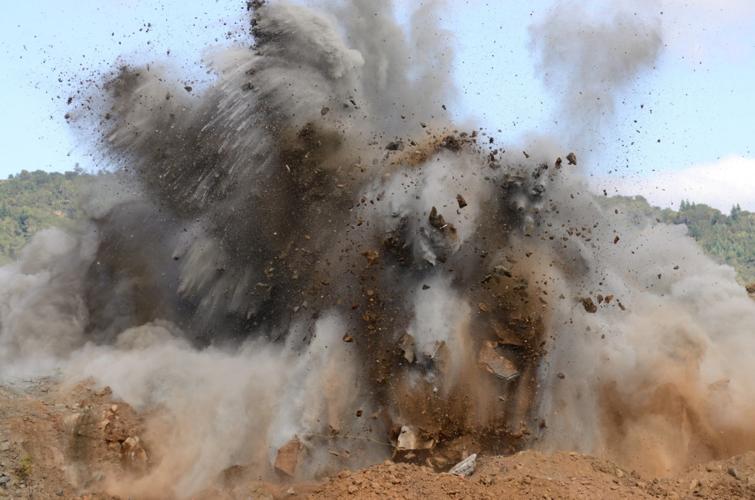




(SWNS)
By Stephen Beech
Public spaces such as stadiums and shopping centers will be better protected from terror attacks thanks to new technology.
The blast prediction tool can save lives by predicting what level of damage an explosion will likely cause in public buildings and transport hubs, say scientists.
The state-of-the-art technology could also support safety assessments following Martyn's Law — legislation passed following the Manchester Arena bombing that killed 22 people and injured more than 1,000 in 2017.
University of Sheffield engineers, who developed the tool to predict the impact of bomb blasts, say it could also be utilized to develop materials that could be placed around explosives to reduce their energy.
They have shown that the tool is more accurate and faster than methods currently used by government agencies to predict the damage of a bomb.
The researchers, from Sheffield’s Blast and Impact Group, say it can predict the impact any explosion will likely have in any confined space.
Their findings, published in the journal Process Safety and Environmental Protection, show it could also be used to predict the structural damage and injuries a bomb blast would cause.
The team says the tool could be used to help design buildings and infrastructure that are better equipped to withstand explosions by reducing structural damage and potential injuries to people nearby.

Photo by David Allen via Pexels
Following recent bomb attacks, engineers and government agencies have been urgently seeking quick-running tools to help them predict, and ideally proactively prevent, casualties.
The Sheffield team explained that a key aspect is being able to predict explosive loading — the pressure that is generated by a blast — in confined spaces where blast wave reflections from walls and other objects can significantly increase its magnitude and duration.
The Terrorism (Protection of Premises) Act, known as Martyn’s Law after Manchester Arena bombing victim Martyn Hett, was enshrined in UK law last year to better protect the public from terrorism.
It requires certain public premises and events to be prepared and ready to keep people safe in the event of an attack.
The new model could enable the rapid assessment of multiple potential scenarios, even when the exact mass or composition of the explosive is not known.
Sheffield engineers are working with the Steel Construction Institute (SCI) to incorporate the model into their EMBlast software, which is used by industry for predicting blast effects on buildings.
Andrew Barr said: “Explosions inside buildings can be far more destructive than those in open air.
"When highâpressure shockwaves hit walls and other obstacles, they bounce back and interact, creating a sustained pressure that can cause severe injuries and major structural damage.
“Engineers assessing these threats have typically relied on lookâup charts developed decades ago for TNT explosions.

(Photo by Mauricio Krupka Buendia via Pexels
"These methods are fast, but can’t be easily adapted to other explosive types or scenarios.



"Our new predictive tool simulates the mechanical, thermal and chemical processes behind this dangerous pressure buildâup, giving engineers and safety specialists a more accurate picture of the potential consequences of an explosion.
“We believe this tool could play a vital role in designing or adapting buildings and infrastructure to better withstand explosions — potentially reducing structural damage and, most importantly, protecting people from injury.
“Highly detailed numerical modeling methods also exist, but they can be slow to run and complex to set up.
"By making carefully chosen simplifying assumptions, our tool achieves high accuracy while producing results in a fraction of the time."
Barr, research fellow in structural and material blast characterization at the University of Sheffield, added: "This speed is critical in situations where quick decisions are needed, such as assessing suspect devices, when a range of possible explosive types and quantities must be considered.”
His colleague Dain Farrimond said: “Explosive detonations are notoriously difficult to study, because they happen in fractions of a second and involve a chain of complex chemical reactions.
"To make rapid modeling possible, we simplified the chemical processes that occur during and after detonation, based on the chemical products we measured following real confined explosions.
"We then validated these assumptions using high-speed measurements of pressure and temperature, confirming that the model results remain reliable across a wide range of scenarios.
“Our testing has also given us insight into the key variables that influence the pressures generated by explosions in confined spaces.
"We hope to use this knowledge to help develop materials that can be placed around explosives to safely reduce their destructive energy.
"We would then also be able to model the blast-reducing effects of these materials by adapting the predictive tool, further assisting quick decision-making by engineers and government agencies."

Photo by Ivan Firmansyah via Pexels
Bassam Burgan, SCI director, said: “Current software for calculating blast loads from energetic materials are either general-purpose computational fluid dynamics (CFD) software or dated software originating from the U.S. military.
"The former are expensive, complex and computationally very demanding, whereas the latter are generally not compatible with modern operating systems and their use is highly restricted.
"As a direct response to industry and government requests, EMBlast was developed, a bespoke software for predicting accurately, fast and simplistically blast loads.
"The main objective was to establish a well-understood scientific basis that is peer reviewed and accepted by industry and government scientists and can be used to satisfy UK regulators in design approvals.
“Barr’s pioneering research has played a central role in advancing EMBlast.
"His work led directly to the development of a new thermochemical model that we have fully integrated into EMBlast, replacing the outdated U.S. military tools that many organizations and blast consultancies previously relied upon."
Burgan added: “Barr’s research has helped ensure that our software provides accurate, defensible, and industry-appropriate blast loading assessments.
"His contribution has not only strengthened the scientific foundation of our product but has also elevated the standard of blast analysis tools available across the UK market.
"We look forward to the next steps from Barr and the University of Sheffield research team, particularly their continued advancements in the thermochemical model, and are excited about the opportunity to integrate these future developments into our software.”


(0) comments
Welcome to the discussion.
Log In
Keep it Clean. Please avoid obscene, vulgar, lewd, racist or sexually-oriented language.
PLEASE TURN OFF YOUR CAPS LOCK.
Don't Threaten. Threats of harming another person will not be tolerated.
Be Truthful. Don't knowingly lie about anyone or anything.
Be Nice. No racism, sexism or any sort of -ism that is degrading to another person.
Be Proactive. Use the 'Report' link on each comment to let us know of abusive posts.
Share with Us. We'd love to hear eyewitness accounts, the history behind an article.